Jon Stewart, the former host of The Daily Show, took aim at President Donald Trump’s recent executive order fast-tracking access to psychedelic drug treatments and the administration’s evolving approach to Iran during a recent episode. Stewart, known for his sharp political satire, used Trump’s remarks on psychedelic therapies and his pronouncements regarding Iran to illustrate what he characterized as a chaotic and unpredictable foreign policy, all framed through the lens of Trump’s own business playbook, The Art of the Deal.
The monologue, which preceded Stewart’s discussion of the ongoing tensions with Iran, began with the comedian’s reaction to President Trump signing an executive order aimed at loosening restrictions on substances like ibogaine. Veterans groups have highlighted the potential of such compounds in treating Post-Traumatic Stress Disorder (PTSD), a condition that affects a significant portion of the veteran population. The executive order, signed ahead of the weekend, seeks to accelerate research and access to these treatments.
During the signing of the order, President Trump reportedly made a lighthearted remark about his own potential need for such treatment, joking about whether he could also have access. This comment, in particular, became a focal point for Stewart’s critique. "He’s depressed, too! Hey, don’t be depressed, sir," Stewart quipped, adopting a mock sympathetic tone. "Trump won’t be president forever." He continued, suggesting that these "little moments in these Oval Office gatherings are somewhat revelatory of the president’s psyche and, really, a good starting place for any accredited mental health professional."
Stewart then played a clip of Trump’s further remarks, where the President elaborated on his philosophy of staying busy to avoid depression. Trump stated he doesn’t have time to be depressed, attributing this to the concept of "outrunning the darkness." Stewart responded with his characteristic wit, saying, "You can’t be depressed if the sadness can’t catch you. And to be frank, I don’t think Donald Trump should treat that with hallucinogenics anyway. But if he did, would we even notice? If he took hallucinogenics, he’d be like: ‘They’re eating the cats and dogs right near my beautiful ballroom. By the way, did you know I’m Jesus?’"
The comedic interlude on psychedelic drugs served as a preamble to Stewart’s more substantive critique of the Trump administration’s foreign policy, specifically concerning Iran. He highlighted a social media post by Trump following failed negotiations, in which the President promised there would be "no more Mr. Nice Guy." Stewart, in an impression of the late ventriloquist Señor Wences, morphed the phrase into "Say hello to Señor War Crimes," and then, adopting the persona of Wences’ puppet Pedro, uttered the catchphrase "S’awright."
Stewart then posed a rhetorical question about the rapid escalation of rhetoric, asking, "How did the certainty of total resolution morph into the uncertainty of total annihilation that Trump announced in less time than it took Karol G to own Coachella?" This question underscored the perceived volatility and abrupt shifts in the administration’s approach to international relations.
The "Art of the Deal" in Foreign Policy
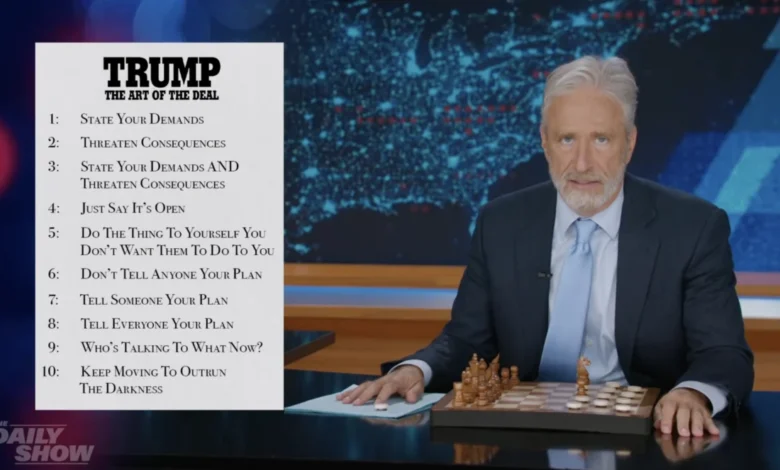
The core of Stewart’s analysis centered on what he depicted as Trump’s transactional and often illogical approach to diplomacy, drawing parallels to Trump’s iconic business book, The Art of the Deal. He introduced a prop – a checkerboard set up for both checkers and chess – to visually represent his critique of Trump’s negotiation tactics.
Stewart outlined a simplified, albeit satirized, version of Trump’s negotiation strategy. "Step 4, The Art of the Deal: Just say [the Strait of Hormuz is] open," Stewart declared, referring to a key waterway for global oil transport. He questioned the efficacy of such pronouncements, asking, "Who’s gonna check? Honestly, who’s going to actually check if it’s open? Even if you have a boat, what are you going to do? You’re gonna drive all the way there?" This pointed to the administration’s rhetoric often preceding concrete or verifiable actions.
Stewart then moved to the subsequent action of implementing a U.S. blockade, framing it as a self-inflicted wound disguised as a strategic move. He described this step as "do the thing to yourself you don’t want them to do to you." He further elaborated on this paradoxical tactic, likening it to a dramatic breakup: "Ooh-hoo-hoo, hit them with the old razzle dazzle: ‘You can’t break up with me, I’m breaking up with you!’ Now, at this point, haters might assume you’ve been winging it the whole time, and they might be getting hungry, or much poorer, or cold."
A Cycle of Demands, Threats, and Illusory Victories
Stewart summarized the perceived cyclical nature of Trump’s negotiation tactics. "So that’s where we’ve arrived at with The Art of the Deal – basically, it’s a cycle. It’s a cycle of demands and threats and premature declarations of victory that allows the negotiator enough wiggle room to, at almost any point, claim that they’ve achieved exactly what they’ve set out to do."
He then delivered a scathing assessment of the implications of this approach, particularly in the context of the Iran nuclear deal. Stewart argued that this method ultimately leads to a situation where a deal is reached that is "probably worse than the nuclear deal Trump pulled our country out of with Iran." He cataloged the alleged consequences of this withdrawal and subsequent escalation: "a devastating war that has killed thousands of innocent Iranians, 13 American soldiers, eroded our credibility as the leader of the free world, sabotaged the world economy and will cost the American taxpayers, who knows, maybe trillions."
Broader Context and Implications of the Iran Policy
The Trump administration’s withdrawal from the Joint Comprehensive Plan of Action (JCPOA), the Iran nuclear deal, in May 2018 marked a significant departure from the previous administration’s foreign policy. The JCPOA, negotiated in 2015, aimed to limit Iran’s nuclear program in exchange for sanctions relief. Critics of the deal argued it did not go far enough in curbing Iran’s ballistic missile program or its regional influence.
Following the U.S. withdrawal, the Trump administration reimposed stringent sanctions on Iran, aiming to cripple its economy and force it to renegotiate a "better deal." This "maximum pressure" campaign led to significant economic hardship for Iran, with its oil exports plummeting and its currency depreciating sharply. The tensions between the U.S. and Iran escalated throughout 2019 and early 2020, including incidents such as attacks on oil tankers in the Strait of Hormuz, the downing of a U.S. drone, and the U.S. drone strike that killed Iranian General Qasem Soleimani in January 2020.
Stewart’s critique highlights the concerns raised by many foreign policy experts and international observers regarding the efficacy and potential fallout of the "maximum pressure" strategy. While proponents argued it would force Iran to the negotiating table on U.S. terms, critics contended that it risked pushing Iran further away from diplomacy, potentially incentivizing it to restart its nuclear program, and increasing the likelihood of a military conflict. The economic impact of these policies has been substantial, not only for Iran but also for global energy markets and international trade.
The "Cool Dad" Persona and the Specter of Nuclear Annihilation
Stewart’s monologue continued with a playful yet pointed reference to the 4/20 holiday. As a guitar riff played and a graphic "COOL DAD" flashed on screen, he asked the audience, "Hey, who wants an edible?" He quickly clarified, "Multivitamin, an edible multivitamin," a nod to the cultural association of the date with cannabis consumption. This moment served to underscore the contrast between the casual, almost detached demeanor of the president and the gravity of the geopolitical situations he was navigating.
The comedian concluded his segment by referencing another Trump promise, a video in which the president stated, "Cuba’s gonna be next." This alluded to a broader pattern of shifting priorities and ambitious, often unfulfilled, foreign policy pronouncements. Stewart’s final words, "Keep moving to outrun the darkness," served as a sardonic sign-off, echoing Trump’s earlier sentiment about avoiding depression by staying busy, but framing it within the context of a world seemingly teetering on the edge of uncertainty due to impulsive and unpredictable leadership. The implication was clear: the cycle of demands, threats, and premature declarations of victory, as illustrated through the lens of The Art of the Deal, had led not to resolution, but to a heightened state of global anxiety.