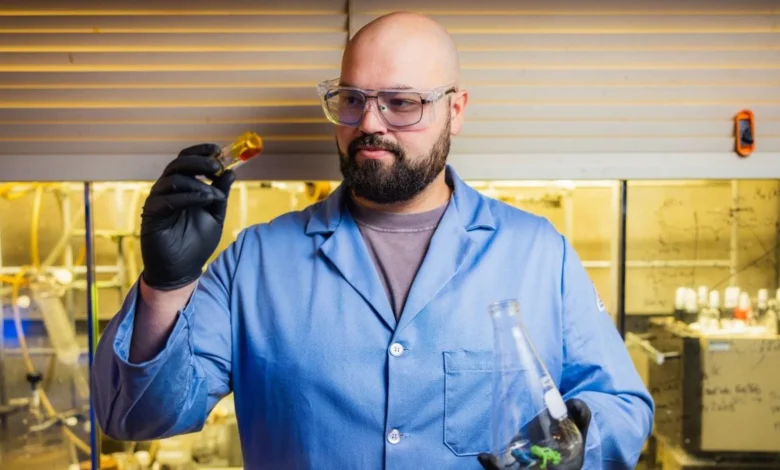
Polyvinyl chloride (PVC), long considered one of the most stubborn and environmentally problematic plastics on Earth, may soon find a lucrative and sustainable second life inside the engines of passenger vehicles, lawn mowers, and jet aircraft. A team of researchers at Virginia Tech has engineered a groundbreaking chemical process that successfully transforms discarded household plumbing pipes, old window frames, and expired credit cards into polyalphaolefin—a premier, high-performance base oil utilized in synthetic lubricants and engine oils.
Published in the prestigious scientific journal Nature, the breakthrough represents a major stride forward in polymer chemistry. Led by Guoliang "Greg" Liu, a chemist and chemical engineer at Virginia Tech, the research addresses two distinct global challenges simultaneously: the ever-mounting crisis of hard-to-recycle plastic waste and the heavy environmental footprint associated with manufacturing industrial lubricants from virgin fossil fuels. While the scientific community celebrates the technical achievement, the research team is already looking toward the horizon, collaborating with academic and economic institutions to scale the process for commercial viability.
The Persistent Problem of Polyvinyl Chloride Waste
To understand the magnitude of the Virginia Tech discovery, one must examine why PVC has historically baffled recycling facilities. Unlike polyethylene terephthalate (PET)—commonly used for water bottles and easily melted down and reshaped—PVC possesses structural complexities that render conventional mechanical and thermal recycling methods largely ineffective.
First, PVC contains a high concentration of chlorine atoms, which accounts for roughly 57 percent of its molecular weight by mass. When heated during standard recycling attempts, PVC can degrade and release hazardous hydrogen chloride gas, which corrodes machinery and poses severe environmental and health hazards. Second, manufacturers routinely incorporate a wide assortment of chemical plasticizers, heat stabilizers, and fillers into PVC to alter its physical properties. Depending on the desired end-use, these additives can make the plastic flexible enough for garden hoses or rigid enough for structural window frames. This chemical heterogeneity makes sorting, washing, and reprocessing post-consumer PVC an economic and logistical nightmare. Consequently, millions of tons of PVC products end up discarded in global landfills annually, where they persist for centuries without breaking down.
Simultaneously, global society relies heavily on industrial lubricants to keep modern mechanical infrastructure functioning. Lubricants act as the silent lifeblood of civilization, reducing friction, mitigating component wear, and extending the operational lifespan of everything from household appliances to heavy industrial machinery and aerospace engines. However, the production of these essential synthetic oils has traditionally depended entirely on petrochemical refining, contributing heavily to greenhouse gas emissions and resource depletion. By converting a waste product that resists traditional recycling into a high-value synthetic lubricant, the Virginia Tech team has unlocked a circular economic model that replaces virgin fossil resources with upcycled municipal waste.
Chronology of a Breakthrough: The Evolution of Upcycling
The road to transforming rigid plastics into slippery synthetic oils did not happen overnight; it was the culmination of years of methodical experimentation in Guoliang Liu’s laboratory. The research trajectory began with earlier investigations published in the scientific journals Science and Nature Sustainability. In those foundational studies, Liu’s team demonstrated that various forms of plastic waste could be successfully broken down and chemically converted into surfactants—amphiphilic chemical compounds widely used as the active ingredients in soaps, household detergents, and industrial cleaning agents.
Encouraged by these early triumphs, the laboratory turned its attention to the ultimate recycling challenge: PVC. Liu assembled a specialized team of graduate researchers to tackle the project. Eric Munyaneza Nuwayo, nearing the completion of his doctoral program, was chosen to lead the multi-faceted project. He was joined by Connor S. Thompson, a chemistry graduate student who shifted his research focus to support the endeavor, and Abby Civiello, a first-year graduate student who rapidly emerged as a critical contributor to the laboratory operations. Affectionately dubbed "the three musketeers" by their mentor, the trio set out to unravel the stubborn molecular architecture of PVC.
Initially, the researchers pursued a straightforward chemical strategy. Because PVC is a heavily functionalized polymer—consisting of long molecular chains of repeating units studded with chlorine atoms—the team hypothesized that they could simply strip away the chlorine and substitute it with other chemical groups to create a novel, functional material. The underlying premise was that modifying these pendant groups would yield a useful, stable polymer without destroying the underlying macromolecular framework.
However, repeated experiments yielded discouraging results. Rather than creating a stable, high-performance material, the chemical substitutions consistently produced soft, gooey, and sticky substances that lacked any practical utility. Frustrated by the gummy residue, Liu experienced a pivotal moment of scientific inspiration. Instead of attempting to preserve the long polymer chains by merely swapping out chemical groups, he decided to reverse course and deliberately shatter the molecular architecture.
"One day I realized—if this polymer is so gooey and so soft, why don’t I just keep breaking the polymer chains down to smaller segments?" Liu recalled.
This conceptual pivot changed the entire direction of the project. By intentionally breaking the long, stubborn polymer chains of PVC down into much smaller hydrocarbon segments, the researchers discovered they could rebuild them into something entirely different and immensely valuable.
The Laboratory Process: From Credit Cards to Synthetic Oil
The physical process developed by the Virginia Tech team is deceptively straightforward, though it relies on precise chemical controls. To initiate the transformation, researchers gather post-consumer or industrial PVC samples—such as fragments of old household plumbing pipes, discarded window frames, or expired credit cards—and submerge them into a specialized solvent.
Next, the team introduces aluminum trichloride alongside alpha-olefins, which are a class of hydrocarbons conventionally utilized in the industrial synthesis of high-grade lubricants. The entire mixture is then heated to approximately 158 degrees Fahrenheit (70 degrees Celsius) for a duration of three hours. During this controlled thermal and chemical reaction, the PVC chains are systematically dismantled and catalytically recombined with the alpha-olefins.
Upon completion of the reaction cycle, the researchers extract a relatively thick, amber-colored lubricating oil. Chemical analysis confirms that this resulting product is polyalphaolefin (PAO)—a premier category of synthetic base oils renowned for their exceptional thermal stability, shear resistance, and ability to maintain consistent viscosity across wide temperature ranges. These base oils serve as the foundational bedrock for premium synthetic engine oils demanded by high-performance automotive and industrial applications.
"Number one, we have proved that it is feasible to use plastic waste to make high-performance lubricants. Number two, these lubricants are green, and they can meet the emerging needs for sustainability by the market," Liu emphasized.
Collaborative Validation and Economic Modeling
Recognizing the immense commercial and scientific implications of their discovery, the Virginia Tech team sought out external validation from leading experts across the United States. To accurately assess the mechanical performance and tribological properties of the upcycled oil, Liu provided physical samples to tribology and materials engineering teams at Texas A&M University, led by renowned researcher Ali Erdemir. Rigorous testing confirmed that the recycled-plastic-derived lubricant performed comparably to—and in some metrics exceeded—standard commercial synthetic base oils.
To decode the intricate quantum and molecular mechanisms driving the chemical transformation, the team partnered with computational chemist William Goddard and his research group at the California Institute of Technology (Caltech). Goddard’s team utilized advanced chemical computations and molecular modeling to simulate the breakdown of the PVC chains and the subsequent formation of the polyalphaolefin structures, providing theoretical backing to the empirical lab results.
Meanwhile, back at Virginia Tech, researcher Xi Chen undertook the vital task of economic and manufacturing analysis. Chen developed sophisticated techno-economic models to evaluate how the laboratory-scale batch process could be translated into a continuous, industrial-scale manufacturing pipeline. These models are crucial for determining the financial feasibility, energy requirements, and carbon lifecycle metrics of scaling the technology for commercial production.
Broader Implications and Future Outlook
The implications of the Virginia Tech breakthrough extend far beyond the confines of academic polymer chemistry. As global regulatory bodies tighten environmental standards and corporations increasingly commit to circular economy targets, industries are actively seeking out sustainable alternatives to virgin fossil-derived inputs. By proving that durable, toxic, and historically unrecyclable plastics like PVC can be upcycled into high-value industrial commodities, the research opens a new frontier in chemical waste management.
Despite the laboratory success, significant hurdles remain before motorists will be pouring recycled credit-card oil into their vehicle crankcases. Scaling any chemical process from a university benchtop to an industrial refinery requires substantial capital investment, stringent safety protocols—particularly regarding chlorine management—and robust supply chains capable of collecting and sorting post-consumer PVC waste at scale.
Nevertheless, Liu and his collaborators remain resolutely optimistic. Their immediate objective is to refine the catalytic efficiency of the reaction, lower production costs, and partner with petrochemical and recycling enterprises to build pilot-scale production facilities.
As the world continues to grapple with millions of tons of accumulating plastic debris, innovations that turn environmental liabilities into industrial assets offer a beacon of hope. Through clever chemistry and persistent scientific inquiry, the "silent heroes" of modern machinery—the lubricants keeping the gears of civilization turning—may soon trace their origins not to deep-sea oil wells, but to the discarded window frames and plumbing pipes of yesterday.
"Lubricants are the silent hero out there," Liu concluded. "We often don’t recognize they exist, but they are out there working quietly. We want to be able to produce the oil on a larger scale to reach more people in the world."