The relentless pursuit of scalable and reliable quantum computers and networks has often been hindered by a fundamental dilemma: how to allow quantum bits, or qubits, to interact strongly with their environment to process and transmit information while simultaneously shielding them from that very same environment to preserve their fragile states. Recently, a team of researchers at the Harvard John A. Paulson School of Engineering and Applied Sciences (SEAS) announced a significant breakthrough that addresses this long-standing challenge. By leveraging microscopic sound waves—known as phonons—the researchers have demonstrated an innovative method to protect quantum information without sacrificing the interactive capabilities required for complex quantum networks.
Published in the journal Nature Physics, the study was conducted within the laboratory of Marko Lončar, the Tiantsai Lin Professor of Electrical Engineering at SEAS. The experimental work was spearheaded by Eliza Cornell, a recent Ph.D. graduate from the Lončar lab who is now a postdoctoral researcher at Boston University, and Zhujing Xu, a former postdoctoral scholar in Lončar’s research group. The implications of this research extend far beyond the academic laboratory, potentially paving the way for ultra-compact quantum networks built directly onto silicon chips and hybrid quantum systems that integrate disparate types of qubits into cohesive architectures.
The Physics of Phonons: A Sound Alternative to Light
For decades, the prevailing methodology for moving quantum information across chip-scale networks has relied on light, or photons. Optical interconnects excel at transmitting data quickly and over long distances. However, as engineers strive to miniaturize quantum processors and pack components more densely onto a single microchip, light encounters severe physical limitations. Because of its relatively long wavelength, light requires larger structures to manipulate and guide, which fundamentally restricts how tightly components can be clustered.
Phonons—tiny packets of mechanical vibration traveling through a solid medium—offer a compelling alternative. At equivalent frequencies, acoustic waves possess wavelengths significantly shorter than those of electromagnetic light waves. This drastically reduced wavelength allows engineers to design vastly smaller mechanical components that can be integrated tightly side-by-side on a semiconductor chip.
Furthermore, phonons exhibit a unique versatility: they interact readily with both solid-state spins (such as those found in diamond defects) and electromagnetic fields. This dual-interaction capability makes phonons exceptionally attractive for hybrid quantum architectures, which aim to bridge different modalities of quantum computing—such as superconducting circuits, trapped ions, and spin qubits—into a single, unified network.
Within the Lončar laboratory, researchers have spent years investigating the physics of these acoustic systems. A cornerstone of their prior work involves the development of phononic cavities. Similar to how an optical cavity traps light between mirrors, a phononic cavity traps mechanical vibrations within a microscopic structure, forcing the phonons to interact intensely with the electron spin of a nearby qubit.
The Core Vulnerability: Balancing Interaction and Coherence
Despite their immense promise, utilizing phonons to transport and mediate quantum information introduces a formidable engineering obstacle: preserving quantum memory.
Qubits derive their computational power from the principles of superposition and entanglement, allowing them to exist in multiple states simultaneously. However, this exact property makes them exquisitely sensitive to external disturbances. Thermal fluctuations, electromagnetic interference, and structural vibrations from the surrounding environment can easily disrupt a qubit, causing it to lose its stored information—a phenomenon known as decoherence. For a quantum system to perform meaningful calculations or store data reliably, its coherence time must be sufficiently long.
Traditionally, physicists combat environmental noise by applying precise microwave pulses to the system. These pulses actively decouple the qubit from ambient noise sources, shielding its quantum memory. Unfortunately, this standard mitigation strategy fails when applied to qubits housed directly inside phononic cavities. The very mechanisms required to maximize the strong coupling between the qubit and the mechanical sound waves also expose the qubit to heightened environmental noise, creating a direct conflict between strong interaction and long-lasting quantum memory.
All-Mechanical Coherence Protection and the Dressed Qubit
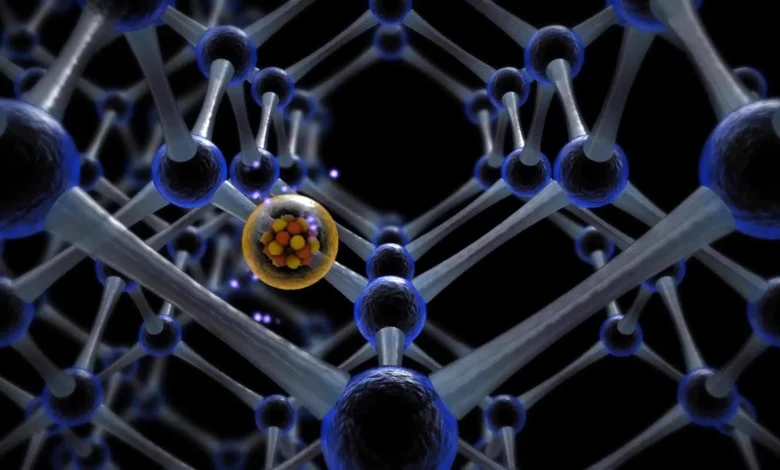
To resolve this impasse, the SEAS research team pivoted away from conventional electromagnetic decoupling methods and turned instead to an entirely mechanical solution. They demonstrated what they term "all-mechanical coherence protection" for a silicon-vacancy spin embedded in diamond.
Rather than interrupting the system with external microwave pulses, the researchers continuously applied a mechanical driving field constructed from phonons. This continuous acoustic driving fundamentally alters the state of the qubit, transforming it into a specialized configuration known in quantum mechanics as a "dressed" state.
In this context, being "dressed" implies that the qubit is effectively surrounded and stabilized by a continuous acoustic field. By maintaining this continuous mechanical interaction, the researchers rendered the silicon-vacancy spin significantly less vulnerable to low-frequency noise originating from its immediate physical environment.
This technique offers a profound architectural advantage: because the protection is delivered via a continuous mechanical field, it is natively compatible with the phononic cavities already designed to link stationary nodes in quantum networks. Consequently, phonons assume a dual, highly efficient role. They serve simultaneously as the transport medium moving quantum information between distant parts of the network and as the protective shield safeguarding that information against environmental decoherence.
Reflecting on the dual utility of the system, Eliza Cornell noted that the primary objective was to resolve a longstanding dichotomy in quantum engineering. The research team sought to engineer a system where a spin could maintain a strong, productive interaction with phonons while simultaneously achieving an extended coherence time. The study successfully proves that this balance is attainable while the qubit remains actively situated inside a functional acoustic cavity.
Quantitative Results and Experimental Verification
To measure the efficacy of their novel approach, the research team evaluated the coherence time of the silicon-vacancy spin before and after the application of the continuous mechanical driving field.
The empirical results demonstrated a striking improvement. By employing continuous-wave mechanical noise suppression, the researchers successfully extended the coherence time of the silicon-vacancy spin by roughly a factor of three. This threefold increase provides concrete, quantitative evidence that all-mechanical coherence protection is not merely a theoretical construct, but a viable, real-world mechanism for stabilizing quantum states in physical devices.
The implications of this enhancement suggest that microscopic sound waves could soon transition from being a niche experimental curiosity to becoming a foundational tool in the development of reliable, scalable quantum processors and quantum memory registers.
Collaborative Effort and Institutional Support
The published study, titled "All-mechanical coherence protection and fast control of a spin qubit," was a collaborative endeavor representing a diverse team of theorists and experimentalists. Alongside Cornell, Xu, and Lončar, the paper’s co-authors include Zhaoyou Wang, Hana K. Warner, Eliana Mann, Michael Haas, Smarak Maity, Graham Joe, Liang Jiang, Peter Rabl, and Benjamin Pingault.
The research infrastructure and personnel involved benefited from robust financial backing from several major federal and institutional entities. Primary support was provided by the National Science Foundation (NSF) under grant number EEC-1941583. Additional funding was supplied by the Air Force Office of Scientific Research under award numbers FA9550-23-1-0333 and FA9550-23-1-0338, as well as by Q-NEXT, a U.S. Department of Energy Office of Science National Quantum Information Science Research Center under award No. DE-FOA-0002253.
Portions of the experimental fabrication and testing were carried out at the Harvard Center for Nanoscale Systems (CNS), a member of the National Nanotechnology Infrastructure Network supported by NSF award No. ECS-0335765. Recognizing the commercial potential of integrating mechanical acoustic control into future quantum hardware, the Harvard Office of Technology Development has actively initiated steps to pursue patent protection and commercialization pathways for the intellectual property arising from the research.
Future Outlook and Broader Implications
As the global technology sector races to overcome the physical bottlenecks of quantum scaling, innovations in chip-level integration will dictate the timeline of commercial deployment. While superconducting quantum processors currently dominate headlines, their reliance on large microwave control hardware limits their potential for dense, large-scale integration.
Solid-state systems utilizing diamond vacancy centers coupled to mechanical resonators offer a distinct path toward room-temperature compatibility and dense on-chip packing. By proving that acoustic waves can both route information and protect it from degradation, the Harvard SEAS team has removed a critical roadblock in phononic quantum engineering.
Future research directions will likely focus on scaling up these devices from single-qubit experimental setups to multi-node quantum integrated circuits. If engineers can maintain or further multiply the coherence time enhancements demonstrated in this study while networking multiple phononic cavities across a single silicon chip, the realization of compact, fault-tolerant quantum computers and secure quantum communication networks will draw significantly closer to reality.