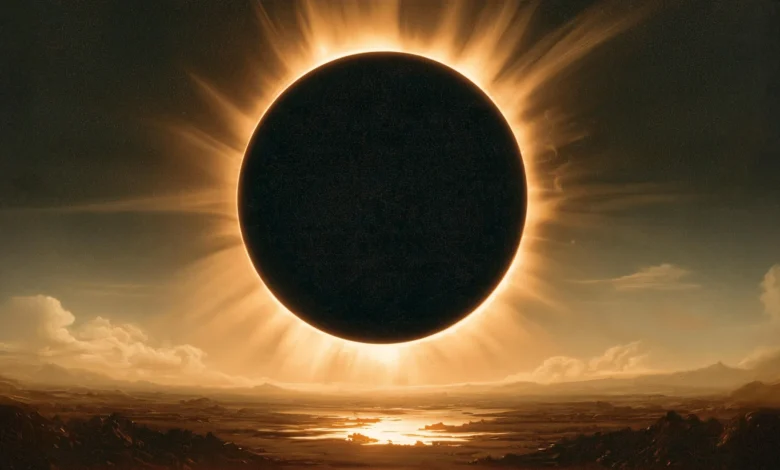
An international coalition of astronomers, historians, and geographers has successfully breathed new life into one of the oldest precisely dated astronomical records in human history. By meticulously aligning historical geography with cutting-edge astrophysical calculations, researchers have reexamined a total solar eclipse that plunged the ancient capital of China’s Lu Duchy into darkness on July 17, 709 BCE. Published in the Astrophysical Journal Letters, this groundbreaking study resolves long-standing discrepancies in ancient chronological data, offers refined measurements of how Earth’s rotation has decelerated over millennia, and potentially provides independent validation for radiocarbon-based models of ancient solar behavior.
The research underscores the immense value of ancient administrative and historical chronicles. By identifying and correcting a subtle geographical displacement in historical mapping, the research team transformed a centuries-old literary description into precise, quantitative data. The findings not only elucidate the physical mechanics governing our planet’s rotation but also offer a rare glimpse into the magnetic volatility of our star during an era long before the invention of the telescope.
A Crucial Clue from the Spring and Autumn Annals
The historical bedrock of the study lies in the "Spring and Autumn Annals" (Chunqiu), a foundational chronicle of the State of Lu compiled roughly two to three centuries after the events it describes. On July 17, 709 BCE, court observers recorded a profound celestial event: the Sun was totally eclipsed. This entry represents the earliest explicitly recorded total solar eclipse with a secure, unambiguous calendar date.
Centuries later, the historical record was expanded. The "Hanshu" (Book of Han), compiled about seven centuries after the eclipse occurred, preserved an additional descriptive addendum detailing the appearance of the sky during totality. It described the obscured Sun as being "completely yellow above and below." Modern researchers have interpreted this striking phrasing as one of the oldest surviving written descriptions of the solar corona—the pearly white, superheated outer atmosphere of the Sun that remains hidden behind blinding solar disk glare until the moon completely blocks the sun.
Lead author Hisashi Hayakawa, an assistant professor at Nagoya University’s Institute for Space-Earth Environmental Research and Institute for Advanced Research, emphasized the uniqueness of the documentation. "What makes this record special isn’t just its age, but also a later addendum in the ‘Hanshu’ based on a quote written seven centuries after the eclipse," Hayakawa noted. "It has been traditionally associated with a record of a solar corona. If this is truly the case, it represents one of the earliest surviving written descriptions of the solar corona in human history."
Resolving a Modern Astronomical Paradox
When the research team initially attempted to model the 709 BCE eclipse using modern astronomical algorithms and established historical estimates of Earth’s past rotation, they encountered a perplexing contradiction. The simulations demonstrated that a total solar eclipse should not have been visible from Qufu, the long-presumed administrative center of the Lu Duchy.
Rather than dismissing the ancient text as an exaggeration or a chronological error, the researchers investigated potential flaws in their spatial baselines. By cross-referencing modern archaeological excavation reports, ancient cartographic conventions, and historical geographic descriptions, the team discovered that previous reconstructions had placed ancient Qufu approximately eight kilometers away from its true historical coordinates.
This seemingly minor geographic correction resolved the paradox entirely. Once the city’s precise ancient location was integrated into the astronomical models, the path of totality aligned perfectly with the historical text. Coauthor Mitsuru Sōma of the National Astronomical Observatory of Japan remarked on the significance of the correction: "This new dataset fixes coordinate errors in previous Earth rotation studies. Additionally, it improves the accuracy of dating and reconstructing historical astronomical events."
With the spatial parameters secured, the research team was able to extract a wealth of geophysical and astrophysical data from the 2,700-year-old event, including the orientation of the solar rotation axis and the physical dimensions of the inferred coronal structure.
Omens, Politics, and the Science of Ancient Chinese Astronomy
The survival of such meticulous celestial observations is not a historical accident. In ancient Chinese society, astronomy was an institution of profound political and cosmological importance. Successive imperial dynasties maintained specialized bureaus of astronomers and astrologers whose primary duty was to monitor the heavens for anomalous phenomena.
This practice, frequently termed omenology, was deeply embedded in early political philosophy. Eclipses, planetary alignments, comets, and auroras were viewed as metaphysical communications from heaven to the earthly ruler. Eclipses, in particular, were interpreted as celestial reprimands warning the emperor to examine his governance, correct moral failings, or reform administrative policies.
Because celestial misbehavior carried severe political implications, court astronomers recorded sky events with rigorous precision. Over successive generations, these continuous logs accumulated into some of the most reliable long-term astronomical databases in human history.
However, the researchers maintain a strict methodological boundary between the primary eclipse report and the later coronal description. While the date and occurrence of the 709 BCE total eclipse are incontrovertible, the interpretation of the "completely yellow above and below" passage as a true coronal observation must be treated with caution, given its preservation in a source written centuries after the fact. Nevertheless, even when viewed strictly as a temporal anchor, the eclipse provides indispensable empirical data for geophysical research.
Decoding Earth’s Decelerating Spin
Earth does not maintain a constant rotational velocity. Over thousands of years, our planet’s rotation has gradually slowed down, primarily due to tidal friction—the gravitational interaction between Earth’s oceans and the Moon, which constantly drains angular momentum from the terrestrial spin.
Because of this ongoing deceleration, Earth completed a full rotation slightly faster 2,700 years ago than it does today. Quantifying this historical discrepancy requires calculating delta T ($Delta T$), a time-correction parameter that measures the difference between Terrestrial Time (uniform atomic time) and Universal Time (which is dictated by Earth’s actual rotation).
Using the newly corrected geographic coordinates for Qufu, the international team derived rigorous constraints for Earth’s rotation during the eighth through sixth centuries BCE. Their calculations placed the $Delta T$ value for the July 17, 709 BCE eclipse between 20,264 and 21,204 seconds.
This tighter constraint provides geophysicists with an essential empirical benchmark. By establishing accurate rotational speeds for deep historical epochs, scientists can refine models of tidal dissipation, core-mantle interactions, and long-term climatic shifts driven by planetary dynamics.
A Window Into Ancient Solar Activity
Beyond terrestrial geophysics, the study offers a fascinating window into stellar physics. The Sun operates on an approximately 11-year magnetic activity cycle, marked by fluctuating numbers of sunspots, solar flares, and coronal mass ejections. Periodically, the Sun enters prolonged eras of suppressed activity known as "grand minima," during which sunspots virtually vanish and the regular cycle dampens significantly.
One such protracted quiet period, the Neo-Assyrian or Homer Grand Minimum, spanned from approximately 808 to 717 BCE. The eclipse of 709 BCE occurred just as this extended quiet interval was coming to an end.
To reconstruct solar activity across millennia where no instrumental records exist, scientists rely primarily on cosmogenic isotopes, such as radiocarbon ($^14textC$), preserved in annual tree rings, and beryllium-10 trapped in polar ice cores. Cosmic rays constantly bombard Earth’s upper atmosphere, producing radiocarbon. When the Sun is active, its powerful magnetic field shields the inner solar system, deflecting cosmic rays and lowering radiocarbon production. Conversely, during solar quiet periods, more cosmic rays enter the atmosphere, increasing radiocarbon levels in biological matter.
The 709 BCE eclipse record offers an independent physical check on these radiocarbon reconstructions. Coauthor Mathew Owens, a professor of space physics at the University of Reading, emphasized the cross-disciplinary value of the work: "This unique historical addendum for the possible solar coronal structure is critical for providing a spot reference on solar activity reconstructions from tree rings and ice cores, as well as providing independent validation of solar activity models."
According to the research team, the descriptive morphology of the corona implied by the ancient Chinese text—suggesting substantial structural complexity and magnetic activity—aligns remarkably well with a star exiting a grand minimum and ascending toward a new activity peak. While the historical nature of the text prevents it from serving as absolute proof, it provides compelling circumstantial evidence that corroborates tree-ring isotope data.
The Enduring Legacy of Ancient Observers
The success of this international investigation highlights the immense power of interdisciplinary science. By bridging the chasms between historical philology, archaeological geography, geophysical modeling, and modern solar physics, researchers can extract quantifiable truths from texts written millennia ago.
An eight-kilometer correction in a long-forgotten city’s boundaries transformed an ancient scribal entry into a precision instrument for measuring planetary rotation and stellar behavior. As Dr. Meng Jin of the Lockheed Martin Solar and Astrophysics Laboratory observed: "Some of our ancestors were very skilled observers. When we combine their careful records with modern computational methods and historical evidence, we can potentially find new information about our planet and our star from thousands of years ago."
Ultimately, the study demonstrates that humanity’s scientific enterprise is a cumulative endeavor. The careful archivists of the ancient Lu Duchy, watching the darkened Sun from the plains of China over two millennia ago, laid down data points that modern scientists are only now fully equipped to read—proving that the echoes of ancient human curiosity continue to illuminate the farthest reaches of space and time.