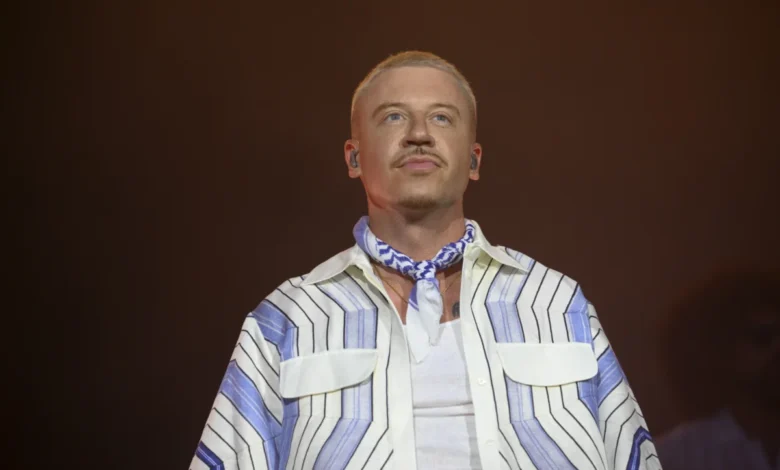
Weeks after a controversial on-stage political statement led to his dismissal from a major U.S. concert tour, American rapper Macklemore launched his self-titled Free Palestine tour in Dublin, Ireland. The high-profile opening night in the Irish capital set a defiant tone for a three-show European trek, featuring guest appearances by Hozier and Kneecap, with all financial proceeds dedicated to humanitarian charities supporting Palestine. The event underscores a growing intersection of global politics, live music entertainment, and corporate-artist friction within the contemporary music industry.
The Dublin performance marks a significant milestone in a rapidly escalating sequence of events that began in early September. Macklemore, known globally for chart-topping hits like Thrift Shop, utilized his platform during a high-profile opening slot on Ed Sheeran’s U.S. stadium run to advocate for Palestinian rights. The subsequent fallout resulted in his removal from the tour, widespread industry debate regarding the boundaries of political speech at commercial events, and a broader conversation about how major artists wield influence on international humanitarian crises.
Chronology of the Controversy
The friction between the artist, tour promoters, and venue management unfolded across a rapid succession of dates and public statements in September:
September 4–5: During back-to-back performances at MetLife Stadium in New Jersey as an opener for Ed Sheeran’s Loop tour, Macklemore delivered impassioned speeches culminating in the phrase Free Palestine. On the second night, he clarified that his remarks were not directed as a criticism of Jewish people, yet the footage quickly went viral on social media, dividing public opinion.
Mid-September: Pressure mounted rapidly against the tour organizers. The Israeli American Council issued a formal petition calling for the rapper’s removal, arguing that stadium concerts should not function as partisan political platforms. Simultaneously, prominent figures in the entertainment industry, including pop star Pink, weighed in on the unfolding discourse via social media.
September 14: The Messina Touring Group, the promoter behind Sheeran’s U.S. dates, officially announced that Macklemore would be dropped from the remaining schedule. Organizers cited direct notifications from various venue operators warning that the presence of the rapper on the bill would lead to widespread venue cancellations, jeopardizing the entire enterprise and impacting hundreds of thousands of ticket holders.
Mid-to-Late September: In an unprecedented show of solidarity, several other opening acts on Sheeran’s tour—including Finneas, Lukas Graham, and Aaron Rowe—alongside a significant portion of the backing band, withdrew from the performances. Reports also surfaced regarding venue resistance, notably from Gillette Stadium owner Robert Kraft, who allegedly pushed back against the rapper’s scheduled appearances. Kraft subsequently announced a joint $2 million donation with Sheeran toward regional humanitarian aid.
September 19: Following intense public scrutiny and criticism over his initial silence, Ed Sheeran addressed the crowd during a performance in Philadelphia, breaking his policy against political commentary to express sorrow over the October 7 attacks in Israel while describing the humanitarian catastrophe in Gaza as disproportionate and unjustifiable.
Late October: Following a localized performance at Colorado’s Red Rocks Amphitheatre, Macklemore formalized his independent advocacy by announcing a targeted three-show European tour spanning Dublin, Paris, and London, designed explicitly to channel funds directly to Palestinian relief efforts.
The Dublin Address and Artistic Defiance
Taking the stage in Dublin before a receptive audience, Macklemore addressed the controversy head-on, framing his messaging around universal human rights rather than partisan division. He emphasized that the contested words were rooted in empathy and shared human dignity.
"Six weeks ago, it was two words. Two words is all that it took. Two words that are rooted in love and liberation," Macklemore told the Dublin crowd, highlighting the intense resistance his remarks had met from institutional entities. "Not against anybody, not divisive. Not a call for hatred. But a call to recognize our shared humanity."
The rapper’s decision to pair his live performances with direct financial contributions is a central pillar of the current tour. Beyond the donation of his estimated $1 million salary from the aborted Sheeran tour segments, proceeds from the Dublin, Paris, and London dates are routed entirely to organizations providing direct aid on the ground in the Middle East. The inclusion of culturally resonant local acts such as Hozier and Kneecap further cemented the solidarity between international artists and the host communities.
Industry Implications and the Boundaries of Free Speech
The public dispute involving Macklemore, Ed Sheeran, and various tour promoters highlights a broader tension within the contemporary live entertainment landscape: the precarious balance between an artist’s freedom of expression and a corporation’s logistical and financial exposure.
Major international tours are complex, multi-million-dollar logistical operations involving dozens of corporate stakeholders, municipal permits, venue owners, and corporate sponsors. When an artist introduces polarizing geopolitical discourse onto the stage, promoters often face immediate pressure from stakeholders concerned with security, brand association, and potential venue lockouts. The Messina Touring Group’s justification for dropping Macklemore—that venues threatened to pull out entirely—illustrates the fragile ecosystem of stadium-level touring, where an artist’s personal conviction can directly threaten the commercial viability of a massive enterprise.
Conversely, the swift departure of supporting acts and band members in solidarity with Macklemore signals a shifting paradigm among creative personnel. Increasingly, musicians and crew members are demanding greater autonomy and moral alignment with the tours they support, challenging the traditional corporate hierarchy of major live music production.
The Evolution of Ed Sheeran’s Public Stance
Ed Sheeran’s initial response to the controversy emphasized a strict separation between commercial entertainment and political activism. In his initial statement following Macklemore’s removal, Sheeran defended his choice to remain publicly silent on complex foreign policy matters, arguing that his concerts should serve as a safe sanctuary for audiences of all backgrounds and ages.
However, the mounting pressure from fans, peers, and industry observers ultimately compelled the British singer-songwriter to pivot. By addressing the conflict directly during his Philadelphia concert, Sheeran acknowledged the immense complexity of the Israel-Haza war, condemning both the October 7 attacks on Israeli civilians and the devastating loss of life and systemic injustice unfolding in Gaza and the West Bank. This nuanced intervention reflected the immense difficulty modern superstar acts face when attempting to maintain strict neutrality in an era where audiences increasingly expect artists to use their cultural capital to address global crises.
Broader Humanitarian and Economic Impact
The financial fallout of the dispute has ironically directed substantial capital toward humanitarian relief efforts. Between Macklemore’s redirected tour salary, ticket proceeds from his independent European tour, and the joint donations pledged by Robert Kraft and Ed Sheeran, millions of dollars have been funneled into aid organizations working within the conflict zone.
While the debate over the appropriateness of political discourse in commercial venues remains polarized among concertgoers, music critics, and industry executives, the operational reality has shifted. Artists are increasingly testing the boundaries of contractual obligations and corporate risk tolerance, while promoters face heightened scrutiny regarding how they manage artistic freedom in globally turbulent times.
As Macklemore concludes his "Free Palestine" mini-tour with upcoming performances at major venues in Paris and London, the legacy of this dispute will likely reverberate across the live music industry for years to come. It serves as a stark reminder of the power of the microphone in contemporary stadiums—not merely as a tool for musical entertainment, but as a lightning rod for international politics, corporate compliance, and artistic conscience.