New Zealand has long maintained its status as one of the world’s premier destinations for travellers seeking a seamless blend of dramatic natural landscapes and high-end hospitality. Situated in the southwestern Pacific Ocean and consisting primarily of two main landmasses—the North Island (Te Ika-a-Māui) and the South Island (Te Waipounamu)—the country spans approximately 268,000 square kilometres. Its diverse topography ranges from active geothermal fields and subtropical forests to deep fjords and glaciated alpine mountain ranges. In recent years, tourism infrastructure across Aotearoa has evolved significantly, balancing its deep-rooted pioneering heritage with a burgeoning luxury sector that attracts hundreds of thousands of international visitors annually.
Understanding the Geography and Strategic Travel Planning
When planning an itinerary to New Zealand, logistics require careful consideration due to the country’s rugged terrain and serpentine roads. Travellers frequently underestimate driving times, assuming distances are shorter than they actually are. Tourism New Zealand data indicates that a typical international visitor stays for an average of 10 to 14 days, which is often sufficient to thoroughly explore either the North or the South Island, but restrictive when attempting to cover both in a single week.
For first-time visitors arriving on the South Island, the alpine resort town of Queenstown serves as the primary gateway for adventure sports, winter skiing, and proximity to the Fiordland National Park. Conversely, the North Island often begins in Auckland, the nation’s most populous urban centre, before transitioning south toward the geothermal wonderlands of Rotorua, the cultural hub of Taupō, and the culinary sophistication of the capital city, Wellington.

Budgetary considerations are another crucial factor for prospective visitors. While New Zealand offers a wide array of accommodation—ranging from rustic Department of Conservation (DOC) huts and self-catering camper vans to ultra-luxury lodges like Huka Lodge and Cabot Lodge—costs can escalate quickly during peak seasons. Guided excursions, helicopter tours, and seasonal ski passes demand prior financial prioritisation to ensure a balanced travel experience.
Arrowtown and Central Otago: A Tapestry of Gold Mining History and Modern Gastronomy
Located just twenty minutes from the bustling alpine hub of Queenstown, Arrowtown offers a preserved window into the Otago gold rush of the 1860s. Established during a period when prospectors flooded the region in search of fortune, the town retains its historic streetscape, featuring more than 60 restored nineteenth-century miners’ cottages and commercial storefronts along Buckingham Street.
Adjacent to Bush Creek lies the partially restored Chinese Miners’ Settlement, a poignant historical site maintained by heritage authorities to commemorate the resilience of Cantonese prospectors who arrived in the region following the initial European gold rush. This cultural landmark provides vital context regarding the multi-ethnic origins of modern New Zealand society.
Beyond its historical preservation, the Arrowtown and broader Central Otago regions have transformed into a world-class culinary destination. The local microclimate—characterised by hot summers, crisp autumns, and cold winters—yields exceptional agricultural produce, most notably Central Otago Pinot Noir. Establishments such as Aosta bring northern Italian culinary techniques to local ingredients, while the sprawling 150-acre Ayrburn development repurposes historic farm infrastructure into a multi-venue dining precinct, featuring contemporary offerings like Billy’s restaurant inside the original homestead.

Accommodation options in the area reflect this dual focus on heritage and comfort. Boutique properties such as Arrowtown House offer intimate lodgings within walking distance of the historic centre, whereas Millbrook Resort provides extensive spa facilities and golf amenities tailored for travellers recovering from rigorous days on the nearby ski slopes of Coronet Peak and The Remarkables.
Taupō and the Waikato River: Centurions of Hospitality and Geothermal Wonder
Moving northward to the central plateau of the North Island, Lake Taupō—the largest freshwater lake in the country, occupying the caldera of a massive rhyolitic supervolcano—serves as a focal point for both natural phenomena and historic luxury hospitality.
The Waikato River, New Zealand’s longest river, drains out of Lake Taupō and funnels through the Huka Falls, where more than 220,000 litres of water per second rush through a narrow fifteen-metre-wide volcanic rock gorge. This dramatic hydraulic display draws hundreds of thousands of sightseers annually, who access the site via established riverside walking and cycling tracks. Further out on the lake itself, boat and kayak excursions navigate to the Ngātoroirangi Mine Bay Māori rock carvings. Sculpted over four summers in the late 1970s by master carver Matahi Whakataka-Brightwell and a team of artists, these towering contemporary stone carvings depict ancestral navigators and serve as a prominent testament to indigenous artistic traditions.
Hospitality in the region is anchored by Huka Lodge, which originally opened its doors as a humble fishermen’s camp in 1924 along the emerald-hued banks of the Waikato River. Over the past century, the property has evolved into an internationally acclaimed retreat, hosting royalty, dignitaries, and discerning travellers while retaining its understated elegance and commitment to outdoor pursuits such as fly-fishing. For travellers seeking a more secluded wilderness experience, the wider Taupō region features remote outposts like Poronui Safari Camp, where luxury canvas tents positioned along the Mohaka River offer exclusive access to pristine backcountry environments.

Lake Tekapo and the Aoraki Mackenzie International Dark Sky Reserve
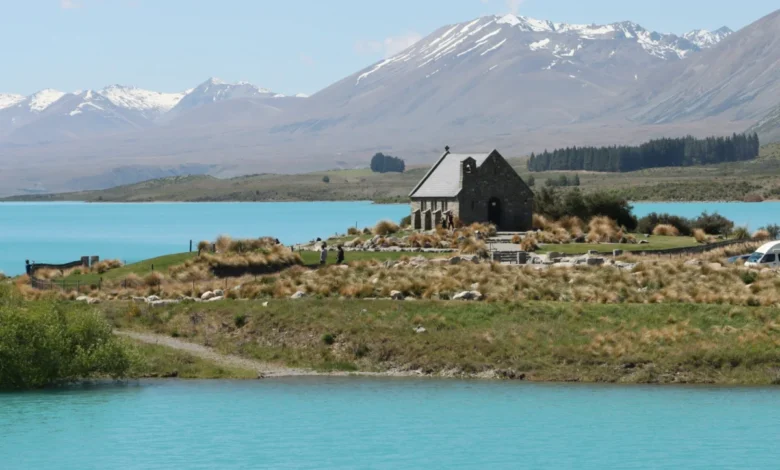
On the central South Island, Lake Tekapo commands attention for its striking milky-turquoise waters, a visual phenomenon caused by glacial flour—finely ground rock particles suspended in the meltwater flowing from the Southern Alps. The lake and its surrounding basin form a core component of the Aoraki Mackenzie International Dark Sky Reserve, the largest Gold-Tier dark sky reserve in the Southern Hemisphere, encompassing 4,300 square kilometres.
Established to protect the nocturnal environment from light pollution, the region has become a global epicenter for astro-tourism. The Dark Sky Project in Tekapo bridges contemporary astrophysics with indigenous Māori astronomy, housing a restored historic 19th-century telescope that offers visitors a tangible connection to early astronomical exploration. Furthermore, the Summit Experience at the Mount John Observatory provides nightly guided access to professional telescopes, allowing visitors to observe the Southern Cross, the Magellanic Clouds, and the galactic core under exceptionally clear atmospheric conditions.
To accommodate the influx of science-minded travellers, local developments such as The Cairns Alpine Resort have introduced modern alpine lodges inspired by historic South Island musterers’ huts. These timber-lined, self-contained units provide functional amenities for visitors returning late from high-altitude stargazing excursions.
Wellington: The Capital of Culture and Culinary Innovation

Perched on the edge of a dramatic harbour at the southwestern tip of the North Island, Wellington functions as New Zealand’s political, creative, and cultural epicentre. Renowned for its compact, walkable urban grid, the city combines Victorian-era wooden architecture with a vibrant contemporary arts scene and an internationally recognised coffee and dining culture.
The cultural landscape received a significant boost with the reopening of the City Gallery Wellington, cementing the capital’s reputation as a premier destination for visual arts exhibitions. Concurrently, Wellington’s culinary footprint continues to expand, driven by independent establishments such as Puffin, a prominent natural wine bar, and Rita, an intimate set-menu restaurant operating out of a converted Aro Valley cottage. These venues reflect a broader national shift toward hyper-seasonal dining and sustainable viticulture.
Hospitality infrastructure in the capital has evolved to match this creative momentum. Boutique establishments like The Intrepid Hotel, situated in the vibrant Te Aro district near Cuba Street, offer design-forward accommodations that integrate seamlessly into the local neighbourhood fabric, providing travellers with immediate access to the city’s thriving culinary and nightlife offerings.
Fiordland National Park: Remote Wilderness and Conservation Stewardship
Occupying the southwestern corner of the South Island, Fiordland National Park represents one of the most remote and dramatically sculpted wilderness areas on Earth. Carved by successive glaciations over millions of years, the park features sheer granite cliffs, dense temperate rainforests, and deep marine inlets such as Milford Sound (Piopiotahi) and Doubtful Sound (Patea).

Access to these remote fjords is primarily managed through the gateway town of Te Anau, situated on the shores of the South Island’s second-largest lake. Beyond serving as the departure point for the Kepler and Milford Track Great Walks, the region offers subterranean excursions into the Te Anau Glowworm Caves, where an underground network of limestone passages is illuminated by thousands of Arachnocampa luminosa larvae.
For travellers navigating the route toward Fiordland, local commerce often intersects with multigenerational family enterprises. Along the approach via The Key, properties such as Davaar Station highlight the intersection of sustainable agriculture and artisanal retail, producing high-end knitwear derived from locally farmed wool. This commitment to provenance mirrors the broader hospitality offerings in the region, including Cabot Lodge—a working sheep and cattle farm overlooking Lake Manapouri—and the Milford Sound Lodge, which provides environmentally sensitive chalet accommodations deep within the rainforest canopy of the Cleddau Valley.
Economic Implications and Sustainable Tourism Strategies
As New Zealand’s tourism sector continues its robust recovery, industry analysts and government agencies increasingly emphasise sustainable growth practices. The implementation of the International Visitor Conservation and Tourism Levy (IVL), alongside strict biosecurity protocols managed by the Department of Conservation and the Ministry for Primary Industries, underscores the nation’s commitment to protecting its fragile endemic ecosystems from invasive species and over-tourism.
Stakeholders across the hospitality and transport sectors stress the importance of dispersing economic benefits beyond traditional urban hotspots like Auckland and Queenstown into regional economies such as Southland, the Mackenzie Basin, and the central North Island. By encouraging longer stays, slower travel itineraries, and respect for indigenous cultural heritage—particularly through authentic engagements with Māori communities and conservation initiatives—New Zealand aims to preserve its natural and cultural integrity for future generations of international visitors.