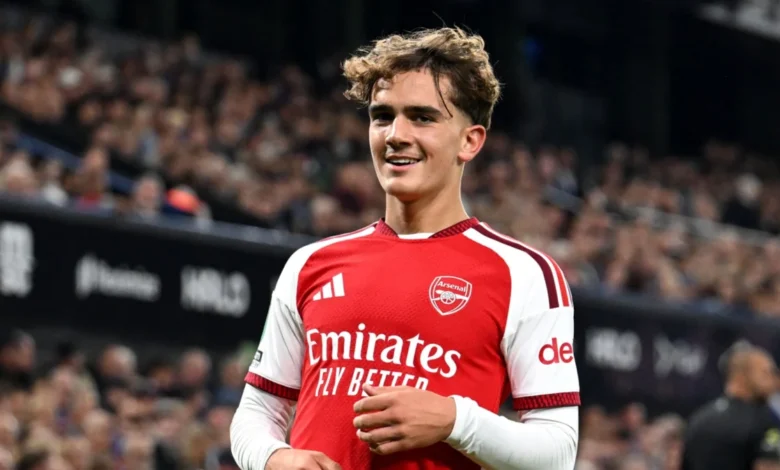
The landscape of modern professional football continues to witness a rapid acceleration in the pathways from elite academies to senior first-team environments. At Arsenal Football Club, the blueprint for nurturing prodigious young talent is currently being tested and refined through the emergence of 16-year-old sensation Max Dowman. Following a dazzling individual performance in the Carabao Cup, where the teenager spearheaded an attacking display and scored twice against Ipswich Town at Portman Road, the conversation surrounding his immediate career trajectory has intensified. While loan opportunities have inevitably been floated by external observers and pundits alike, Arsenal manager Mikel Arteta has adopted a measured, long-term approach, confirming that the club reviews the player’s development in rigorous six-month cycles.
Arteta’s management of young talent is built on a foundation of calculated patience and meticulous observation. Despite the clamour for regular senior minutes—amplified by comparisons to elite European contemporaries such as Barcelona’s Lamine Yamal—Dowman’s competitive exposure at the senior level this season remains largely restricted to his standout 90-minute display in the domestic cup competition. Having been omitted from the matchday squads for recent Premier League fixtures against Aston Villa and Sunderland, questions regarding a potential temporary departure to gain regular playing time have naturally surfaced within footballing circles.
Navigating the Delicate Balance of Development and First-Team Integration
Addressing the media regarding the future of the teenage midfielder, Arteta clarified the club’s initial stance heading into the current campaign. The technical staff deliberately chose to retain Dowman within the senior setup to integrate him fully through pre-season preparations, shielding him from premature loan speculation.
The Arsenal manager emphasised that any future decisions regarding a temporary transfer will be contingent upon a multi-faceted evaluation process. This includes tracking Dowman’s developmental milestones, assessing the physical and tactical demands placed upon him, monitoring squad depth and availability across various competitions, and measuring the efficiency of his output whenever opportunities arise. Drawing from his own professional journey—which saw him move to Paris Saint-Germain at the age of 17—Arteta noted that the success of a loan move is heavily dependent on variables such as coaching philosophy, the welcoming environment of the host club, and whether the player is genuinely integrated into the tactical fabric of the team rather than merely occupying a squad number. For now, the explicit instruction is to maintain his current environment at the Emirates Stadium, where he can continue to absorb the demands of elite-level competition.
A Historic Rise Through the Academy Ranks
Max Dowman’s ascent through the footballing pyramid has been nothing short of meteoric. Over the past twelve months, the youngster has shattered numerous records, cementing his status as one of the most exciting prospects in European football. During Arsenal’s previous title-challenging campaign, Dowman etched his name into the record books by becoming the youngest goalscorer and starter in the Premier League, while also making history as the youngest player to feature in the UEFA Champions League, a campaign that culminated in the Gunners reaching the final.
This rapid progression mirrors the trajectory of fellow Hale End graduate Ethan Nwaneri, who broke the record as the Premier League’s youngest-ever player in 2022 at just 15 years of age. In a bid to accelerate his tactical maturation, Nwaneri was subsequently dispatched on successive developmental loans to continental European heavyweights Marseille and Borussia Dortmund, providing a working model for how Arsenal manages elite teenage talent. However, while Nwaneri’s path involved immediate exposure to foreign leagues, the technical staff at London Colney are treating Dowman’s case with bespoke parameters, weighing the benefits of domestic first-team proximity against the necessity of guaranteed weekly minutes.
Punditry and Public Discourse: The Debate Over Senior Caps and International Recognition
The extraordinary nature of Dowman’s talent has inevitably sparked broader conversations regarding his readiness for senior international football. Former Premier League striker Jay Bothroyd, speaking on Sky Sports News, offered a forthright assessment of the teenager’s standing within the modern game, drawing comparisons with established professionals.
Bothroyd argued that Dowman’s current technical and tactical proficiency surpasses that of several players currently on the fringes of the senior national setup, asserting that the 16-year-old merits active consideration for international selection. Highlighting the modern philosophy that "if you’re good enough, you’re old enough," Bothroyd pointed to the psychological profile of modern elite youngsters, who possess the ambition to compete at the highest level immediately rather than waiting for conventional age milestones. With the European Championships slated for 2028—at which point Dowman will be 18 years of age—analysts and former professionals are increasingly projecting his inclusion as a cornerstone of the national team’s future generation, drawing parallels to other rising prospects such as Liverpool’s electric winger Rio Ngumoha.
Strategic Implications for Arsenal’s Squad Building
The management of Max Dowman highlights a broader strategic challenge facing elite Premier League clubs: balancing the immense financial and competitive pressures of competing for domestic and continental titles with the moral and developmental imperative of giving homegrown talent a pathway to the first team.
Arteta’s policy of six-month evaluations offers a flexible framework that prevents young players from stagnating on the bench while ensuring they are not thrust into environments that could stunt their growth. By keeping Dowman within the inner sanctum of the senior squad, Arsenal retains direct control over his physical conditioning, tactical education, and psychological development.
As the domestic fixture list intensifies with the concurrent demands of the Premier League, domestic cup competitions, and European fixtures, opportunities for rotation are bound to arise. How Dowman capitalises on those fleeting moments will dictate the conclusions drawn by Arteta and his coaching staff when the next evaluation window opens. For now, the young prodigy remains firmly rooted in North London, where his development continues to be monitored with a blend of fierce protection and soaring ambition.