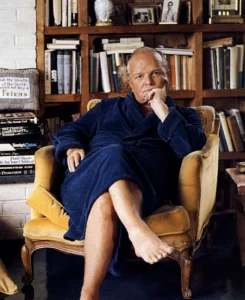
When Guillaume Excoffier first arrived in Beirut in the early 2010s, he found himself not merely visiting a city, but uncovering a living archive of mid-century ambition. A French dealer and interior designer by trade, Excoffier became transfixed by the capital’s overlooked modernist landscape—a dense, concrete-rich catalog of structures erected between the 1950s and the mid-1970s. This era, widely regarded as the "Golden Age" of Lebanese urban development, was characterized by a rapid, optimistic economic expansion that manifested in Brutalist office blocks, soaring concrete basilicas, and residential tributes to Le Corbusier’s Radiant City. These buildings were not mere copies of European trends; they were nuanced regional adaptations. Architects of the time skillfully integrated vernacular elements—such as the iconic triple-arched windows of Ottoman-era dwellings—with modern structural innovations like deep-shade breezeways, concrete screens, and advanced cantilever designs suited for the Mediterranean climate and the city’s notoriously steep, sloping terrain.

A Chronology of Modernist Ambition
The development of modern Beirut occurred in distinct waves, tied closely to the region’s economic and political shifts. During the 1950s, the city became a playground for avant-garde architectural experimentation. International firms and local pioneers collaborated to house an emerging middle class, utilizing new materials such as pre-fabricated concrete and reinforced steel. This period of growth was punctuated by massive, ambitious public projects, most notably the Tripoli International Fair designed by Oscar Niemeyer in 1963.

However, the history of Beirut’s architecture is inextricably linked to the city’s status as a site of global conflict. The construction landscape has historically been marked by a stop-start rhythm; projects that promised a future of prosperity were often halted by regional instability. Niemeyer’s fairground, a sprawling, visionary complex of domes and plazas, remains an unfinished monument to that era—a skeletal reminder of the fragility of grand urban plans. Excoffier’s recent project, documenting these buildings alongside photographer Matthieu Salvaing for their book Modernist Beirut (published by Éditions Norma), serves as both a preservation effort and a testament to the resilience of a city that continues to build and rebuild amidst adversity.

The Ashrafieh Restoration: A Personal Intersection
Excoffier’s professional fascination with the city eventually became deeply personal. In 2023, he secured an apartment in a 1952 building in the Ashrafieh neighborhood. The structure, representative of the early-modernist wave, offered the hallmark features of the period: 13-foot-tall ceilings and a spatial flow that bridges the gap between interior comfort and the exterior environment.

Upon acquiring the space, Excoffier opted for a rigorous restoration. He stripped away the "charmless" renovations of previous decades, exposing the original concrete bones of the apartment. He opted for polished concrete floors and period-appropriate window fixtures that allow the apartment to function as a "blank canvas." For Excoffier, the project was an exercise in dialogue—not just between the past and present, but between the specific architectural history of Beirut and his own global collection of 20th-century design.

Architectural Synthesis and Global Influences
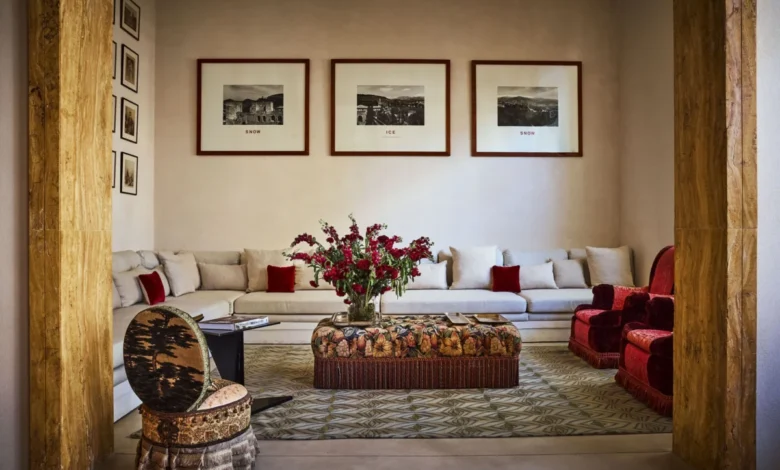
Excoffier’s interior design philosophy functions as a cultural crossroads. He rejects the notion that living with antiques requires a "froufrou" or overly traditional aesthetic. Instead, he orchestrates a juxtaposition of eras. In his drawing room, one finds a 1983 cabinet by Aldo Rossi placed in conversation with an 1810 Biedermeier piece. The Biedermeier style, which stripped away the heavy, ornate gilding of the Empire period, is often cited by architectural historians as the precursor to modernism. By placing these pieces together, Excoffier highlights the visual lineage of the pyramid-topped cabinet, showing how 19th-century furniture design laid the groundwork for 20th-century postmodern forms.

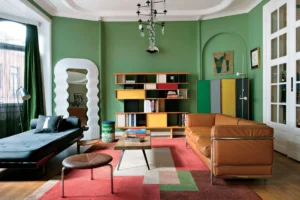
His collection includes a diverse array of seminal pieces: tubular Dr. Sonderbar seats by Philippe Starck, the "Spine" bench by André Dubreuil, and chairs by Josef Hoffmann. The design scheme is intentionally non-minimalist. "Beirut is not about minimalism," Excoffier explains. "It’s a city of hospitality, where hosting 40 people for a gathering is considered a small, intimate event." This social reality dictates the layout of the home, which prioritizes flexible, communal spaces over the sterile, curated silence often found in contemporary design galleries.

Supporting Data and Local Craftsmanship
The project is significant not only for its historical curation but for its integration of local labor. While Excoffier sources high-end European design pieces from the global market, he balances these with utilitarian, bespoke elements produced by Beirut-based artisans. The lounge’s sectional sofa, the dining table, and even the kitchen stools were fabricated within a short drive of the apartment.

Perhaps the most unconventional elements in his collection are the giant, fading ice cream cones displayed in the bedroom. Originally sourced from a nearby local shop, these items act as "ready-made" sculptures in the vein of Claes Oldenburg. They serve as a poignant, if whimsical, reflection of the city’s character: "They are so faded and charming—they feel like Lebanon in the summer," he notes. This willingness to blend high-art lithographs by Richard Artschwager or John Baldessari with local, vernacular kitsch underscores a broader trend in interior design: the move toward "curated eclecticism," where the identity of the home is defined by the narrative tension between the global and the hyper-local.

Implications for Urban Preservation
The preservation of mid-century buildings in Beirut remains a contentious issue. As the city continues to densify, many of these 1950s and 60s structures are threatened by redevelopment. Experts in the field argue that the destruction of this specific architectural layer would strip the city of its unique mid-century identity.

"People believed in a brighter future," Excoffier says of the architects who designed these buildings. That belief is etched into the very concrete of the city. The survival of these buildings depends on a shift in public perception—from viewing them as "old" or "obsolete" to recognizing them as essential historical markers of Lebanon’s modernization.

The implications of Excoffier’s work go beyond mere interior design. By documenting these spaces and choosing to live within one, he is contributing to a broader cultural effort to validate Beirut’s architectural heritage. His home serves as a case study for how these apartments, originally designed for a rising post-war middle class, can be adapted for contemporary living without losing the character that defined their original construction.

Conclusion
Guillaume Excoffier’s career shift from an art-world professional to a gallery owner, and finally to an independent interior designer, mirrors his own trajectory through the city of Beirut. Living between Paris, Dubai, and Beirut, he embodies a global design perspective that is increasingly common, yet he remains deeply grounded in the specificities of his adopted home. Whether he is scouring an auction house for a rare Jean Royère piece or negotiating for a discarded decorative object from a local merchant, his process is driven by the hunt.

As Beirut continues to navigate the complexities of its future, the work of individuals like Excoffier provides a necessary reminder of the city’s past. His apartment is more than just a residence; it is a manifestation of a city that has always looked outward, synthesizing international modernism with its own resilient, enduring spirit. The apartment stands as a tribute to the dynamism and creative energy that continue to define the city, proving that even in the face of uncertainty, the act of living in—and preserving—one’s architectural environment is a powerful form of cultural continuity.