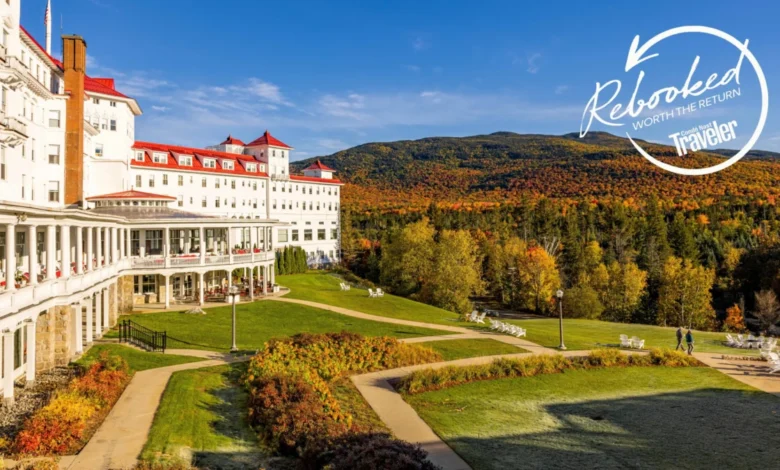
The historic Omni Mount Washington Resort stands as a premier architectural and economic anchor within New Hampshire’s White Mountains, drawing thousands of travelers annually during the peak autumn foliage season. Spanning 2,600 acres in the village of Bretton Woods, the landmark property captures a significant portion of New England’s seasonal tourism revenue while exemplifying the evolution of early 20th-century grand resort architecture. Built in 1902 and framed by the formidable 6,288-foot peak of Mount Washington—the highest summit in the northeastern United States—the resort merges historical preservation with modern luxury, serving as a case study in how heritage properties maintain economic viability in the modern travel sector.
Main Facts and Architectural Heritage

Constructed in the Spanish Renaissance Revival style, the Omni Mount Washington Resort is instantly recognizable by its striking white exterior and distinctive red-tiled roof. Opened to the public in July 1902, the hotel was the vision of industrialist Joseph Stickney, who aimed to create a world-class mountain sanctuary for the wealthy elite of the Gilded Age. The main building accommodates 269 guest rooms and suites, complemented by expansive public spaces such as a 900-foot-long back veranda that provides panoramic views of the Presidential Range.
The property’s operations extend far beyond traditional lodging. It functions as a multi-season recreational hub featuring two championship golf courses, the adjacent Bretton Woods Ski Area—the largest ski destination in New Hampshire—and a 25,000-square-foot spa facility. Recent multi-million-dollar capital investments have further diversified the guest experience, notably the 2021 debut of the 69-room Presidential Wing and comprehensive guest room renovations completed in the historic wing.
Chronology of Development and Historical Significance

The timeline of Bretton Woods and the Mount Washington Hotel is deeply intertwined with American economic and diplomatic history.
- July 1902: The Mount Washington Hotel officially opens its doors, constructed by an estimated 250 Italian stonemasons and artisans using local granite and steel framing, at a cost of approximately $1.7 million—an immense sum at the turn of the century.
- July 1944: The resort achieves international historical prominence as the site of the United Nations Monetary and Financial Conference, commonly known as the Bretton Woods Conference. Delegates from 44 allied nations gathered at the hotel to establish the international monetary system, leading to the creation of the International Monetary Fund (IMF) and the World Bank, and establishing the U.S. dollar as the dominant global reserve currency.
- 1955–1990s: Following decades of shifting ownership and economic fluctuations common to grand American resort hotels, the property undergoes several transitions aimed at modernization, incorporating winter sports infrastructure to counteract seasonal revenue drops.
- 1991: The hotel is designated a National Historic Landmark, recognizing its exceptional architectural significance and its pivotal role in 20th-century global economic history.
- 2006: Omni Hotels & Resorts assumes management of the property, initiating a series of infrastructure upgrades, including the expansion of ski amenities, sustainable energy updates, and the addition of modern luxury accommodations like the Presidential Wing.
- 2021–Present: The resort opens the Presidential Wing, modernizing its inventory while continuing to host high-profile cultural, scientific, and corporate events, such as astronomical lecture series hosted in its Prohibition-era subterranean lounge, known historically as The Cave.
Economic Implications and Regional Tourism Impact
The economic footprint of the Omni Mount Washington Resort extends well beyond its immediate property lines, serving as a primary economic engine for Carroll County and the broader north-central region of New Hampshire. According to regional tourism metrics, the autumn foliage season—spanning from late September through mid-October—generates a substantial portion of the state’s annual tourism revenue, which routinely exceeds $5 billion statewide.

Hospitality analysts note that properties like the Omni Mount Washington play a vital role in stabilizing local employment, supporting hundreds of direct hospitality jobs as well as indirect supply chains involving regional agriculture, construction, and outdoor recreation outfitters. Small neighboring communities, such as North Conway and Jackson, experience a seasonal economic surge driven by visitors transiting through the region. Events like Jackson’s annual "Pumpkin People" celebration highlight how private-public regional cooperation enhances visitor retention and extends the average length of stay.
Furthermore, the resort’s ability to seamlessly integrate high-end hospitality with ecological access—ranging from guided alpine hikes and fly-fishing to eco-friendly ski operations—reflects a broader industry trend toward experiential luxury travel. Guests increasingly demand vacations that combine environmental immersion with high-end wellness and culinary programming, such as the regional farm-to-table menus featured at the resort’s Stickney’s steakhouse.
Broader Industry Context and Future Outlook

As the hospitality sector navigates changing climate patterns and shifting consumer preferences, historic destination resorts face unique operational challenges. Maintaining century-old structures while meeting modern environmental standards requires substantial capital expenditure. In response, properties in the White Mountains have increasingly invested in year-round programming, transitioning from traditional seasonal models to continuous operation hubs that attract remote workers, wellness travelers, and corporate retreat groups.
The ongoing appeal of the Omni Mount Washington Resort underscores the enduring market demand for authentic heritage travel paired with contemporary amenities. By balancing its legacy as the birthplace of modern international finance with ongoing investments in guest infrastructure, the resort remains a benchmark for grand hotel preservation in North America, illustrating how historical integrity and commercial viability can successfully coexist in the competitive modern travel economy.