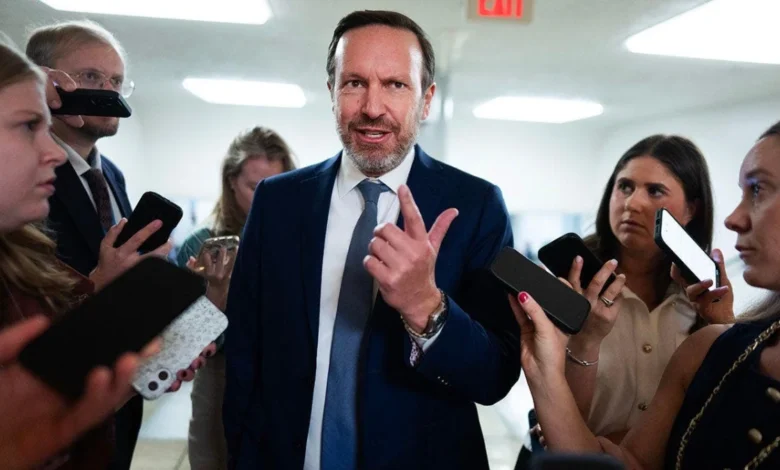
Senator Chris Murphy, the Democratic junior senator from Connecticut, has been hospitalized following a stroke, prompting an immediate outpouring of concern from colleagues and party leadership as the nation approaches a critical juncture in the election cycle. The news, confirmed by his chief of staff, Allison Herwitt, on Sunday, came as a surprise to many, given Murphy’s active schedule in the final weeks leading up to the midterm elections.
The incident occurred on Saturday afternoon while Murphy was attending his son’s hockey game. The senator reportedly began experiencing sudden physical symptoms, specifically numbness in his arm, which prompted immediate medical intervention. After being stabilized at a local medical facility, Murphy was transferred to the prestigious Johns Hopkins Hospital for specialized care and ongoing observation.
Chronology of the Medical Event
According to the official statement provided by Herwitt, the timeline of events began mid-day Saturday. The transition from the local hospital to Johns Hopkins indicates a proactive approach by his medical team to ensure access to specialized neurological resources.
By Sunday morning, reports confirmed that Murphy was alert and conscious. The medical team at Johns Hopkins has expressed a positive outlook, noting that the senator is responding well to initial treatments. While no specific details regarding the severity of the stroke or the expected duration of his hospital stay have been disclosed, the official communication emphasized that doctors remain encouraged by his progress and are optimistic regarding his potential for a full recovery.
The Significance of Senator Murphy’s Role
Senator Chris Murphy, born on August 3, 1973, has served as a central figure in the Democratic Party since his election to the Senate in 2013. A staunch advocate for progressive policies, he has spent recent years navigating complex legislative landscapes, most notably in the realms of gun safety reform and foreign policy.
At 53 years old, Murphy has established himself as a prominent voice in the upper chamber. His political trajectory has not gone unnoticed by observers, with many analysts identifying him as a potential contender for the 2028 Democratic presidential primary. His influence extends beyond his home state of Connecticut, as he has become a frequent surrogate for the national party, crisscrossing the country to campaign for Democratic candidates. Prior to his hospitalization, Murphy had been scheduled to travel to New Hampshire on Sunday to continue his efforts in support of the party’s midterm agenda, a commitment that has now been indefinitely postponed.
Understanding Strokes: Clinical Context and Prevalence
The sudden nature of Senator Murphy’s medical emergency highlights the importance of recognizing the symptoms of a stroke, an event that remains a leading cause of disability and death in the United States. According to the Centers for Disease Control and Prevention (CDC), someone in the United States has a stroke every 40 seconds.
Medical experts generally classify strokes into two main categories: ischemic, which occurs when a blood vessel carrying blood to the brain is blocked by a clot, and hemorrhagic, which occurs when a blood vessel leaks or ruptures. While the specific clinical diagnosis for Senator Murphy has not been publicly released, the rapid onset of numbness—a classic warning sign—often leads to faster medical intervention, which is the most critical factor in improving patient outcomes. The "BE FAST" acronym (Balance, Eyes, Face, Arms, Speech, Time) is the standard public health guidance for identifying the onset of a stroke, and the senator’s decision to seek immediate care upon experiencing arm numbness aligns with established medical recommendations.
Implications for the Midterm Elections
The hospitalization of a high-profile senator during the closing weeks of a campaign season inevitably introduces a degree of uncertainty into the political landscape. As the Democratic Party works to defend its majority in the Senate, the loss of a key surrogate like Murphy, even temporarily, requires a recalibration of campaign resources.
However, political analysts suggest that the impact may be limited to the logistics of the current campaign. Because Murphy is not up for re-election in the current cycle, there is no risk of a seat flipping or a primary contest being disrupted. Instead, the focus remains on the broader message the party intends to convey. Historically, when high-ranking officials face health crises, the opposition often tempers its rhetoric, leading to a temporary "rally around the candidate" effect or a period of political detente. It is expected that both Democratic and Republican colleagues will express well-wishes as the senator recovers.
Official Responses and Public Reaction
The office of Senator Murphy has been the primary point of contact for updates, maintaining a professional and measured tone in their communications. Chief of Staff Allison Herwitt has acted as the sole spokesperson, ensuring that information remains accurate and focused on the senator’s health.
Within the halls of Congress, reactions have been swift and supportive. While formal statements from party leadership are forthcoming, individual members of the Connecticut delegation and other Senate colleagues have taken to social media and public channels to share their support for the senator’s family and his recovery. This reflects the often-overlooked reality that behind the partisan divides of Washington, D.C., there exists a degree of collegiality during times of personal crisis.
Future Outlook and Legislative Continuity
As Murphy continues his recovery at Johns Hopkins, the question of his return to the Senate floor remains a secondary concern to his long-term health. The Senate has robust procedures in place for the temporary absence of its members, and it is unlikely that his absence will derail any essential legislative business in the immediate term.
The broader implications for his potential 2028 presidential aspirations will likely remain on hold. For now, the political apparatus that surrounds a figure of his stature will pivot toward maintaining the momentum of the current campaign season without him. Observers will be watching closely for the next medical update, which will likely provide more clarity on his timeline for returning to public life.
Data-Driven Perspective on Congressional Health
The health of sitting members of Congress is an issue that surfaces periodically in the national discourse. With an aging legislative body, the medical resilience of senators and representatives is often a subject of quiet discussion. According to data from the Congressional Research Service, the average age of members in the 119th Congress remains at historic highs, bringing increased scrutiny to the health and longevity of those in power.
Senator Murphy, at 53, is significantly younger than the average age of a U.S. Senator, which typically hovers in the mid-60s. This youth is often cited by medical professionals as a positive indicator for recovery from traumatic medical events such as strokes. The resilience of the human body, combined with the world-class care provided by institutions like Johns Hopkins, provides a statistically favorable environment for a full return to function.
Conclusion
The hospitalization of Senator Chris Murphy serves as a sobering reminder of the unpredictability of health, regardless of one’s professional standing or personal influence. As the senator undergoes treatment, the focus of his constituents and his colleagues remains squarely on his well-being. His career, marked by a consistent presence on the national stage and a commitment to his party’s goals, has earned him a level of respect that transcends the current political divide.
As the coming days unfold, the public will wait for further news from his medical team. For now, the narrative surrounding the senator is one of hope for a steady recovery and a return to the work that has defined his decade-long tenure in the United States Senate. The incident also serves as a broader public health reminder of the necessity of vigilance regarding personal health, as the symptoms he experienced are universal, and the urgency of the response he received serves as a benchmark for how such crises should be managed to ensure the best possible medical outcome.