The 2026 United States midterm elections delivered a historic and seismic shift in the nation’s political landscape, resulting in what political analysts have widely described as a "blue tsunami." In a stunning repudiation of the ruling administration, American voters handed the Democratic Party decisive control of both chambers of Congress. The electoral shockwaves swept through longstanding Republican strongholds, leaving the GOP grappling with an existential crisis, a plunging financial portfolio for the president, and intense internal battles over the party’s future direction.

The scale of the Democratic victory surpassed even the most optimistic projections from party strategists. By capturing a commanding majority in the House of Representatives—securing upwards of 237 seats—and seizing control of the Senate, the Democratic coalition has fundamentally rewritten the federal legislative map.
A Historic Sweep and the Fall of GOP Strongholds
The defining narrative of the 2026 midterms was the Democrats’ ability to breach deep-red territory. For decades, the Lone Star State of Texas remained an elusive prize for Democrats, plagued by false dawns and narrow defeats. On Tuesday night, however, that era of frustration ended. In a historic dual victory, James Talarico was elected to the US Senate, becoming its youngest member, while Gina Hinojosa triumphed in the gubernatorial race to become the state’s first Latina governor. Their victories powered a broader wave that saw unexpected Democratic gains in conservative bastions across Iowa, Kansas, South Carolina, and Ohio.

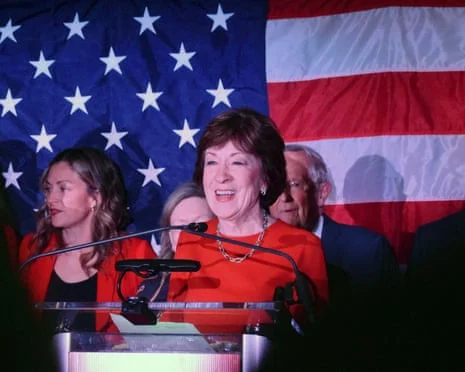
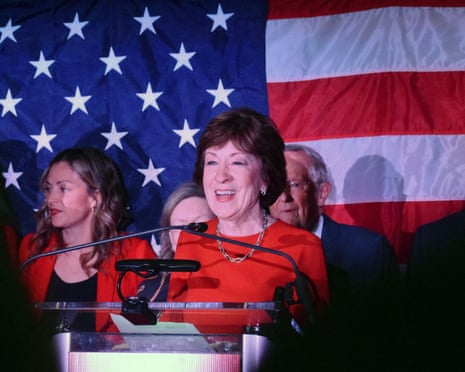
In Maine, the long political tenure of Republican Senator Susan Collins came to an abrupt and dramatic end. Collins, a fixture of Washington and state politics for three decades, was unseated by working-class Democratic challenger Troy Jackson. Political commentators compared the sudden collapse of her campaign to Ernest Hemingway’s famous description of bankruptcy: gradually, then suddenly. Jackson’s grassroots populism struck a chord with voters fatigued by economic anxieties and national political polarization.
Further compounding Republican woes, the party’s mid-decade redistricting push—engineered to cement conservative advantages—massively backfired. Districts explicitly gerrymandered to favor Republicans in states like Texas and California flipped to Democratic candidates, demonstrating the potency of a mobilized and frustrated electorate.

Economic Fallout and Financial Pressures on the President
The political earthquake immediately translated into economic volatility. Tradeable investment assets closely tied to Donald Trump experienced precipitous drops following the election returns. Stock in the Trump Media and Technology Group (DJT), traded on the Nasdaq exchange, plummeted to historic lows, trading at just over $5 per share—a staggering fall from its all-time high of $101. The company’s stock shed roughly 11% overnight as election results crystallized.
Similarly, digital assets championed by the president’s inner circle, including World Liberty Financial tokens and various novelty crypto coins, suffered double-digit losses. Financial experts noted that the valuation of these assets has historically been pegged directly to Trump’s personal popularity and political momentum. With public approval ratings facing severe headwinds, investors rapidly divested, signaling a loss of confidence in the administration’s financial ecosystem.

Conversely, traditional Wall Street financial markets rallied in the wake of the congressional shift. The Dow Jones Industrial Average surged 2%, while the S&P 500 and the tech-heavy Nasdaq each climbed over 1%, recovering sharply from overnight futures losses triggered by investor anxiety over potential regulatory crackdowns on sectors like artificial intelligence.
Congressional Leadership Upheaval
The disastrous midterm results instantly triggered a scramble for leadership within the Republican Party. House Speaker Mike Johnson announced he would not pursue the role of minority leader in the upcoming Congress, effectively relinquishing his position atop the caucus.
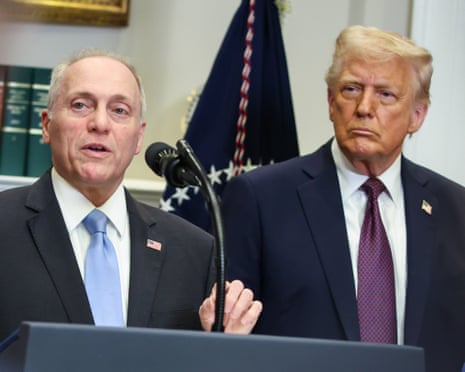
Within hours, prominent party figures launched bids to steer the fractured GOP through its transition into the minority. Louisiana Representative Steve Scalise, the current House majority leader, formally announced his candidacy, emphasizing the need for operational discipline and a unified legislative vision. He was swiftly joined by Ohio Representative Jim Jordan, the hard-line chairman of the House Judiciary Committee. Both men previously vied for the speakership in 2023 and now present competing visions for charting the party’s path back to a congressional majority ahead of the 2028 presidential cycle.
On the winning side, current House Minority Leader Hakeem Jeffries officially announced his candidacy for speaker of the House. Supported by a robust and expanded Democratic caucus, Jeffries is poised to make history as the first Black speaker of the House of Representatives when the new Congress is sworn in this coming January. Jeffries characterized the election results not merely as a blue wave, but as an "American tsunami," citing a mandate from the American public to tackle the cost of living, lower consumer prices, and address healthcare accessibility.

International Repercussions and Diplomatic Reactions
The seismic shift in Washington did not go unnoticed on the global stage, eliciting swift and varied reactions from international leaders. European officials largely welcomed the prospect of a legislative check on the Trump administration. British Prime Minister Andy Burnham stated that the election results offered a vital "opportunity" for the global community to refocus on easing cost-of-living pressures and addressing prolonged international conflicts.
Spanish Prime Minister Pedro Sánchez hailed the American outcome as a powerful rejection of "hate, sexism, climate denialism, and the privileges of the elites," drawing parallels to progressive victories in other parts of the world. Meanwhile, in Iran, senior parliamentary speaker Mohammad-Baqer Ghalibaf attributed Republican losses directly to the administration’s unresolved military entanglements in the Middle East, echoing domestic criticisms from figures like Vice President JD Vance, who reportedly acknowledged that the conflict had severely damaged the party’s electoral prospects.
Implications and the Road Ahead
As Washington prepares for a transitional period before the newly elected Congress takes office in January, the political landscape stands fundamentally altered. Democrats face the complex challenge of managing a diverse coalition while delivering tangible legislative results on the economy, healthcare, and government accountability. Meanwhile, a chastened Republican Party must reconcile internal divisions, address plummeting support among key demographic groups, and formulate a viable strategy to counter a resurgent opposition. With a lame-duck executive branch now facing a fully empowered, opposition-controlled legislative branch, the next two years promise intense institutional friction and a profound reshaping of American governance.