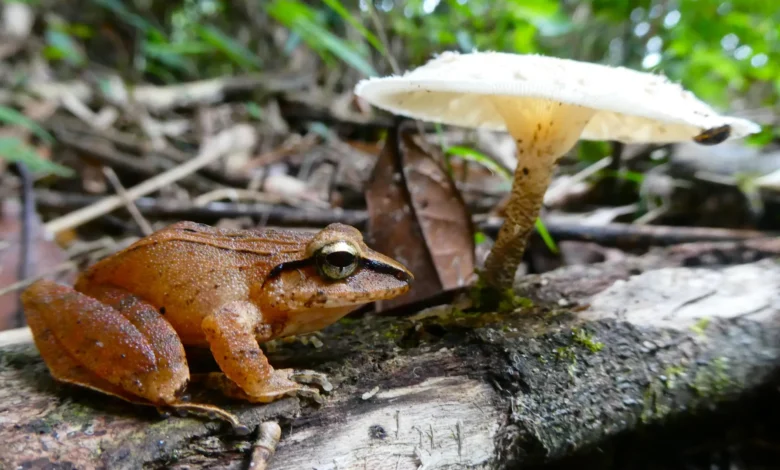
For nearly half a century, the silent forests of Brazil have held a troubling ecological mystery. Beginning in the 1970s, herpetologists and field researchers noticed a sudden, deeply alarming drop in amphibian populations across Brazil’s Atlantic Forest—one of the most biologically diverse regions on the planet. Species that were once abundant seemed to vanish into thin air, leaving behind silent streams and empty canopies. For decades, the exact driver behind these sweeping declines remained an elusive puzzle, frequently debated among conservation biologists, epidemiologists, and climatologists.
Now, a team of researchers from the Center for Conservation Genomics at the Smithsonian’s National Zoo and Conservation Biology Institute (NZCBI) and Pennsylvania State University (PSU) has finally pieced together the puzzle. Publishing their findings in the journal Molecular Ecology, the scientific team has uncovered compelling evidence pointing directly to a deadly fungal pathogen as the prime suspect in these historical die-offs. By combining cutting-edge genomic analysis with decades-old museum archives, researchers have closed one of the most enduring cold cases in wildlife epidemiology, offering vital lessons for modern conservation as emerging pathogens continue to threaten global biodiversity.
The Culprit: Chytridiomycosis and the Global Amphibian Crisis
The suspected agent behind the devastation is chytridiomycosis, a devastating infectious disease commonly referred to as "chytrid." The disease is caused by Batrachochytrium dendrobatidis ($Bd$), a microscopic, aquatic fungus that attacks the keratin-rich layers of a frog’s skin. Because amphibians rely heavily on their skin for vital physiological processes—including respiration, hydration, and electrolyte balance—disruptions caused by the fungus can quickly lead to cardiac arrest and death.
Epidemiological evidence suggests that the pathogen originally emerged in Asia before spreading globally via international trade and human transit during the 1970s and 1980s. However, because the scientific community did not formally identify and describe Batrachochytrium dendrobatidis until 1999, the wave of destruction had already swept across the globe unchecked. By the time researchers recognized the threat, hundreds of amphibian species worldwide had been pushed to the brink of extinction, with numerous local populations winking out entirely before scientists even understood what was happening.
"After almost 50 years, we still aren’t confident what caused many historical amphibian die-offs, making these declines some of the most enduring cold cases in wildlife epidemiology," explained Jack Boyette, an NZCBI graduate fellow and doctoral candidate at PSU who led the groundbreaking study.
Chronology of a Crisis: The Boracéia Biological Station
To crack the case, the research team focused on a specific epicenter of the historical tragedy: the Boracéia Biological Station, nestled within the dense, humid expanse of Brazil’s Atlantic Forest. Between 1979 and 1982, field researchers documented catastrophic declines among local amphibian populations at the site.
Over the decades, scientists advanced various hypotheses to explain the sudden disappearances. Some argued that shifts in regional climate patterns or unusually extreme weather events had triggered the die-offs. Others pointed toward localized habitat destruction or pollution. However, the new molecular study presents robust evidence that an aggressive, emerging fungal pathogen was sweeping through the forest canopy and streams at the exact same historical moment.
"While environmental factors could have played a role, our findings most directly implicate the chytrid fungus, revealing that regional invasion of the pathogen coincided with these unexplained amphibian disappearances," Boyette noted.
The Time Machine: Unlocking Natural History Collections
Because the die-offs occurred long before modern field surveillance of chytrid was possible, the researchers had to devise an innovative strategy to travel back in time. They found their answer in an unexpected place: the drawers and storage jars of natural history museums.
The Smithsonian’s National Museum of Natural History houses an irreplaceable repository of specimens collected by William Ronald Heyer, a former curator of amphibians and reptiles. Heyer conducted five rigorous collecting expeditions to the Boracéia Biological Station, strategically spanning the critical era of the decline. His fieldwork included two major expeditions during the 1970s, right before the population collapse, followed by three expeditions during the 1980s, after the devastating die-offs had already occurred.
These meticulously preserved specimens provided the research team with a biological time machine. By extracting DNA and testing tissue samples from specimens collected across different decades, the scientists could pinpoint precisely when the pathogen arrived at the site and map the velocity of its spread through the local ecosystem.
In total, the team analyzed more than 370 preserved amphibian specimens representing 17 distinct species, screening them for the genetic signatures of chytrid infection.
The Data: A Sharp Infection Surge and a Surprising Paradox
The laboratory results painted a dramatic picture of an ecological invasion. None of the amphibian specimens collected at Boracéia prior to 1979 showed any molecular evidence of chytrid infection. However, among the specimens collected during the 1980s—coinciding precisely with the population collapse—more than 50 percent tested positive for the fungus.
This sharp statistical inflection point provided smoking-gun evidence that the pathogen had arrived in the region right as the local frog populations were collapsing. Yet, as the researchers dove deeper into the data, they uncovered a counterintuitive pattern that initially baffled them.
Species that suffered the most severe, catastrophic population declines showed little to no detectable trace of the fungus in the historical museum specimens. Conversely, species whose populations remained stable and resilient frequently tested positive for chytrid.
Far from disproving the fungal hypothesis, this paradox revealed a nuanced story of species susceptibility and pathogen dynamics. The researchers concluded that highly vulnerable frog species were killed so rapidly by the fungus that their immune systems were overwhelmed within days, leaving few infected individuals alive to be collected by field researchers. Meanwhile, more tolerant species could harbor the pathogen without suffering immediate, fatal health consequences, making them far more likely to end up preserved in museum jars.
"It’s important to keep in mind that not all species suffered catastrophic losses at Boracéia," Boyette said. "The species that didn’t decline may have naturally tolerated the fungus, allowing them to become infected without suffering mass mortality. By contrast, the species that declined most dramatically may have been so susceptible that infected frogs died before Heyer could collect them."
The Unsung Value of Natural History Museums
For the scientific community, the study serves as a powerful testament to the foresight of early naturalists and the immense, enduring value of natural history museums. The collectors who gathered these specimens decades ago could not have predicted the emergence of global fungal pandemics, nor could they have anticipated the advent of quantitative PCR and genomic testing.
Michael Campana, a genomicist at NZCBI who contributed to the research, emphasized that modern scientific breakthroughs depend entirely on the stewardship of historical archives.
"Museum collectors could not have anticipated how important their collections would be to our modern conservation challenges, but without them, we would never be able to detect pathogens that went unnoticed for decades and reconstruct disease outbreaks that would otherwise remain a mystery," Campana stated.
By bridging historical fieldwork with modern molecular biology, researchers can reconstruct ancient disease dynamics that would otherwise be lost to history. This retrospective capability is becoming increasingly critical as conservationists face new and emerging wildlife pathogens. For instance, wildlife health experts are currently tracking Batrachochytrium salamandrivorans ($Bsal$), a related fungal threat devastating salamander populations in Europe, raising urgent concerns about its potential introduction to North America and beyond. Understanding how Bd emerged, spread, and adapted in places like the Atlantic Forest provides a vital operational playbook for mitigating future biological crises.
Signs of Resilience: Recovery in the Atlantic Forest
Amidst the sobering history of the Boracéia die-offs, the research team’s latest field surveys offer a glimmer of genuine hope for the future of Brazilian amphibians.
Collaborating closely with researchers from the University of São Paulo, the scientific team conducted six intensive field expeditions to Boracéia between 2022 and 2024 to assess the current status of the local amphibian community. Out of the 17 species represented in Heyer’s historical collections from the 1970s and 1980s, the modern surveys successfully located 12. While the remaining five species were not found—leaving their current conservation status uncertain and raising concerns about potential local extirpations—the overall picture is one of remarkable ecological resilience.
The surveys indicate that the majority of amphibian species at Boracéia have gradually rebounded since the dark days of the early 1980s. Crucially, the chytrid fungus has not vanished from the environment; modern testing confirms that Bd is still actively circulating among local frog populations. However, the dynamics of the infection have changed.
Scientists hypothesize that generations of natural selection have weeded out the most susceptible individuals, leaving behind populations with enhanced genetic tolerance to the pathogen. This acquired resilience allows many species to coexist with the fungus today without suffering catastrophic mass mortality, illustrating a vital distinction between mere infection and actual disease-induced death.
Broad Implications and Future Directions
While the study offers a definitive explanation for the historical declines at Boracéia Biological Station, the authors emphasize that their findings are geographically specific. The arrival and impact of chytrid can vary widely across microclimates, elevations, and forest ecosystems, meaning these results cannot serve as a blanket explanation for every historical amphibian disappearance across the vast expanse of the Atlantic Forest.
Nevertheless, the research establishes a robust methodological framework for investigating wildlife declines around the globe. The scientific team is already expanding their research scope. Current projects involve sequencing deeper DNA extracts from museum specimens to uncover the specific genetic mechanisms that dictated why some frog lineages succumbed while others survived.
Simultaneously, researchers are pioneering the use of ancient environmental DNA (eDNA)—retrieving genetic traces shed by organisms into soil, water, and sediment—to fill gaps in historical records where physical specimens are lacking. These combined efforts are steadily illuminating the complex epidemiological history of the past century.
As global ecosystems face compounding pressures from habitat fragmentation, climate change, and wildlife disease, understanding the evolutionary interactions between hosts and pathogens is more urgent than ever. By learning how Brazil’s frogs weathered the storm of an invisible fungal pandemic half a century ago, conservationists may unlock the genomic and ecological insights needed to safeguard vulnerable wildlife from the next wave of global epidemics.