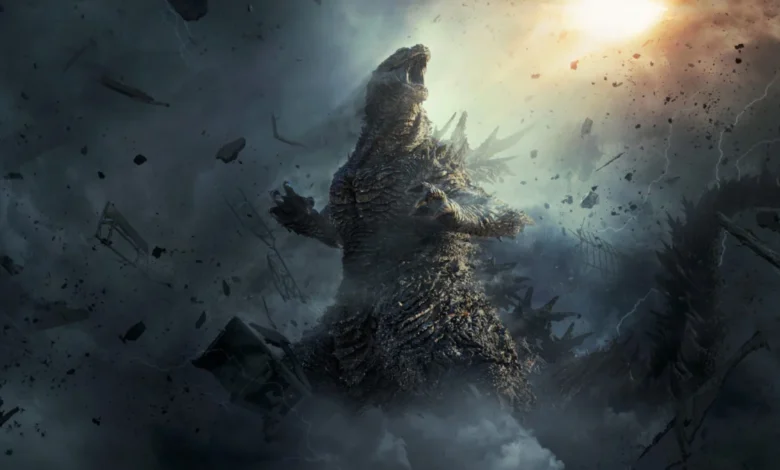
The North American box office is bracing for a seismic weekend as Toho’s critically acclaimed monster epic Godzilla Minus Zero prepares to trample the competition. Industry tracking indicates that the Kaiju sequel is on a definitive trajectory to capture the number-one spot, targeting a robust $30 million opening weekend across 3,254 domestic venues. This formidable debut outpaces a diverse slate of newcomers, establishing an early autumn battleground that highlights shifting theatrical strategies across major studios, specialty distributors, and international players alike.
The cultural and financial momentum propelling Godzilla Minus Zero is heavily tied to the unprecedented domestic and international success of its predecessor. Released in late 2023, Godzilla Minus One defied expectations by pulling in $11.4 million during its opening weekend in the United States. Benefiting from overwhelmingly positive word-of-mouth, an absence of heavy studio competition during the dual Hollywood actors’ and writers’ strikes, and exceptional audience retention, that sci-fi epic ultimately clawed its way to $57 million domestically. It secured its place in history as the highest-grossing live-action Japanese film in North America, capped off by a historic global haul of $113 million and an Academy Award win for Best Visual Effects.
Capitalizing on this goodwill, Godzilla Minus Zero aims to expand the franchise’s footprint by breaking new technological ground. Distributed in the U.S. by GKids, the film holds the distinction of being the first Japanese production ever specifically filmed for Imax presentation. Consequently, analysts project that the sequel will heavily overindex on premium large formats, driving higher average ticket prices and boosting overall box office yields.
Directed once again by Takashi Yamazaki, the narrative picks up two years after the events of the previous film. In this post-war Japanese setting, Godzilla undergoes a terrifying regeneration and resurfaces, forcing authorities and civilians alike to confront a lethal new monster tormenting the recovering nation. Owen Gleiberman, chief film critic for Variety, praised the film as an "even grander follow-up to ‘Godzilla Minus One,’" solidifying the franchise’s critical prestige alongside its commercial dominance.
The Animation Race: The Cat in the Hat Targets Second Place
While Godzilla is expected to tower over the weekend, Warner Bros. Animation’s The Cat in the Hat aims to secure a strong second-place finish. The family film is tracking for an opening weekend between $20 million and $25 million from roughly 4,000 domestic theaters.
Despite its wide release footprint, these tracking figures suggest a softer launch compared to earlier theatrical adaptations of Dr. Seuss’s beloved literary works. Historical benchmarks, unadjusted for inflation, show that 2008’s Horton Hears a Who! opened at $45 million, 2012’s The Lorax debuted at $70 million, and 2018’s The Grinch dominated with a $67 million start. However, contemporary box office analysts note that the theatrical ecosystem has undergone structural transformations in the post-pandemic era.
Studio executives are likely looking at the trajectory of Sony’s 2024 animated adventure Garfield as a more realistic blueprint. Garfield opened to a modest $23 million domestically but leveraged strong family appeal and international markets to leg out to $91 million domestically and $257 million globally.
The Cat in the Hat enters the marketplace with several strategic advantages. Notably, the family demographic has remained largely underserved since the September release of the animated feature Forgotten Island. Furthermore, the film will enjoy a clear runway with no direct animated competition until Walt Disney Animation Studios releases its original feature Hexed on November 25.
The film operates on a substantial $92 million production budget, necessitating robust international receipts and strong word-of-mouth to achieve long-term profitability, particularly given that theater exhibitors typically retain roughly 50% of domestic ticket sales. Directed by Alessandro Carloni and Erica Rivinoja, the animated adaptation features Bill Hader providing the voice of the mischievous, hat-wearing feline who arrives to cheer up two siblings navigating the challenges of moving to a new town. This project marks the second major feature adaptation of the classic book, following Universal and Imagine Entertainment’s 2003 live-action comedy starring Mike Myers. That iteration opened to $38 million and finished its run with $134 million globally against a production budget exceeding $100 million, a performance considered underwhelming at the time.
Targeting Mature Audiences: Wild Horse Nine Enters the Fray
At the opposite end of the demographic spectrum, Searchlight Pictures is rolling out the dark buddy comedy Wild Horse Nine. Directed by acclaimed filmmaker Martin McDonagh and starring cinematic heavyweights John Malkovich and Sam Rockwell, the film is targeting an opening of $5 million to $7 million.
Searchlight has opted for an initial footprint of approximately 1,000 screens, representing a significantly wider launch strategy than McDonagh’s previous feature, 2022’s The Banshees of Inisherin. That film initially debuted in limited release before expanding into a slow-burn box office success, ultimately accumulating $10.5 million domestically and $50 million worldwide while earning multiple Academy Award nominations. Wild Horse Nine hopes to replicate that awards-season trajectory. Set against a volatile historical backdrop, the narrative follows two CIA operatives, played by Malkovich and Rockwell, who are dispatched from Santiago to Easter Island shortly before the outbreak of the Chilean military coup.
The film’s performance will serve as another crucial bellwether for the specialty box office, a sector that has experienced uneven theatrical recovery as older, prestige-leaning audiences return selectively to brick-and-mortar cinemas.
International Expansion: Ramayana: Rise of a Legend Makes History
Rounding out the weekend’s diverse theatrical newcomers is the monumental Indian epic Ramayana: Rise of a Legend, distributed by Sony Pictures. The film is projected to gross approximately $6 million during its initial four-day opening frame.
This projected yield aligns closely with the performance of recent Telugu-language and pan-Indian fantasy blockbusters in North America, including Kalki 2898 AD ($5.6 million), Devara Part 1 ($5.6 million), and Pushpa: The Rule – Part 2 ($5 million), all of which debuted in 2024 and exhibited varying degrees of box office longevity through specialized community-driven viewings.
Significantly, Sony is distributing Ramayana: Rise of a Legend across 1,300 North American theaters. This milestone represents the widest domestic release ever granted to an Indian motion picture, underscoring the increasing mainstream viability and institutional distribution support for South Asian cinema in Western territories.
Broader Industry Implications
The convergence of Godzilla Minus Zero, The Cat in the Hat, Wild Horse Nine, and Ramayana: Rise of a Legend illustrates a healthy diversification within the contemporary theatrical marketplace. Rather than relying on a single dominant demographic, theater owners are leaning into a multi-quadrant strategy that caters concurrently to franchise action enthusiasts, families, prestige cinema patrons, and culturally diverse audiences.
As Hollywood navigates the final quarters of the fiscal year, the opening weekend results will provide critical data regarding premium large-format demand, the elasticity of family-friendly animation budgets, and the viability of mid-tier prestige releases in an increasingly crowded entertainment landscape. With Godzilla Minus Zero poised to lead the charge, the weekend underscores that cinematic spectacle and targeted audience engagement remain the primary engines driving box office recovery.