The landscape of modern cinema is frequently defined by the transformative power of its leading actors, yet few performers have navigated the complexities of biographical portrayal with the consistency and acclaim of Helen Mirren. Throughout a career spanning over five decades, Mirren has breathed life into historical figures ranging from monarchs to philosophers. However, her latest turn as the legendary thriller author Patricia Highsmith in Anton Corbijn’s upcoming film A Talent for Murder represents a significant departure from her previous work, testing the boundaries of her craft in ways she describes as uniquely taxing.
Speaking at The Hollywood Reporter’s Studio at the 1 Hotel during the Toronto International Film Festival (TIFF), Mirren candidly addressed the psychological toll of inhabiting the late author. While her resume includes icons such as Queen Elizabeth II, Golda Meir, and Catherine the Great, Mirren suggests that Highsmith—the creative force behind The Talented Mr. Ripley—presented an unprecedented hurdle due to their stark personality differences.
The Anatomy of a Challenging Portrayal
For an actor renowned for her ability to project authority, elegance, and measured stoicism, the characterization of Patricia Highsmith required a shift into much darker territory. Highsmith, particularly during her final years in Switzerland, was characterized by an abrasive, reclusive, and deeply troubled disposition. Mirren noted that while she could find common ground with historical titans like the Queen, identifying with Highsmith’s internal landscape proved to be a formidable exercise.
“I would say Patricia might be one of them, honestly, because she is so different from how I am,” Mirren remarked during the TIFF event. “I could sort of identify with Her Majesty, the Queen, to a certain extent. Golda Meir—on the realm of difficulty, I would say Queen, Golda, and Patricia Highsmith probably is the most difficult because of the way she is portrayed in the film. I suspect the way she was at the end of her life. She was very, very abrasive, very reclusive, and, you know, basically, very fucked up.”
This admission highlights the dichotomy between the actor’s public persona and the grit required to capture a literary figure whose own life was marked by cynicism and deep-seated misanthropy. The film aims to capture this specific, late-life period, focusing on a version of Highsmith that is far removed from the polished historical figures Mirren has historically mastered.
A Career Built on Historical Reincarnation
Mirren’s filmography serves as a masterclass in biographical acting. Her approach to these roles has consistently balanced the physical mimicry required to satisfy an audience’s recognition with the internal emotional truth of the subject. Her notable portfolio includes:
- Elizabeth II: The Queen (2006) – A role that earned her the Academy Award for Best Actress and set a new standard for portraying living historical figures.
- Maria Altmann: Woman in Gold (2015) – A nuanced performance centered on the legal and emotional battle for Nazi-looted art.
- Golda Meir: Golda (2023) – A demanding role requiring extensive prosthetics and an immersion into the high-stakes political environment of the Yom Kippur War.
- Ayn Rand: The Passion of Ayn Rand (1999) – A portrayal that captured the intellectual intensity of the controversial philosopher.
- Elizabeth I: Elizabeth I (2005) – An HBO miniseries that showcased her ability to command screen presence in period drama.
- Alma Reville: Hitchcock (2012) – A subtle, essential performance as the creative partner to her legendary husband.
Mirren has previously articulated her philosophy regarding this specific discipline. In a 2015 interview with The Hollywood Reporter, she emphasized that while the external requirements—such as gait, speech patterns, and mannerisms—are essential for credibility, the foundational work is indistinguishable from the construction of a fictional character. “The essential journey is exactly the same, really, as with a fictional character, which is a journey of imagination and the journey of telling the story,” Mirren noted.
The Production and Narrative Arc of A Talent for Murder
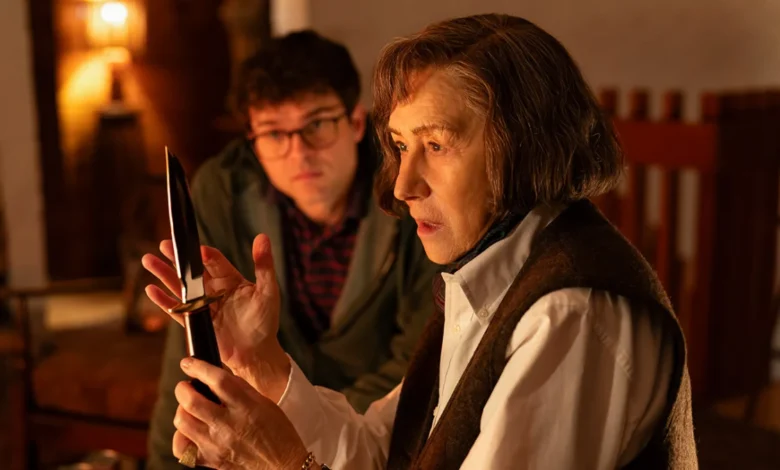
Directed by the visionary Dutch photographer and filmmaker Anton Corbijn, A Talent for Murder is an adaptation of Joanna Murray-Smith’s 2014 stage play, Switzerland. The narrative serves as a psychological cat-and-mouse game set in the isolated landscape of Switzerland.
The plot centers on a young, ambitious man, played by Alden Ehrenreich, who is dispatched to the author’s home by her New York publisher. His mission is a high-stakes ultimatum: he must convince the famously reclusive Highsmith to write one final installment in her celebrated Ripley series. The film also features performances by Olivia Cooke and Juliet Stevenson, rounding out a cast that aims to navigate the claustrophobic tension of the original play.
The transition from stage to screen for Switzerland presents significant opportunities for cinematic exploration. The play was widely lauded for its sharp dialogue and its examination of the thin line between creator and creation. With Corbijn—known for his stylized, atmospheric visual language in films such as Control and A Most Wanted Man—at the helm, the film is expected to emphasize the desolate, cold beauty of the Swiss setting as a reflection of Highsmith’s inner psyche.
Implications for Biographical Cinema
The release of A Talent for Murder, scheduled for October 23, arrives at a time when biographical cinema is undergoing a period of intense scrutiny. Audiences and critics alike are increasingly focused on the ethics of representing real-life figures, particularly those whose private lives were marked by complexity or controversy.
Mirren’s perspective suggests a shift in how high-profile actors are engaging with the "biopic" genre. By moving away from the "heroic" or "monumental" figures that dominated mid-20th-century filmmaking, she is engaging with the darker, more human elements of figures who, like Highsmith, are not easily sanitized for mainstream audiences.
The analytical consensus on Mirren’s approach suggests that her commitment to "difficulty" is precisely what sustains her career longevity. By actively seeking out characters who challenge her personal morality and demeanor, she avoids the trap of repetition. In the case of Highsmith, the challenge is not just technical; it is a test of empathy for a character who, by most accounts, actively rejected it.
The Cultural Legacy of Patricia Highsmith
Patricia Highsmith remains one of the most significant figures in 20th-century literature. Her work, characterized by moral ambiguity and psychological suspense, redefined the crime genre. However, her reputation was often marred by her personal life, which was characterized by volatility and an often-contentious relationship with her peers.
By centering a film on her final years, the production team behind A Talent for Murder is choosing to lean into the legend of the author rather than providing a sanitized summary of her bibliography. For Mirren, this is an opportunity to explore the burden of genius and the isolation that often accompanies a life spent in the pursuit of dark narratives.
As the industry prepares for the October 23 release, the focus remains on whether this portrayal will redefine how the public views the intersection of Mirren’s established talent and Highsmith’s complex literary legacy. If the early reactions from the festival circuit are any indication, the collaboration between Mirren and Corbijn is poised to be one of the most discussed performances of the year, further cementing Mirren’s status as a transformative force in the craft of acting.
The convergence of a high-caliber cast, an acclaimed director, and a source material that demands psychological depth suggests that A Talent for Murder will not merely be a retrospective of Highsmith’s life, but a tense, character-driven thriller that challenges the audience’s perceptions of one of literature’s most enigmatic figures. Whether or not it stands as the most difficult role of Mirren’s career, it is undoubtedly a capstone in a long, storied trajectory of bringing the most complex real-life figures to the screen.