For decades, the standard narrative of an Alaska vacation followed a familiar script: massive cruise ships docked at coastal hubs, discharging millions of visitors into commercial districts largely owned and operated by outside entities. While travelers marveled at the staggering glaciers, breaching humpbacks, and snow-capped peaks of the Last Frontier, the Indigenous communities whose ancestral stewards cared for these lands for millennia frequently found themselves pushed to the margins of the state’s lucrative tourism economy.
Today, that paradigm is undergoing a profound structural transformation. Across Alaska, Native corporations established under federal legislation are no longer content with merely acting as cultural backdrops for cruise lines and tour operators. Instead, they are acquiring, building, and operating the very infrastructure of tourism—from cruise ports and passenger terminals to motorcoach lines, wilderness lodges, and cultural centers. This paradigm shift ensures that economic benefits remain anchored within local communities while giving Indigenous peoples complete autonomy over how their histories and cultures are presented to the world.
The Roots of Self-Determination: The Alaska Native Claims Settlement Act
To understand the modern landscape of Indigenous-led tourism in Alaska, one must examine the foundational legislation that made it possible. In 1971, the United States Congress passed the Alaska Native Claims Settlement Act (ANCSA), a landmark law designed to resolve long-standing land claims by Alaska Natives. Under ANCSA, Congress transferred nearly 44 million acres of land to Alaska Native ownership and authorized the creation of more than 200 village and regional for-profit corporations.

These corporations—owned entirely by Alaska Native shareholders—were charged with managing their lands and financial assets to secure long-term economic stability and cultural preservation for future generations. While many corporations initially focused on natural resource extraction, such as timber, mining, and fisheries, a growing number have recognized tourism as a sustainable, community-driven economic engine. By leveraging their ancestral lands, rich cultural heritage, and strategic business investments, corporations like the Huna Totem Corporation and Doyon, Limited are building a vertically integrated tourism corridor that stretches from coastal ports deep into the continental Interior.
Reclaiming the Coast: The Rise of Indigenous-Owned Ports and Terminals
The transformation of Alaska’s maritime tourism is perhaps most visible in Southeast Alaska, where historical erasure is actively being countered by physical and cultural reclamation. In downtown Juneau, where over a million cruise passengers disembark annually between April and October, visible markers of Indigenous history were once remarkably scarce.
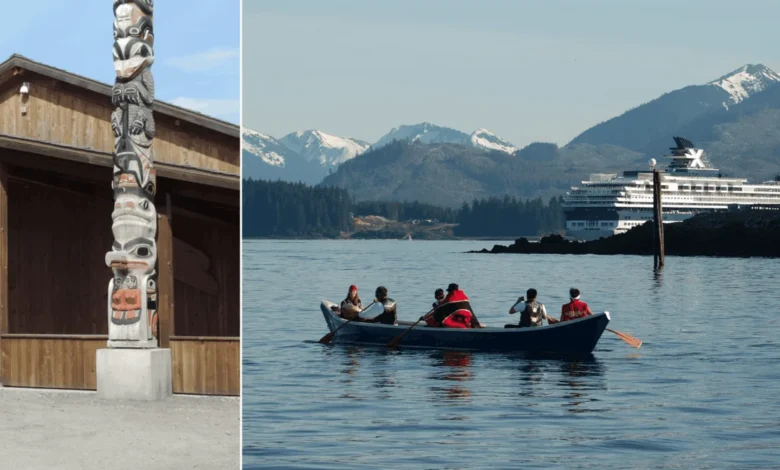
That began to shift in 2023 with the introduction of Kootéeyaa Deiyí (Totem Pole Trail), a city-wide project spearheaded by the Sealaska Heritage Institute (SHI). The trail features intricately carved totem poles representing the Tlingit, Haida, and Tsimshian peoples who have inhabited the region for millennia. Among them stands the Kaagwaantaan Kootéeyaaéyaa pole, detailing the crests of the Kaagwaantaan Tlingit clan. For Ricardo Worl of SHI, the trail serves as a vital physical assertion of presence. "This is an opportunity to reestablish our presence on our ancestral lands," Worl explains, viewing the initiative as an essential starting point for educating visitors about authentic Indigenous history.
Building upon this momentum, village corporations are taking direct ownership of maritime infrastructure. Huna Totem Corporation, a Tlingit village corporation representing shareholders with ties to Hoonah and Glacier Bay, created Icy Strait Point in Hoonah in 2004. Recognized as Alaska’s first private cruise destination, Icy Strait Point has become the gold standard for Native-owned tourism.

Operating on a model explicitly designed to balance economic viability with cultural preservation, Icy Strait Point features two cruise ship piers situated a half-mile apart to distribute visitor flow evenly. The site incorporates forested walking trails, two gondola systems leading to the summit of Hoonah Mountain, and the historic 1912 salmon cannery—once a haunting symbol of economic loss following the decline of the commercial fishing sector—which has been meticulously transformed into a museum, retail space, and cultural hub.
According to Ruth Banaszak, director of marketing and communications for Huna Totem, the initiative was conceived to ensure generational economic stability. "We hire around 350 people for the season," Banaszak notes. "So, in a town of 950, anybody who wants to have a job in the community has one." Furthermore, the development has empowered local residents to launch independent enterprises, such as marine wildlife tours to Point Adolphus, where visitors regularly encounter orcas, humpback whales, sea lions, and sea otters.
Expanding the Network: Strategic Partnerships and Regional Growth
Buoyed by the success in Hoonah, Huna Totem has begun exporting its community-centric business model to other rural regions of Alaska, often forming strategic alliances with other Native corporations.
In 2024, Huna Totem opened the Glacier Gateway cruise terminal in Whittier, significantly expanding its footprint in Southcentral Alaska. In the same year, Huna Totem joined forces with Doyon, Limited—the regional Native corporation for Interior Alaska—and the local Klawock Heenya Corporation to open a new single-ship cruise port on Klawock Island, located on Prince of Wales Island. Designed around Tlingit cultural values and local community involvement, the Klawock Island development ensures that economic yields return directly to the island’s residents.

Additionally, Huna Totem and Doyon have jointly acquired key operational assets, including Portage Glacier Cruises and Alaska Coach Tours. These acquisitions establish seamless, Native-owned touchpoints that accompany travelers from the moment they step off a cruise ship until they board a motorcoach for inland excursions.
Looking ahead to 2028, Huna Totem is spearheading the development of ꟹakʼw Landing in downtown Juneau. Slated for its first full season in 2028, the waterfront project is engineered to streamline passenger flow—eliminating the need for traditional tender boats at the site—while integrating prominent cultural elements, including two monumental totem poles commissioned through the Sealaska Heritage Institute.
Bridging Coast and Interior: Doyon, Limited and the Wilderness Experience
While maritime tourism dominates the state’s visitor statistics, Interior Alaska offers a vastly different landscape of vast wilderness, boreal forests, and sub-arctic expanses. Doyon, Limited, headquartered in Fairbanks and representing the predominantly Dene people of the Interior, might seem an unlikely participant in the cruise-driven tourism sector. However, commercial realities dictated a proactive approach.
"More than 60% of visitors come to Alaska by cruise," explains Jordan Sanford, president of Doyon Tourism. "If we wanted to grow, we needed to be involved."

Doyon’s tourism strategy bridges the coastal cruise market with remote wilderness lodges. For three decades, Doyon has operated Kantishna Roadhouse deep within Denali National Park, making it the park’s sole Indigenous-owned lodge. Accessible primarily via a brief bush plane flight—pending the anticipated 2027 reopening of park road access following a major landslide—the lodge offers immersive backcountry experiences free from cellular connectivity. Evenings at Kantishna feature cultural programming, including presentations on traditional Dene beadwork, regalia, and storytelling, framed against the backdrop of North America’s tallest peak, Denali.
Since 2004, Doyon has also partnered with Aramark to operate official park bus tours, transit services, and campgrounds within Denali National Park. This collaborative approach allows Doyon to capitalize on shifting consumer preferences. According to Sanford, contemporary travelers are increasingly seeking authentic, values-driven experiences rather than generic, mass-market packaged tours. "We put shareholders to work, and they share their culture," Sanford notes, contrasting Indigenous stewardship with decades of historical tourism operated exclusively by non-Native entities.
Future Horizons: The Northern Lights and the Vision of a Native-Owned Corridor
Doyon’s upcoming developments continue to target critical gaps in Alaska’s seasonal tourism infrastructure. The corporation is currently leading the restoration of the historic 1925 Chatanika Gold Camp near Fairbanks, scheduled to open in 2027 as an advanced northern lights viewing and cultural experience center. Historically, aurora borealis tourism in the region has been an unmanaged, ad-hoc affair characterized by tourists pulling off highway shoulders. The Chatanika project aims to formalize this market by providing robust cultural programming, heated shelters, and educational contexts that elevate aurora viewing into a holistic cultural exchange.
Ultimately, these interconnected ventures point toward an ambitious long-term vision shared by Alaska Native corporate leaders: the creation of a continuous, Native-owned travel corridor across the state. In this envisioned ecosystem, a traveler’s entire itinerary—from embarking at a Native-owned port, riding on a Native-owned motorcoach, exploring a Native-owned wilderness excursion, to resting at a Native-owned lodge—is managed by the people whose ancestors have inhabited the landscape for millennia.

For the tourism industry, this trend signals a definitive maturation of the Alaskan market. For Alaska Native corporations, it represents the reclamation of economic sovereignty and the ultimate realization of self-determination, ensuring that the stories of the Last Frontier are told by the people who know them best.