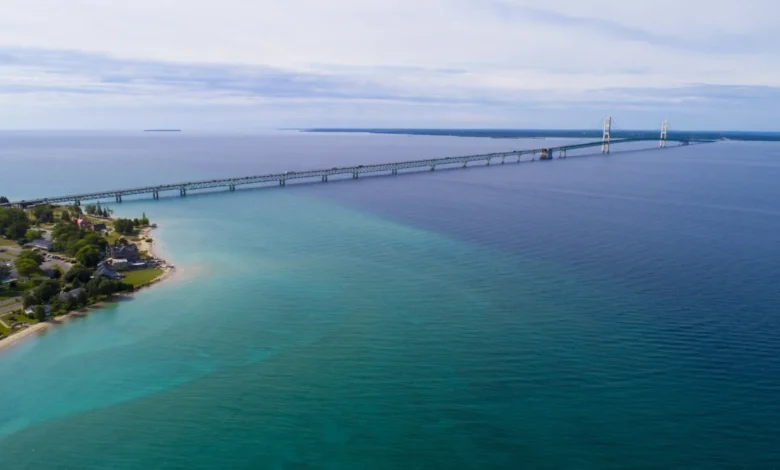
In a significant escalation of the long-standing regulatory battle over the aging Line 5 pipeline, Michigan Governor Gretchen Whitmer announced on Tuesday a formal pause on all pending and issued state permits for Enbridge Energy’s controversial proposal to bury a new pipeline segment in a tunnel beneath the Straits of Mackinac. The move, which effectively halts progress on the multi-billion-dollar infrastructure project, arrives as state regulators grapple with the legal implications of a recent Michigan Supreme Court ruling that criticized the scope of previous environmental reviews.
The decision places the future of the Straits of Mackinac tunnel project in severe doubt, forcing a comprehensive reassessment of how state agencies, specifically the Michigan Department of Environment, Great Lakes and Energy (EGLE), evaluate the potential ecological impacts of industrial projects on the Great Lakes. Governor Whitmer, whose second and final term concludes on January 1, framed the decision as a necessary exercise in administrative diligence, emphasizing that her administration’s commitment to protecting the Great Lakes remains the primary driver of state policy.
A Legal and Regulatory Turning Point
The catalyst for this sudden regulatory freeze was a Michigan Supreme Court decision rendered earlier this summer. In that ruling, the court invalidated a permit previously granted by a separate state agency, determining that the state had failed to conduct a sufficiently broad analysis of the potential environmental consequences of the tunnel project. The justices argued that the review process was too narrow, failing to adequately account for the cumulative risks posed to the sensitive ecosystems of the Straits, where Lake Michigan and Lake Huron converge.
Governor Whitmer noted that the pause is not merely a political gesture but a procedural requirement to ensure that EGLE’s evaluation process withstands future judicial scrutiny. By stopping the permitting process, the administration is compelling regulators to broaden their scope, potentially forcing Enbridge to provide significantly more data on spill prevention, climate impact, and the long-term viability of the tunnel design.
Historical Context: The Life and Controversy of Line 5
Line 5, an essential artery for energy transport across North America, has been operational since 1954. Spanning 645 miles, the pipeline carries approximately 22 million gallons of oil and natural gas liquids daily between Ontario and Wisconsin. The four-mile section that traverses the Straits of Mackinac is widely considered the most ecologically sensitive portion of the entire route.
The Straits serve as a critical habitat for diverse flora and fauna, and the region holds profound cultural and spiritual significance for the Anishinaabe peoples. For these Indigenous communities, the Straits are a central feature of their creation stories and serve as a protected ancestral burial ground. The persistent threat of a pipeline rupture in these waters has galvanized a coalition of tribal nations, environmental activists, and local residents who argue that the risk of a catastrophic spill outweighs the economic benefits of the energy flow.
A Chronology of Conflict
The struggle over Line 5 has been characterized by nearly a decade of litigation, protests, and legislative maneuvering:
- 1954: Enbridge Energy commences operations of the original dual-pipeline segment across the Straits of Mackinac.
- 2017–2018: Public concern peaks following reports of anchor strikes and visible damage to the pipeline’s protective coating, leading to increased calls for a shutdown.
- 2018: The state of Michigan and Enbridge sign an agreement to pursue the construction of a concrete tunnel beneath the lakebed to house a replacement pipeline, intended to mitigate spill risks.
- 2020: Governor Whitmer officially moves to revoke the 1953 easement that allows the pipeline to sit on the lakebed, setting the stage for a protracted legal battle.
- 2023–2024: Federal agencies, including the U.S. Army Corps of Engineers, grant preliminary approvals for the tunnel, despite ongoing state-level legal challenges.
- Summer 2024: The Michigan Supreme Court rules that state permit reviews were insufficient, setting the stage for the current administrative pause.
- Late 2024: Governor Whitmer announces the indefinite suspension of state permits to allow for a comprehensive environmental review.
Enbridge’s Stance and the Economic Debate
Enbridge Energy maintains that the current pipeline is safe and that the tunnel project represents the most modern, secure solution for energy transportation in the region. Ryan Duffy, a spokesperson for the company, emphasized that the tunnel would effectively eliminate the risk of an anchor strike or a leak into the open waters of the Great Lakes.
“Line 5 delivers the energy people depend on every day,” Duffy stated in a recent press release. “At Enbridge, we remain committed to that purpose and equally committed to safeguarding the Great Lakes.” The company argues that the permit pause is an unnecessary bureaucratic delay that threatens regional energy security, particularly as the Upper Midwest remains heavily reliant on the pipeline for propane and heating fuels during the harsh winter months.
However, critics suggest that Enbridge’s focus on the tunnel is a distraction from the larger, underlying issue of the nation’s reliance on fossil fuel infrastructure. Data from various environmental impact assessments suggests that a significant leak in the Straits could affect hundreds of miles of shoreline, causing irreparable damage to the tourism and commercial fishing industries that sustain the regional economy.
Tribal Sovereignty and Environmental Justice
The opposition to Line 5 is largely led by Michigan’s 12 federally recognized tribes. These nations argue that the pipeline violates treaty rights and endangers resources that are essential to their cultural survival. Legal counsel representing the Bay Mills Indian Community, the Sault Ste. Marie Tribe of Chippewa Indians, and the Little Traverse Bay Bands of Odawa Indians have welcomed the Governor’s pause as a victory for tribal sovereignty.
“No matter who the governor is, it’s in all of our interests to keep the Great Lakes free of oil and to transition away from Line 5,” said Laura Berglan, a senior attorney at Earthjustice. The coalition of tribes maintains that the environmental impact statements provided by Enbridge have consistently downplayed the threat of a rupture, particularly regarding the unpredictable currents of the Straits, which are among the most complex in the Great Lakes system.
Broader Implications and Future Outlook
The decision to freeze permits has far-reaching implications for energy policy in the Great Lakes region. By demanding a higher threshold for environmental accountability, the Whitmer administration is setting a precedent that may influence how future industrial projects are permitted in Michigan.
Furthermore, the timing of the announcement—coinciding with a recent 1.3-million-gallon spill on a separate segment of Line 5 in Wisconsin—has provided political ammunition to those who argue that the pipeline’s aging infrastructure is inherently prone to failure. The Wisconsin incident served as a stark reminder of the potential for human error and mechanical degradation, reinforcing the skepticism of environmental regulators.
As Governor-elect Jocelyn Benson prepares to transition into office, the issue of Line 5 remains a high-stakes legacy item. While the federal government has signaled its interest in the tunnel project, the state’s ability to block or regulate it through environmental permitting remains a powerful tool. Whether the project moves forward depends heavily on whether Enbridge can provide a level of scientific certainty that satisfies the increasingly rigorous requirements of Michigan’s environmental agencies.
Ultimately, the halt on the Line 5 tunnel permits is a reflection of a growing societal shift toward prioritizing environmental resilience over traditional industrial expansion. As the state moves toward a future defined by cleaner energy transitions, the battle over the Straits of Mackinac stands as a defining conflict between the economic demands of the past and the ecological imperatives of the future. The coming months will likely see further legal wrangling as Enbridge attempts to navigate these new regulatory hurdles, while environmental advocates continue to press for a full decommissioning of the pipeline.