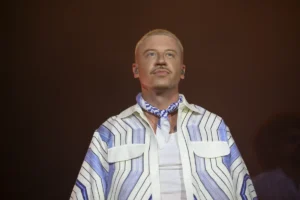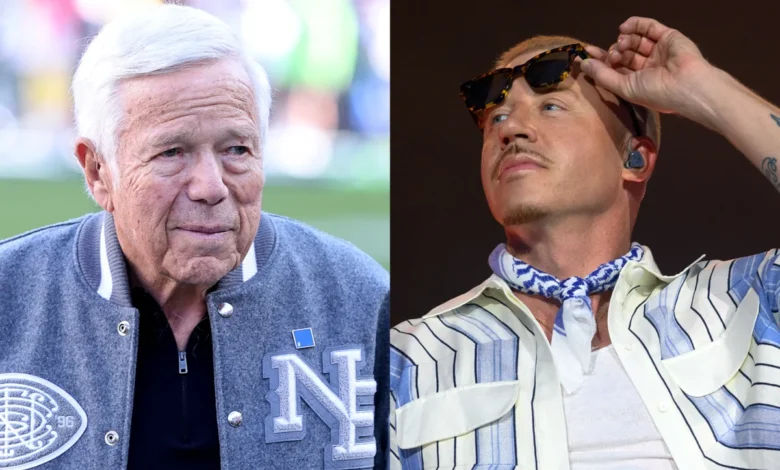
The intersection of major league entertainment, high-profile stadium ownership, and geopolitics has once again taken center stage following a high-stakes cultural clash between billionaire sports mogul Robert Kraft and Grammy-winning rapper Macklemore. New England Patriots owner and Gillette Stadium operator Robert Kraft has officially confirmed that he made the decisive call to bar the Seattle rapper from opening for pop superstar Ed Sheeran at his venue. The cancellation follows Macklemore’s vocal and visible expressions of solidarity with Palestinians, chants of “Free Palestine,” and performance of politically charged material during the initial legs of Sheeran’s sprawling tour.
The controversy has ignited a broader national debate regarding the boundaries of free speech in commercial entertainment spaces, the definitions and weaponization of antisemitism, and the immense leverage held by corporate venue owners in shaping the cultural landscape. What began as an artistic choice to include a prominent supporting act on a major stadium tour has rapidly transformed into a complex geopolitical flashpoint, exposing deep divisions within the entertainment industry over the ongoing Israel-Hamas conflict.
Roots of the Controversy: MetJersey Performances and Geopolitical Advocacy
The friction that ultimately led to Macklemore’s removal from the remainder of Ed Sheeran’s Loop tour began in early September, when the rapper joined the trek for a high-profile two-night stint at MetLife Stadium in East Rutherford, New Jersey. Stepping onto the massive stage before tens of thousands of fans, Macklemore did not shy away from addressing the devastating humanitarian crisis unfolding in Gaza and the occupied West Bank.
During the concert, the rapper explicitly shouted “Free Palestine,” displaying graphic images of the destruction resulting from Israel’s military campaign in Gaza. Furthermore, he performed his recent protest anthem, “Hind’s Hall,” a track explicitly written to honor pro-Palestinian student demonstrators at Columbia University and named after Hind Rajab, a six-year-old Palestinian girl killed in Gaza.
In addresses to the stadium crowds, Macklemore made his intentions clear, telling the audience that a primary motivation for joining the tour was the opportunity to utilize major stadium platforms to amplify his stance. He emphasized that he wanted his words to resonate globally, ensuring that populations from Gaza to the West Bank knew they were not forgotten by international observers.
However, these impassioned stage moments immediately drew sharp condemnation from various Jewish advocacy organizations and venue leadership, setting the stage for swift administrative retaliation.
Robert Kraft’s Defense and the Venue Safety Mandate
In a formal statement provided to media outlets, Robert Kraft defended his decision to block Macklemore from performing at Gillette Stadium. Kraft, who is Jewish and has maintained a decades-long record of philanthropy supporting Israel and Jewish causes, asserted that the rapper’s actions crossed a definitive line regarding hate speech and community safety.
Kraft stated that the decision was based on Macklemore’s recent stage rhetoric, the material shared during the New Jersey concerts, and a broader historical context. Specifically, Kraft alluded to a 2014 incident where Macklemore faced heavy criticism and accusations of antisemitism after wearing a costume featuring a prosthetic nose during a surprise performance in Seattle—an outfit critics argued played into harmful Jewish caricatures. While Macklemore issued an apology at the time, insisting the disguise was not intentionally antisemitic, the episode has continued to follow the artist.
Gillette Stadium management emphasized a strict operational policy aimed at ensuring all events hosted at the facility remain entirely free of hate speech, creating a welcoming and secure environment for all patrons. Kraft argued that allowing Macklemore to perform would violate these corporate safety and inclusivity standards.
Crucially, Kraft pushed back against suggestions that his actions constituted an attempt to silence advocacy for Palestinian civilians or minimize their suffering. He noted that he has personally directed financial resources toward Palestinian communities over many decades, funding athletic and entrepreneurial initiatives. Nevertheless, Kraft argued that advocacy for Palestinians must not come at the expense of the Jewish community or ignore the culpability of Hamas in the ongoing conflict. He maintained that standing in solidarity with Palestinian people should not be mutually exclusive with standing firmly against Hamas, antisemitism, and bigotry.
Macklemore’s Rebuttal and Tour-Wide Fallout
The fallout from the Gillette Stadium ban quickly extended beyond Foxborough, Massachusetts, resulting in Macklemore being dropped entirely from the remainder of Ed Sheeran’s tour. In response to the escalating situation, Macklemore released an extensive statement detailing the behind-the-scenes pressure exerted by venue executives.
According to the rapper, Robert Kraft personally contacted Ed Sheeran to inform him that Macklemore would not be permitted to perform within Gillette Stadium. Furthermore, Macklemore alleged that Kraft went a step further by coordinating with fellow venue owners to issue a collective ultimatum to the headlining artist: retain Macklemore on the tour, and face a complete lockout from major entertainment venues nationwide. While representatives for Kraft have not publicly addressed the specific allegation regarding a coordinated multi-venue ultimatum, the practical result remains unchanged—the rapper has been entirely removed from the tour roster.
In his public statements, Macklemore strongly rejected the categorization of his political speech as antisemitic. He argued that conflating legitimate criticism of the Israeli government, opposition to Zionism, or expressions of solidarity with Palestinians with hatred toward Jewish people ultimately undermines the fight against genuine antisemitism. According to the artist, deploying accusations of antisemitism to stifle political critique serves to shield the Israeli state from international accountability rather than protecting Jewish communities.
The Broader Implications for Live Entertainment and Geopolitical Discourse
The public clash between Robert Kraft and Macklemore underscores a profound structural shift in the live entertainment industry. As artists increasingly use stadium tours as platforms for global political commentary, venue owners—who bear legal, financial, and reputational responsibilities for the properties they control—are exercising unprecedented oversight regarding permissible speech.
Industry analysts note that this incident highlights the growing difficulty of separating high-stakes geopolitical conflicts from commercial entertainment. Stadiums, traditionally viewed as neutral spaces designed for escapism and mass entertainment, are increasingly becoming battlegrounds for ideological expression. Billionaire owners and corporate conglomerates are demonstrating an increasing willingness to draw hard lines, balancing contractual obligations to headlining acts against their own institutional values and donor relationships.
Furthermore, the controversy shines a spotlight on the precarious position of supporting acts in major concert tours. Unlike headliners who hold significant contractual leverage, opening acts are often uniquely vulnerable to the administrative decisions of venue operators who hold absolute authority over access to physical stages.
Looking Ahead: Calls for Dialogue and Unresolved Tensions
As the dust settles on the immediate touring controversy, both sides have articulated a desire for broader peace, though their pathways and rhetorical frameworks remain starkly divergent.
In the concluding remarks of his statement, Kraft expressed profound respect for Ed Sheeran, praising the British singer-songwriter’s unique capacity to unify diverse audiences through music. Additionally, Kraft extended an olive branch, stating that he would welcome an opportunity to sit down directly with Macklemore to discuss the facts surrounding the geopolitical conflict. Kraft emphasized that despite their current friction, their ultimate goals should align: peace for all peoples, the cessation of human suffering, and the elimination of hatred in all its forms.
Representatives for Macklemore have thus far declined to comment further on Kraft’s invitation for dialogue, leaving the immediate future of their private communication uncertain.
As geopolitical tensions continue to reverberate across cultural and athletic institutions worldwide, the confrontation between Robert Kraft and Macklemore serves as a watershed moment. It highlights the deepening complexities of free expression in the digital and live performance eras, proving that the modern stage is no longer insulated from the complex, volatile realities of international politics.