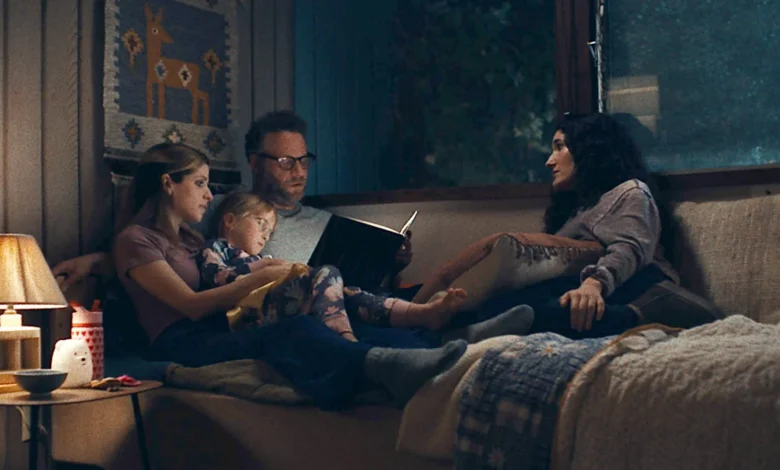
The release of the upcoming comedy-drama Babies, written and directed by Lauren Miller Rogen and starring Seth Rogen and Anna Kendrick, marks a significant moment in contemporary cinema’s exploration of the "child-free" lifestyle. Premiering to an attentive audience at the Toronto International Film Festival (TIFF) at the 1 Hotel, the film serves as a semi-autobiographical examination of the couple’s own decision-making process regarding family planning. By weaving together elements of personal grief, the complexities of modern marriage, and the social pressures placed on couples to reproduce, the project distinguishes itself as a rare, honest look at a life path that is increasingly common yet frequently stigmatized in popular culture.
The Genesis of a Personal Narrative
The conceptual roots of Babies date back approximately a decade, to a period when the Rogen household became a temporary sanctuary for a friend and her young child following the friend’s separation from her husband. This lived experience provided the initial spark for a narrative that Lauren Miller Rogen initially envisioned as a television series. However, the project remained in a state of development limbo for several years.
According to Miller Rogen, the primary obstacle to the film’s completion was the lack of a definitive conclusion to her own internal journey. The narrative required the emotional and intellectual resolution that only time could provide. "I didn’t know the ending at that point," she explained during a discussion at the TIFF Studio, presented by Canada Goose. "Once we had the kajillion conversations and done all the work and sort of found our own conclusion, then I was like, ‘Oh, now it’s a movie because I know the ending of it.’"
The production timeline was remarkably efficient once the script reached its final form. Miller Rogen penned the screenplay in January 2025, completing the draft by the spring, with principal photography commencing in the fall of that same year. This swift turnaround underscores the clarity of vision she achieved after years of contemplation.
Narrative Architecture and Character Dynamics
In the film, the protagonists, Annie and Aaron—whose names are derived from the middle names of Lauren and Seth—find their quiet, child-free life disrupted when a friend, played by Kate Berlant, moves in with her young daughter. This domestic shift forces the couple to confront the realities of parenthood in a visceral way, moving beyond theoretical discussions into the day-to-day chaos of raising a child.
Parallel to this domestic adjustment, the film delves into heavier emotional terrain. The character of Annie navigates the harrowing experience of her mother’s battle with Alzheimer’s disease. This plot point is profoundly rooted in reality; Lauren Miller Rogen lost her own mother to complications arising from early-onset Alzheimer’s in 2020. By intertwining the decision to remain child-free with the existential weight of familial illness, the film explores how trauma and legacy influence the desire—or lack thereof—to pass on one’s genes and nurture a new generation.
Anna Kendrick, who portrays the central character, noted the intensity of the performance. During the TIFF event, she admitted that the script’s proximity to Miller Rogen’s reality was striking. "I don’t know how she did it because some of it felt so close to reality and so intense," Kendrick observed. "I was like, ‘I think I’d be setting myself on fire on set.’"
Statistical Context and Societal Shifts
The subject matter of Babies arrives at a time when the decision to remain child-free is becoming a statistically significant phenomenon. According to data from the U.S. Census Bureau and various sociological studies, birth rates in many developed nations have been in a steady decline for the past decade. Factors contributing to this trend include rising costs of living, the prioritization of career stability, and a growing cultural acceptance of child-free living as a legitimate life choice rather than a deficiency.
Despite these trends, cultural pressure remains high. Seth Rogen pointed to the persistence of traditional nomenclature, such as the term "dad duty," which he characterizes as "obnoxious." Such terminology suggests that childcare is a task that must be endured or fulfilled as a chore rather than a natural extension of parenting. By challenging these linguistic tropes, the film seeks to unpack the underlying assumptions that society holds about what constitutes a "complete" or "successful" life.
"We hang out with our friends and their kids a lot," Seth Rogen stated. "An interesting perspective the film has is that you can like kids and be good with kids, and be very responsible people, and be in a very happy marriage, and tick every box that one would think you need to tick in order to be the perfect parent in many ways, and you could still just maybe not really want it."
Professional Implications and Artistic Bravery
The decision for a creator to turn the camera on their own life—particularly when that life involves such sensitive topics as family planning and grief—is inherently risky. Seth Rogen praised his wife’s bravery in the project, noting that while the film is undoubtedly a comedy, it functions as an honest mirror for the couple’s existence. "When I look at it, it’s shocking how personal it is, honestly, and about very personal things in our lives," he remarked.
This level of vulnerability is increasingly sought after by modern audiences who are growing weary of idealized, sanitized versions of family life on screen. By centering the film on a couple that is happy, responsible, and fulfilled without children, Babies offers a counter-narrative to the standard Hollywood trope where the resolution of a comedy inevitably leads to the protagonists having a baby.
Bridging the Divide
Despite the film’s focus on the child-free experience, both Lauren and Seth are careful to emphasize that the project is not intended to be a critique of parenthood itself. Rather, it is a nuanced look at the validity of different choices. Miller Rogen noted that she has many friends who have built "beautiful families" and that she and her husband share deep, rewarding relationships with those children.
"I think that it was about not just making [Babies] feel real and grounded to us, but also sort of honoring what we’ve witnessed so many times, and how beautiful that relationship is," she said. The film is intended to resonate with parents and non-parents alike, functioning as a bridge for conversations that are often ignored or mishandled in social settings.
Looking Toward the Release
As the film moves toward its 2027 theatrical release, the conversation surrounding it will likely center on its role in normalizing the dialogue around life choices. The film does not provide a definitive "right" or "wrong" answer to the question of whether to have children; instead, it provides a roadmap for how to reach one’s own conclusion.
By combining the comedic timing for which Seth Rogen is known with the sensitive, grounded writing of Lauren Miller Rogen, Babies stands to be a landmark film for a generation of viewers grappling with the same questions. The industry’s reception at TIFF suggests that the appetite for such authentic, human-centric storytelling is higher than ever. As the release date approaches, the film will likely serve as a primary touchstone for discussions regarding reproductive autonomy, the changing definitions of family, and the courage required to define one’s own path in a world that often demands conformity.