The evolution of a residence often mirrors the evolution of its inhabitant, a sentiment vividly captured in the latest architectural project of Suzanne McFayden. For the Jamaican-born writer, philanthropist, and prolific contemporary art collector, her newest home in Austin, Texas, represents more than a change of address; it signifies the commencement of what she calls her "third act." Following the graduation of her youngest child from college this past spring, McFayden has transitioned from the roles of daughter, student, wife, and mother into the reflective space of an empty-nester. This transition is articulated through a meticulously curated environment where beauty, resilience, family, and provocation intersect, creating a home that functions simultaneously as a sanctuary and a private gallery.

A Strategic Transition: From Brutalism to "Sleeping Beauty"
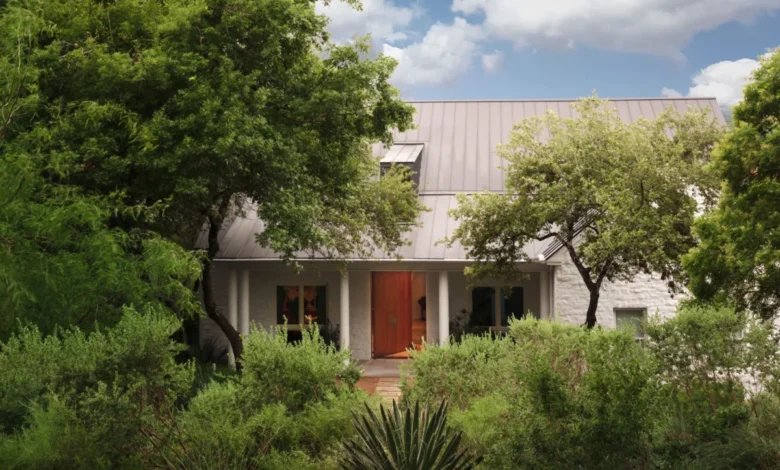
The chronology of McFayden’s residential history provides essential context for her current aesthetic choices. In 2020, her previous home—a 7,000-square-foot Brutalist concrete structure in Austin—gained international attention when it was featured by Architectural Digest. While that residence was an industrial monolith, her new home represents a pivot toward the "cozy and nourishing." Seeking a space that offered tranquility and ample wall surface for her expanding art collection, she discovered a property she describes as a "sleeping beauty," nestled within a lush thicket of Red Oak and Live Oak trees in Austin’s Hill Country.
To realize this vision, McFayden reunited with the creative team responsible for her previous industrial home: local architect Paul Lamb and New York City–based interior designer Jennifer Vaughn Miller. The challenge was to reconcile McFayden’s natural proclivity for minimalism with a desire for a space that felt layered, warm, and deeply personal.

The Architectural Philosophy: A Society of Rooms
Architect Paul Lamb approached the project by invoking the philosophy of the legendary 20th-century American architect Louis Kahn, who famously stated, "The room is the beginning of architecture." Rather than viewing the house as a singular external shell, Lamb and McFayden conceived of the home as a "society of rooms," where design is generated from the inside out. This approach ensured that each space remained autonomous yet harmonious, tailored to the specific artworks and emotional states they were intended to house.
The entrance sets a thematic tone for the entire residence. A five-foot-wide by ten-foot-tall front door features a custom pineapple doorknob crafted by local artisan Hawkeye Glenn. The pineapple, a traditional Jamaican symbol of hospitality, serves as a subtle nod to McFayden’s heritage. Beyond the threshold, the foyer—which Lamb refers to as the "Hall of Ancestors"—is finished in Domingue limewash paint, providing a soft, light-filled backdrop for a 2014 Senegalese tribal chair by Babacar Niang and a vintage Isamu Noguchi Akari light sculpture.

Curatorial Precision: Art as an Identity Narrative
McFayden’s collection is not merely a display of wealth but a compendium of soul-driven acquisitions that reflect her multi-layered identity as a Black woman, an immigrant, and a survivor. Her journey into serious collecting began in earnest at Art Basel in Switzerland in 2010. She notes that this was a transformative moment where she finally saw herself represented in the art world—a stark contrast to the Eurocentric art history courses she encountered during her studies at Cornell University.
The foyer showcases this narrative through prominent works such as Sanford Biggers’s Quilt 8 (The Cartographer’s Conundrum), which is layered over an 1850s antique textile, and Frida Orupabo’s pinned paper collage Woman Flying II / Birdy. These pieces are joined by Ayana V. Jackson’s pigment print Stella and beaded sculptural works by Nádia Taquary, creating a space that honors lineage and flight.

Spatial Chronology and Interior Detail
The interior design, led by Jennifer Vaughn Miller, was tasked with creating a "calming canvas" that would not compete with the bold, often provocative, artwork. The color palette was drawn directly from the surrounding Texas landscape, utilizing natural greens ranging from emerald to olive, complemented by ivory-colored custom rugs and warm textures like rose mohair and crimson velvet.
The Library: A Moody Retreat
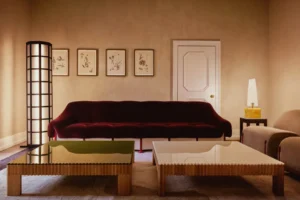
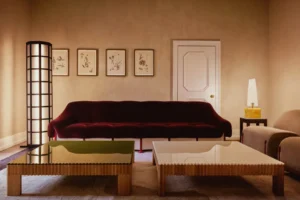
The library serves as a dramatic counterpoint to the airy foyer. Painted in Farrow & Ball’s Radicchio, the room is evocative of a classical lair, anchored by a crimson, low-slung Mario Bellini sofa for B&B Italia. A custom ebony bookcase towers over the space, featuring artwork by Didier William and Tschabalala Self. The room is illuminated by a floating pendant by Hervé Van der Straeten and a sculptural Crepuscule floor lamp by Material Lust, highlighting a vintage Jorge Zalszupin tea trolley.

The Media Room: Celebrating Black Joy
In the media room, McFayden requested a space that specifically represented "Black joy." Architect Paul Lamb responded with a custom black-on-black ceramic unit made of glazed terra-cotta wall tiles by Elgin Butler. This installation anchors works by Derrick Adams (Style Variation 12) and Simone Leigh (The Village Series #14). The furniture in this room, including a George Nakashima Slab oak burl coffee table and a Roche Bobois Apex ottoman, balances midcentury craftsmanship with contemporary forms.
The Primary Suite: Strength and Sensuality
The primary bedroom and its adjacent sitting area are designed for reflection. A nesting configuration of Roche Bobois Bubble sofas in ivory bouclé faces Elizabeth Catlett’s orange onyx sculpture, Nude Torso. McFayden describes the sculpture as "sexy, sassy, and strong," noting that the figure’s posture suggests a readiness for the challenges of a new day. This area also features a 1930s Gio Ponti ebonized walnut coffee table and walls finished in Farrow & Ball’s Wimborne White.

Supporting Data: The Rise of the Private "Museum-Home"
The McFayden residence reflects a broader trend in the high-end real estate and art markets: the integration of museum-grade curatorial standards into domestic spaces. According to recent market reports from Art Basel and UBS, private collectors are increasingly designing homes around their collections rather than fitting art into pre-existing rooms. This "architecture of the collection" requires specialized lighting, climate control, and spatial planning that mirrors professional gallery environments.
Furthermore, McFayden’s involvement as the former board chair of the Blanton Museum of Art and a trustee of the Studio Museum in Harlem places her at the center of a movement dedicated to elevating Black and diaspora artists. Her home serves as a physical manifestation of this advocacy, providing a platform for both established masters like Jean-Michel Basquiat and Ruth Asawa and contemporary voices like Naudline Pierre and Kwesi Botchway.

Professional Analysis: Implications for Contemporary Design
From a design perspective, the McFayden home challenges the traditional "white cube" gallery aesthetic. By utilizing deep reds, earthy clays (such as Benjamin Moore’s Onondaga Clay in the powder room), and textured cork walls in the kitchen, the design team demonstrates that high-value contemporary art can thrive in "moody" and "sultry" environments.
The use of "feeling" as a primary design metric—as suggested by Lamb’s statement that "feeling is first"—marks a shift away from the rigid syntaxes of modernism toward a more fluid, inclusive form of luxury. This is perhaps best exemplified in the guest bedroom, where Lorraine O’Grady’s The Fir-Palm hangs. The surreal photomontage, which merges Caribbean and New England flora, serves as a metaphor for McFayden’s own hybrid identity, suggesting that home is not just a place where one lives, but a place where one’s existence is validated.

Conclusion: The "Third Act" as a Cultural Statement
Suzanne McFayden’s Austin home is a testament to the power of intentional living. By surrounding herself with works that reflect her journey—from the "Hall of Ancestors" to the "wall of Black joy"—she has created a residence that is both a private retreat and a significant cultural statement. As an empty-nester entering her "third act," McFayden has utilized her space to redefine the concept of home, moving beyond a mere vessel for family life into a sophisticated environment of self-actualization and artistic preservation.
The project underscores a vital lesson in contemporary architecture: the most successful homes are those that do not merely house objects, but those that tell a coherent, evolving story of the human spirit. In the Hill Country of Austin, McFayden’s "sleeping beauty" has indeed awakened, providing a vibrant backdrop for whatever happens next in a life defined by beauty, resilience, and provocation.