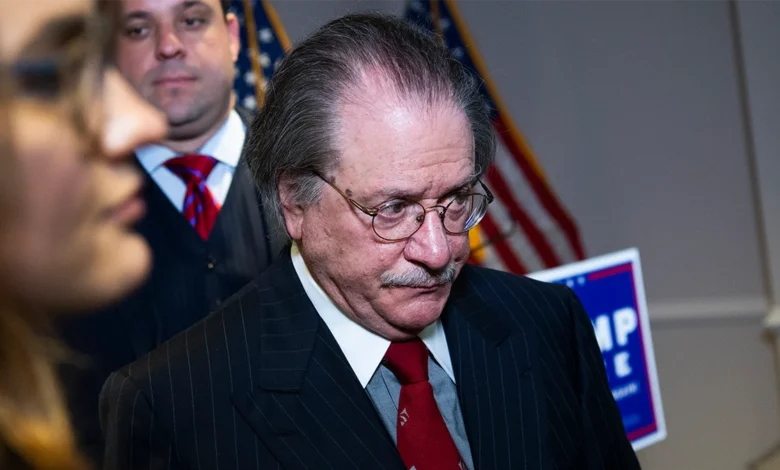
The departure of Joseph diGenova from his high-profile assignment within the Department of Justice marks a significant shift in the federal government’s ongoing efforts to probe the origins of the investigation into Russian interference in the 2016 presidential election. According to two sources familiar with the matter, diGenova—a veteran attorney and former U.S. Attorney for the District of Columbia—has officially stepped down from his role, a decision that concludes weeks of speculation regarding his influence and standing within the Trump administration and the upper echelons of the Justice Department.
The resignation, which was first reported by ABC News, arrives at a critical juncture for the Department of Justice as it navigates intense political pressure and internal scrutiny. While diGenova had been tapped to assist in the investigation into the so-called "Grand Conspiracy"—a theory suggesting that various actors within the intelligence community and the Obama-era Justice Department worked in concert to undermine Donald Trump’s candidacy and subsequent presidency—his tenure was reportedly marred by a gradual loss of confidence from key stakeholders.
The Erosion of Internal Support
The circumstances surrounding diGenova’s departure point to a disconnect between his investigative trajectory and the priorities of the Justice Department’s leadership. Sources close to the situation indicate that diGenova had been effectively sidelined long before his formal resignation was tendered. This period of diminished influence suggests that his specific approach to the investigation no longer aligned with the broader strategic objectives of the DOJ or the White House.
Historically, diGenova has been a vocal critic of the federal investigation into Russian interference, frequently appearing on cable news programs to argue that the inquiry was predicated on flawed intelligence and politically motivated actors. However, his transition from an external commentator to an internal investigator proved complex. Achieving the necessary clearance and maintaining the trust of institutional officials required a level of discretion and alignment that observers say was increasingly absent during his time at the department.
Chronology of a Controversial Assignment
The involvement of Joseph diGenova in the administration’s investigative efforts began with high expectations from the president’s legal team. To understand the gravity of his resignation, one must view it within the broader timeline of the Trump-Russia investigations:
- Mid-2016: Initial concerns regarding Russian interference in the electoral process lead to the opening of the FBI’s "Crossfire Hurricane" investigation.
- May 2017: Robert Mueller is appointed as Special Counsel to investigate potential coordination between the Trump campaign and Russian officials, as well as obstruction of justice.
- Early 2018: As the Special Counsel’s investigation gains momentum, the administration begins exploring independent avenues to investigate the investigators. diGenova is floated as a potential addition to the legal team, though a formal agreement was initially hindered by conflicts of interest.
- Mid-2018: diGenova begins his advisory role regarding the "Grand Conspiracy" investigation, operating within the Department of Justice framework.
- Late 2018–Early 2019: Reports emerge of internal friction between diGenova and Justice Department officials. His appearances on public media outlets become a point of contention for those who prefer a more low-profile investigation.
- Present Day: diGenova submits his resignation, officially ending his formal role within the Justice Department.
Supporting Data and Political Context
The investigation into the origins of the Russia probe is not a singular event but a collection of inquiries that have cost the federal government millions of dollars and occupied thousands of hours of staff time. According to public records, the Special Counsel’s office spent over $32 million by the time its final report was issued. The subsequent efforts by the administration to investigate the origins of that probe—often referred to as "investigating the investigators"—have similarly utilized significant resources, including the deployment of senior DOJ personnel and external legal counsel.
The political stakes are equally high. For the administration, the goal was to identify and expose perceived biases within the FBI and DOJ that could have led to the launch of the initial Russia investigation. Critics of this approach, however, maintain that such inquiries serve to undermine the independence of the Justice Department and intimidate career public servants. The departure of an investigator like diGenova highlights the difficulty of balancing these political objectives with the rigid, non-partisan protocols of federal law enforcement.
Official Responses and Institutional Silences
The Department of Justice has maintained a standard policy of not commenting on the specific employment status of individuals involved in ongoing sensitive investigations. When reached for comment, a department spokesperson declined to elaborate on the reasons for diGenova’s resignation, citing privacy and internal investigative protocols.
From the perspective of the White House, the resignation is being framed as a natural conclusion to a specific phase of the investigative process. Despite the private frustrations reportedly felt by administration officials, public statements have remained muted, emphasizing that the focus remains on the "pursuit of truth" regarding the origins of the Russia investigation.
Observers have noted that diGenova’s resignation is likely to be perceived differently across the political spectrum. His supporters may view his exit as a casualty of a "deep state" bureaucracy that is resistant to reform. Conversely, those who have been critical of the administration’s efforts to influence the Justice Department are likely to see his departure as a return to more traditional norms, wherein legal investigations are shielded from the direct political theater of television commentary.
Implications for Future Investigations
What does the exit of a key figure like diGenova mean for the future of these inquiries? Primarily, it suggests that the Department of Justice is tightening its grip on the investigative process. The transition from high-profile, politically connected investigators to more conventional, career-oriented personnel may signal a shift in how the government handles internal investigations.
Furthermore, this development highlights the persistent tension between the executive branch’s desire for political accountability and the judiciary’s demand for institutional integrity. The investigation into the "Grand Conspiracy" remains a polarizing issue, and diGenova’s resignation serves as a reminder that the personnel involved in such high-stakes matters are subject to the same institutional pressures that they are tasked with investigating.
The loss of an individual with diGenova’s experience and legal background will likely necessitate a reorganization of the current investigative team. Whether this leads to a new, more methodical phase of inquiry or a winding down of these specific efforts remains to be seen. As the Justice Department continues to navigate these complex waters, the public and the media will be watching closely to see if other personnel changes follow.
Analysis: The Weight of Institutional Credibility
The resignation of diGenova underscores a fundamental truth in Washington: the credibility of an investigation is inextricably linked to the perceived neutrality of the investigators. When an individual’s public commentary begins to overshadow their investigative work, the institutional risk to the Department of Justice increases significantly.
The "Grand Conspiracy" narrative, while potent in certain political circles, requires a level of forensic rigor that is difficult to sustain when the investigator is simultaneously a public face for the administration’s political grievances. By sidelining diGenova, the DOJ was essentially making a calculation that his presence had become a liability to the legitimacy of the investigation itself.
Looking forward, the Department of Justice will likely focus on quieter, more technical investigations that can withstand the scrutiny of the courts and the public. The era of high-profile, media-driven investigative assignments appears to be waning, replaced by a preference for traditional, internal administrative reviews.
As this story continues to develop, the focus will inevitably shift to who, if anyone, will replace diGenova, and whether the administration will continue to prioritize the "Grand Conspiracy" theory with the same intensity. For now, the departure of Joseph diGenova stands as a pivotal moment in the administration’s long-running efforts to recalibrate its relationship with the Department of Justice.
This is a developing story. As further details emerge regarding the circumstances of diGenova’s departure and the future of the investigative team, updates will be provided to ensure a comprehensive understanding of these events. The interplay between political strategy and federal law enforcement remains one of the most significant narratives in modern American government, and the resignation of such a prominent figure is a clear indication that this saga is far from over.