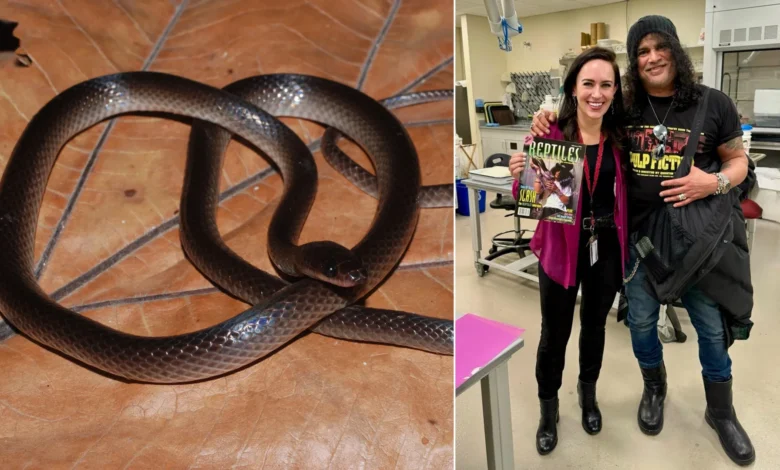
For decades, Saul Hudson—universally recognized by his stage moniker, Slash—has captivated global audiences as the iconic, top-hat-wearing lead guitarist of the hard rock band Guns N’ Roses. Known for electrifying guitar solos and an enduring presence in the annals of rock history, Hudson’s influence has long extended beyond the music industry. An avid, lifelong herpetophile, the musician has consistently advocated for zoos, natural history museums, and wildlife conservation. Now, that deeply rooted passion has culminated in an unexpected and prestigious scientific tribute: researchers have officially named a newly identified species of snake from the tropical forests of New Guinea Lielaphis slashi, commonly referred to as Slash’s groundsnake.
The formal description of the species, published in the peer-reviewed scientific journal Zootaxa, represents the intersection of childhood admiration, rigorous fieldwork, and advanced genetic analysis. For the scientists behind the discovery, bestowing the legendary guitarist’s name upon the creature bridges a personal love for rock music with a lifelong dedication to herpetology.
A Childhood Inspiration and a Scientific Tribute
The path toward naming a newly discovered reptile after a rock star began decades ago in the mind of Dr. Sara Ruane, the Field Museum’s Associate Curator of Herpetology and the senior author of the descriptive research paper. Ruane recalls that Guns N’ Roses was a staple of her musical diet starting in the first grade. By the time she reached fifth grade, she had already informed her teacher of her lifelong ambition to become a herpetologist—a scientist specializing in the study of reptiles and amphibians.
That professional trajectory was further galvanized at age twelve when Ruane opened an issue of Reptiles Magazine to find Slash featured on the cover, cradling his pet reticulated python.
"I thought, ‘This guy is so cool,’" Ruane remembers. Years later, as a professional scientist with the authority to name newly documented species, she revisited that foundational interview. In the article, Hudson spoke candidly about his profound appreciation for natural history museums, his childhood excursions searching for local snakes, and his enduring fascination with reptiles. Recognizing these shared passions, Ruane determined that the legendary musician would be an ideal namesake for an undiscovered reptile species.
The opportunity materialized following the analysis of a 28-inch-long, reddish-brown snake specimen harvested from the dense, biodiverse forests of New Guinea. Upon learning of the honor, Hudson expressed profound gratitude.
"As a long-time herpetophile, I am extremely honored and humbled to have Lielaphis slashi from New Guinea named after me," Hudson said. "It is really exciting, I never would have imagined this moment would arrive."
Fieldwork in the Depths of New Guinea
The journey of the physical specimen began nearly two decades prior to its formal classification. New Guinea, situated just north of Australia, holds the designation of the world’s second-largest island, surpassed in landmass only by Greenland. Divided politically between the nation of Indonesia and Papua New Guinea, the island boasts an extraordinarily rich ecosystem characterized by vast tropical rainforests and unparalleled biological diversity, much of which remains scientifically undocumented.
In 2006, during nocturnal field research in these remote habitats, Dr. Chris Austin—a professor and curator of herpetology at the Louisiana State University Museum of Natural Science—encountered an unfamiliar snake. Recognizing that many of the island’s groundsnakes are strictly nocturnal, Austin conducted his searches strategically.
"These New Guinea groundsnakes are nocturnal, so the best way to find them is at night," explained Austin, a co-author of the Zootaxa study. "They are typically found just after sunset at the base of large trees where they are looking for something to eat. When working at night in New Guinea, you need to be very careful as there are several highly venomous species that look very similar to the non-venomous groundsnakes."
The discovery initiated a long-term scientific collaboration. Following the completion of her doctoral studies, Ruane worked alongside Austin at Louisiana State University in 2016. The two researchers united their expertise to examine the poorly understood taxonomy of New Guinea’s serpentine fauna, laying the groundwork for the eventual identification of the new species.
Cutting-Edge Genetics and Physical Taxonomy
At first glance, the collected specimen did not immediately stand out as an entirely novel discovery. Morphological assessments alone often fail to capture the nuanced divergences within tropical snake populations, necessitating advanced laboratory methodologies to confirm species boundaries.
Tianqi Huang, a post-doctoral researcher at the Field Museum working alongside Ruane and the study’s first author, spearheaded the genetic investigations.
"Using multiple cutting-edge genetic analyses, we found that L. slashi is genetically distinct from other similar snakes in the same genus," Huang stated. "The combination of physical characteristics, like differences in numbers of scales when compared with other species, and the genetic evidence is what led us to realize that it is an entirely new species. We also used ecological modeling to show that L. slashi‘s preferred habitat is different from similar snakes."
By synthesizing molecular data with detailed counts of physical scales and predictive ecological modeling, the research team established that Lielaphis slashi occupies an evolutionary lineage distinct from any previously cataloged organism.
Behavioral Ecology and Anatomy of Slash’s Groundsnake
Despite the breakthrough in classification, behavioral data regarding Lielaphis slashi remains limited. Observing secretive nocturnal snakes in their native forest canopy and understory presents immense logistical hurdles for field researchers.
"It’s incredibly hard to observe snakes in the wild before they slither away, so our knowledge about L. slashi is limited," Ruane noted.
Nevertheless, the anatomical structure of the snake offers vital clues regarding its trophic role and survival strategies within the ecosystem. Morphological examinations indicate that snakes within this genus possess specialized, enlarged teeth situated toward the rear of their jaws. Rather than relying on constriction—the hunting method employed by animals like boa constrictors—these groundsnakes utilize their rear teeth to secure slippery prey. Scientists infer that L. slashi likely feeds on small, smooth-scaled lizards and the subterranean eggs of other reptiles.
Despite the colloquial reputation of Guns N’ Roses as "the most dangerous band in the world," its reptilian namesake poses zero threat to human safety. Lielaphis slashi lacks venom capable of inflicting serious harm on humans, functioning instead as a specialized predator within its localized food web.
Environmental Pressures and Conservation Imperatives
While Slash’s groundsnake presents no physical danger to humans, human expansion and industrial pressures pose an acute, escalating threat to the survival of the species and the broader endemic wildlife of New Guinea.
The habitats sustaining Lielaphis slashi face severe environmental degradation driven by expanding commercial sectors, notably industrial coffee farming and mineral mining operations. Conservation biologists emphasize that formal taxonomic descriptions serve as an indispensable foundational step in mitigating these ecological losses.
"The habitats that Slash’s groundsnake is from are under threat from industries like coffee farming and mining," Ruane warned. "That’s part of why describing the species that live there is important. Every species should be recognized in order for us to better understand how ecosystems work, how everything fits into the environment. We can’t conserve animals or other living things that we don’t know about."
Without comprehensive scientific inventories identifying which organisms inhabit vulnerable ecosystems, policy makers and conservationists cannot accurately gauge the ecological toll of deforestation and habitat fragmentation. By formally classifying Lielaphis slashi, the research team has contributed a vital data point to global biodiversity mapping efforts.
The collaborative research initiative behind this discovery featured contributions from a multidisciplinary team of scientists, including Tianqi Huang (Field Museum and Rutgers University), Chris Austin (Louisiana State University Museum of Natural Science), Justin Bernstein (Slippery Rock University and the American Museum of Natural History), Bulisa Iova (Papua New Guinea National Museum and Art Gallery), Jackson Roberts (Virginia Museum of Natural History), Jeffrey Frederick (University of Kentucky), and Sara Ruane (Field Museum). Through their combined efforts, a childhood rock-and-roll fandom has been permanently etched into the scientific record, shining a spotlight on the urgent need to protect the fragile ecosystems of New Guinea.