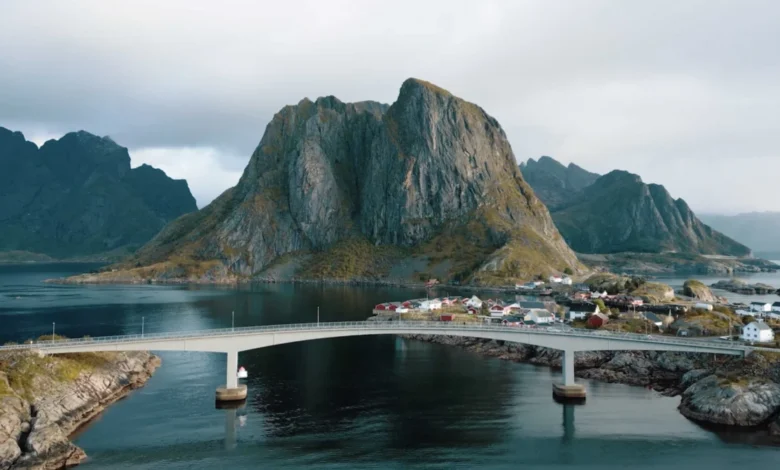
The remote Norwegian archipelago of Lofoten, located 68 degrees north of the Arctic Circle, has long drawn nearly one million annual visitors with its prehistoric mountain ranges, dramatic fjords, and midnight sun. However, a significant shift is underway in how travelers experience this fragile subarctic landscape. Rather than focusing solely on traditional outdoor recreation such as mountaineering and wild camping—activities that have increasingly strained local infrastructure and prompted regulatory crackdowns—tourism operators are steering visitors toward the region’s intricate foodways. At the center of this movement is Holmen Lofoten, a culinary hotel situated in the southwestern village of Sørvågen, which has successfully bridged the gap between immersive hospitality and environmental stewardship.

The Evolution of Holmen Lofoten: From Cod Factory to Culinary Sanctuary
Established as a hospitality and culinary destination in 2007, Holmen Lofoten occupies a cluster of mustard-colored rorbuer—traditional, stilted fishermen’s cabins featuring corrugated and grass-topped roofs—that were once part of a bustling local cod factory. The property is owned and operated by Ingunn Rasmussen and her son, Håvar Holmen. Rasmussen, the daughter of a local fisherman, assumed control of the site in October 2001 with a vision to revitalize the historic area while meticulously preserving its original architectural integrity.

Over the years, the property has evolved without losing its elemental character. Guest rooms feature minimalist, locally sourced furnishings designed to keep the focus on the surrounding wild ocean and craggy shoreline. Beyond standard hotel operations, Holmen serves as an incubator for regional gastronomy, most notably through its biannual series, Kitchen on the Edge of the World.

Kitchen on the Edge: A Decade of Collaborative Arctic Gastronomy
Launched in 2018, Kitchen on the Edge of the World brings acclaimed international chefs to the remote Lofoten kitchen four times a year. The initiative, now surpassing its 30th edition, was designed to foster an intimate dialogue between global culinary talents and the local ecosystem. Past guest chefs include prominent figures such as Ana Roš of Slovenia’s three-Michelin-starred Hiša Franko and British farm-to-table pioneer Simon Rogan.

The 30th edition of the event was helmed by Matt Orlando, a California-born, Copenhagen-based chef renowned for his commitment to sustainable, zero-waste cooking. Orlando, the former head chef of Noma and founder of the closed circular restaurant Amass—as well as the Michelin-starred Esse in Copenhagen—spent four days integrating international techniques with foraged subarctic ingredients. Alongside Orlando, resident mixologist Mia Hjorth Hansen of Aarhus-based bar Gedulgt crafted cocktails using hyper-local elements, such as vermouth infused with foraged blackcurrant leaves and Campari steeped in wild yarrow flowers.

The Science and Economics of the Arctic Food System
The culinary philosophy at Holmen is deeply intertwined with the unique ecological conditions of Northern Norway. The region experiences a powerful convergence of climates: the warm currents of the Gulf Stream collide with cold Arctic waters, creating a nutrient-dense marine ecosystem. Furthermore, prolonged summer daylight accelerates plant growth, while sea spray naturally nourishes coastal lamb-grazing pastures.

This synergy between geography and agriculture was underscored by Bjørg-Elin Kjærns, a food and agriculture specialist with Love Food, an organization that connects small-scale regional producers with local restaurants. According to Kjærns, traditional regional staples—including sustainable coastal lamb (Lofotlam), wild-harvested seaweed, and historical stockfish (tørrfisk)—represent some of the most environmentally sustainable food production models in existence. However, she emphasizes that environmental conservation is inextricably linked to the economic viability of local livelihoods. When commercial kitchens and hospitality venues choose locally sourced products, they directly support the continuity of the entire regional ecosystem.

This economic integration extends to pioneering enterprises such as the Lofoten Seaweed Company, co-founded by Angelita Eriksen and Tamara Singer in the nearby village of Napp. Operating as a women-led team, the company hand-harvests seven varieties of wild seaweed—including sugar kelp and nori—from the powerful tidal currents of the Nappstraumen straits. Their products not only supply Holmen’s kitchen but are also utilized by elite establishments across Scandinavia, illustrating how traditional coastal knowledge can be successfully commercialized to support modern artisanal economies.

Addressing the Pressures of Modern Tourism
The rising popularity of Northern Norway presents distinct socio-environmental challenges. Data from tourism boards indicates that inbound visitor growth in Northern Norway outpaced the national average, intensifying a familiar tension: how to accommodate the influx of travelers while protecting the delicate environment from overexposure.

In recent years, the impacts of unregulated tourism have become a point of contention for permanent residents. Issues such as improper waste management, trail erosion, and underprepared hikers underestimating unpredictable Arctic weather led regional authorities to implement stricter regulations, including bans on wild camping outside of designated grounds. Furthermore, local guides, including Holmen’s hiking leader Audun Rasmussen, have increasingly withheld the specific locations of fragile mountain routes to prevent social media-driven overcrowding.

Industry analysts note that shifting traveler behavior toward food- and culture-centric tourism offers a viable mitigation strategy. By anchoring the visitor experience in agricultural heritage, foraging, and communal dining, destinations like Holmen encourage a more respectful, slower-paced engagement with the landscape.

Broader Implications for Sustainable Hospitality
As global hospitality trends move away from passive consumption toward participatory education, the model established in Sørvågen offers a blueprint for remote tourism management. By maintaining transparent, fully visible kitchen spaces, fostering direct interactions between diners and producers, and embedding zero-waste principles into every meal, Holmen Lofoten demonstrates that luxury and environmental responsibility can coexist.

Ultimately, the integration of food systems into the tourism narrative serves a dual purpose: it provides an economic buffer for local farmers, fishers, and foragers, while instilling a deeper ecological awareness in visitors. As Ingunn Rasmussen notes, the long-term preservation of the Lofoten Islands depends entirely on attracting visitors for the right reasons—ensuring that the appreciation of the landscape matches the effort required to protect it.