For decades, popular culture has associated the travel-heavy, exotic mysteries of Dame Agatha Christie with the meticulous, mustache-twirling Belgian detective Hercule Poirot. Following a series of high-profile cinematic revivals directed by Kenneth Branagh—which transported audiences from the opulent carriages of the Venice Simplon-Orient-Express to a paddle steamer on the Nile and finally to a shadowy, decaying Venetian palazzo—Poirot has long held a monopoly on global transit-based whodunnits. Meanwhile, the literary footprint of June Marple, the unassuming elderly spinster introduced by Christie across a dozen novels and 20 short stories, remained firmly planted in the tranquil, deceptively lethal soil of the English countryside. For the vast majority of her literary lifespan, Miss Marple solved complex homicides from the quiet comforts of her backyard in the fictional village of St. Mary Mead.
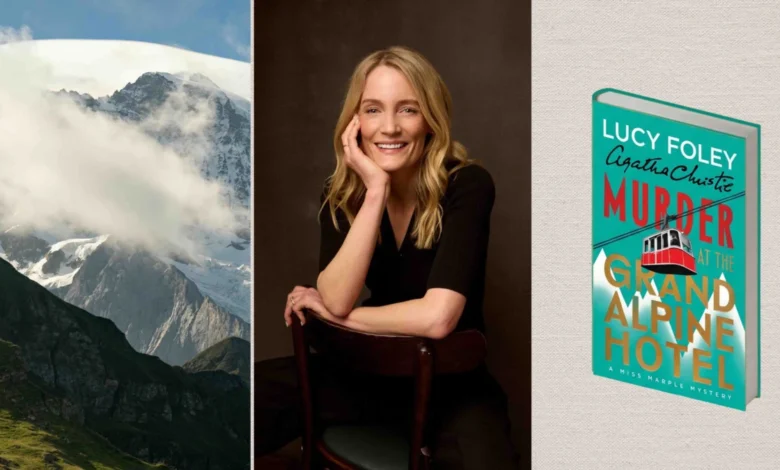
That paradigm is now officially shifting. In a publishing event that bridges half a century of literary silence, the Agatha Christie estate has commissioned bestselling suspense author Lucy Foley to pen a brand-new Miss Marple novel. Titled Murder at the Grand Alpine Hotel, the book officially marks the first authorized Miss Marple mystery in 50 years. Rather than keeping her in St. Mary Mead, Foley has chosen to thrust the Victorian-era observer into an extravagant, perilous, and atmospheric Swiss Alps adventure. Complete with hidden speakeasies, ice-skating waiters in full black tie, and treacherous, isolating mountain passes, the new novel places Miss Marple in a landscape more traditionally inhabited by literary secret agents like James Bond or hard-boiled espionage figures.
The commissioning of this novel represents a calculated evolution for the Christie brand, blending the cozy domesticity of traditional whodunnits with the high-stakes, rugged geography of mid-century action thrillers. Speaking exclusively about the project, Foley revealed the creative calculations behind uprooting the iconic sleuth and sending her into the teeth of the Swiss winter.
The Genesis of an Alpine Whodunnit
When approached by the Agatha Christie estate, Lucy Foley faced a distinct creative dilemma: should she replicate the familiar, comforting formulas of the classic St. Mary Mead stories, or should she fundamentally challenge the character by placing her in an entirely foreign environment? According to the author, the estate explicitly encouraged a fresh interpretation rather than a paint-by-numbers pastiche.
This directive led Foley to a simple realization—in the original works penned by Agatha Christie, Miss Marple is granted remarkably few opportunities to travel. Aside from a rare excursion featured in A Caribbean Mystery, the amateur detective’s world is remarkably localized. Feeling a sense of narrative sympathy for a character denied the pleasures of global exploration, Foley decided a grand holiday was long overdue.
However, the choice of the Swiss Alps was not merely aesthetic; it was designed to place Miss Marple into direct conversation with a very specific, historically masculine genre of 1950s literature. During the post-war era, rugged mountain landscapes served as the primary backdrop for hard-boiled action thrillers written by authors such as Ian Fleming and Eric Ambler. While Foley notes a profound admiration for the page-turning escapism of these works, she observed that they were unmistakably written by men, for men.
The narrative coup of Murder at the Grand Alpine Hotel, therefore, lies in subverting that traditionally masculine space. By placing Miss Marple and her devoted friend Dolly Bantry at the geographical and social center of a high-altitude thriller, Foley introduces a radical shift in perspective. The nexus of power within the story is entirely decentralized, handed over to two elderly women whose deceptively harmless exterior belies a razor-sharp understanding of human nature.
Historical Context: Post-War Europe and the Porous Alps
To establish authenticity within the novel, Foley embarked on an extensive research itinerary throughout the European alpine regions. Beginning in Chamonix in the French Alps, her research journey expanded across borders into Italy and Switzerland, traversing Zermatt, St. Moritz, Le Corbier, and passing through the Mont Blanc tunnel.
The temporal setting of the novel—the early 1950s—infuses the narrative with sharp socio-political tensions. Set roughly five years after the conclusion of the Second World War, Murder at the Grand Alpine Hotel captures a continent still grappling with the physical and psychological scars of global conflict. In the opening chapters, passengers representing a patchwork of nationalities—Italians, the French, the British, Americans, and even Germans—find themselves uncomfortably confined together on a train ascending the mountain.
This forced proximity creates immediate social friction. The post-war reality meant that different nations experienced the 1950s through drastically divergent economic lenses. While Britain was still firmly subjected to strict rationing programs—leaving citizens noticeably undernourished and, in Foley’s evocative phrasing, looking a bit gray—other European nations displayed distinct signs of post-war recovery. These stark cultural and economic disparities manifest in small details, such as the observation that Italian travelers boasted the finest luggage, the French displayed the most luxurious furs, and the British appeared visibly worn down by years of austerity.
Furthermore, the geographical specifics of the Swiss-French-Italian border region played a vital role in shaping the novel’s plot. Mountain passes in this part of the Alps are naturally porous and historically difficult to man, defend, and monitor. This landscape inevitably raises critical historical questions regarding who inhabited these borderlands during the Second World War and how wartime actions continue to cast long shadows into the peacetime era. Within the narrative, several characters find themselves returning to a region they traversed years earlier, frequently manipulating or outright rewriting their own wartime histories to secure personal advantages.
Research, Reality, and Alpine Hospitality Traditions
Foley’s meticulous research extended beyond geopolitical history into the hyper-specific traditions of luxury alpine hospitality. Drawing on a lifelong familiarity with the mountains—cultivated by ski-enthusiast parents who introduced her to the slopes at a young age—she sought to capture the duality inherent in alpine environments.
Historically, human perception of the mountains underwent a fundamental shift during the Romantic era. Prior to this cultural pivot, alpine regions were widely viewed through a lens of terror and dread—wastelands populated by bad spirits, severe danger, and inevitable death. The Romantics successfully reframed the mountains as sites of sublime beauty and awe. Yet, as Foley discovered firsthand while tackling challenging alpine routes like the Vallée Blanche above Chamonix—where skiers navigate the Mer de Glace glacier tethered by ropes and equipped with crampons—the ancient dichotomy between natural wonder and mortal peril remains deeply embedded in the mountain experience.
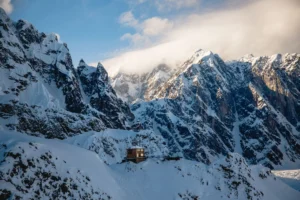
This blend of luxury and latent danger heavily informed the architecture and atmosphere of the fictional hotel. The physical setting was directly inspired by the Refuge du Montenvers, an isolated historic hotel sitting high above Chamonix accessible via a vintage red mountain train. Once the final evening train departs, guests are left entirely isolated with the majestic, forbidding expanse of the mountains—a setting tailor-made for psychological suspense.
Foley also integrated fascinating historical oddities discovered during her visits to legendary establishments such as Badrutt’s Palace Hotel and the Kulm Hotel in St. Moritz. Among these historical treasures were archival photographs documenting the forgotten tradition of ice-skating waiters. During the height of the mid-century resort boom, servers dressed in full black tie would glide onto outdoor ice rinks, balancing trays laden with champagne buckets and crystal coupes while executing complex skating maneuvers. Such period-accurate details provide the novel with a rich, immersive texture that honors the golden age of European travel.
The Hotel as an Instrument of Suspense
In discussing the mechanics of mystery writing, Foley reflected on Agatha Christie’s classic formula: the optimal mystery relies on a culprit who is simultaneously glaringly obvious and yet seemingly impossible to suspect. For Foley, the physical layout of a grand hotel serves as the ultimate engine to generate and sustain this specific brand of suspense.
Hotels possess a distinct, compartmentalized geography, frequently featuring hidden corridors, back-of-house passageways, and secret rooms accessible only to veteran staff or favored guests. Drawing on real-world inspirations, such as the clandestine subterranean bars found within historic establishments like the Kulm Hotel, Foley constructed a physical environment where spaces can conceal as much as they reveal.
Beyond architecture, the hotel functions as a unique sociological vacuum. It offers a level of radical anonymity where individuals can check in and adopt personas entirely disconnected from their everyday lives at home. This democratization of space allows wealthy elites, secret agents, recovering war criminals, and ordinary travelers to brush shoulders, creating an environment where identity is perpetually fluid and unreliable.
Why Miss Marple Excels as a Global Traveler
While detectives like Hercule Poirot are frequently swayed by superficial charm, often blinded by the outward appearance of innocent youth or beauty, Miss Marple operates under an entirely different observational framework. Her enduring strength as a detective lies in her capacity for relentless, unbiased observation and her deep understanding of human psychology.
Even when removed from the familiar boundaries of St. Mary Mead, Miss Marple evaluates foreign environments through the lens of human nature studied universally. To her, a village in the English countryside serves merely as a microcosm for humanity at large. Whether in a Caribbean resort or an isolated Swiss ski chalet, she reads character with unflinching accuracy.
Moreover, the character’s legacy is defined by a subtle complexity. Far from being a gentle, harmless grandmother archetype, Marple is driven in various canonical texts by powerful emotions, including righteous anger and an unyielding sense of moral retribution. Capable of shifting her demeanor to become whatever a situation demands—much like the shadowy figures of espionage fiction—she remains entirely unique within the canon of detective literature.
Implications and the Future of the Franchise
The publication of Murder at the Grand Alpine Hotel signals more than a nostalgic revival; it demonstrates the enduring commercial and creative viability of classic mystery properties when entrusted to contemporary authors who respect the source material while expanding its boundaries. By injecting modern pacing and expanded global geographies into a 50-year-old dormant franchise, the Agatha Christie estate has successfully revitalized its second most famous detective for a new generation of readers.
When asked where she might direct Miss Marple next, Foley offered a subtle Easter egg rather than a definitive itinerary. Referencing canonical clues regarding Miss Marple’s youth—specifically the revelation that she once lived abroad in a foreign country before settling in St. Mary Mead—Foley hinted that any future installments might look backward into the detective’s formative years. For now, however, Murder at the Grand Alpine Hotel stands as a definitive, high-altitude triumph that proves classic investigative intuition requires no passport, yet benefits immensely from a change of scenery.