The culinary landscape of the American Midwest is defined by a fierce dedication to regional comfort foods, but few items hold the cultural, historical, and gastronomic significance of the Chicago-style hot dog. Far more than a simple ballpark snack, this culinary institution represents a strict architectural discipline rooted in immigrant history, local manufacturing, and an unwavering community code. To understand Chicago is to understand its hot dog stands—neighborhood anchors where socioeconomic divides dissolve over steamed poppyseed buns and all-beef frankfurter links.
Anatomy of the Chicago-Style Hot Dog

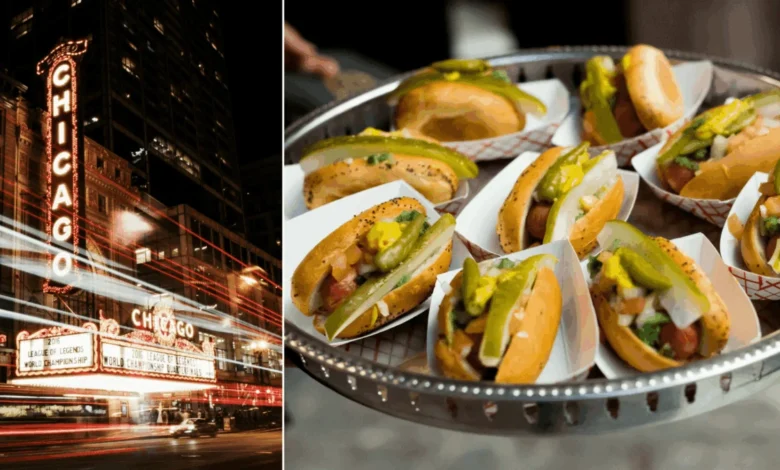
The quintessential Chicago dog is governed by an unyielding set of assembly rules designed to ensure a balanced flavor profile in every single bite. The foundation begins with an all-beef frankfurter featuring a natural casing, which delivers a distinct textural "snap" upon the first bite. This link is nestled inside a steamed, fluffy poppyseed bun.
The standard configuration of toppings—colloquially referred to as being "dragged through the garden"—includes yellow mustard, chopped white onions, bright neon-green sweet pickle relish, tomato wedges or slices, a pickle spear, spicy pickled sport peppers, and a generous dusting of celery salt. This precise combination delivers a complex interplay of acidity, heat, saltiness, and freshness.
Perhaps the most famous rule governing this culinary tradition is the strict prohibition of ketchup. Deeply embedded in Chicago food culture, locals view the sweet, tomato-based condiment as an architectural and flavor disruption that ruins the delicate balance of the other toppings. While tourists occasionally test this unspoken boundary, veterans of the local food scene know that asking for ketchup on a Chicago dog is a quick way to signal outsider status.

Historical Context and Evolution of the Stand Culture
The proliferation of the hot dog stand in Chicago is deeply intertwined with the city’s immigration patterns and industrial boom of the early 20th century. During the Great Depression, unemployed workers and recent immigrants—particularly from Greece, Italy, and Eastern Europe—opened street carts and roadside stands as a resilient means of economic survival. Selling inexpensive, high-protein meals like hot dogs and sausages allowed working-class residents to afford a hot meal during times of severe economic hardship.
Over the decades, these stands evolved from simple pushcarts into permanent neighborhood fixtures. They became community living rooms, operating late into the night to serve shift workers, nightlife crowds, and families alike. The traditions established during this era—such as the Depression-style dog or the Maxwell Street Polish—remain core pillars of the city’s identity.

Fixin’ Franks: Hardware Store Hospitality
One of the most uniquely local manifestations of Chicago’s hot dog culture can be found at Fixin’ Franks, a family-owned operation with multiple outposts uniquely situated inside local Home Depot stores. Tucked near the store exits, these stands serve as a welcome reward for residents wrapping up arduous home-repair projects.
Fixin’ Franks maintains a tight, locally sourced menu that highlights regional favorites including classic hot dogs, Polish sausages, Maxwell Street sausages, Italian beef, and elotes. While their standard Chicago dog is expertly constructed, culinary adventurers frequently elevate the experience by adding a spoonful of J.P. Graziano hot giardiniera, bringing an extra layer of Chicago-bred heat and crunch to the classic formula.

Byron’s Hot Dogs: The Presidential Salad Approach
Operating for over half a century, Byron’s Hot Dogs with locations in Lakeview and Ravenswood has carved out a distinct niche in the local culinary scene. Famed for serving their signature franks at the White House during the Obama administration, Byron’s diverges slightly from the traditional assembly method.
While most establishments adhere strictly to the classic "dragged through the garden" blueprint, Byron’s adds lettuce, green peppers, and cucumber slices to their standard dressing of mustard, relish, onions, tomato, pickle spears, and celery salt. Though managing this towering assembly requires considerable dexterity, the addition of fresh garden vegetables imparts a refreshing crispness that playfully redefines the boundaries of the traditional hot dog.

Jim’s Original: The Legacy of Maxwell Street
No exploration of Chicago’s street food history is complete without examining Jim’s Original, the undisputed heavyweight champion of the Maxwell Street Polish sausage. Founded in 1939 by Macedonian immigrant Jimmy Stefanovic—who took over his aunt and uncle’s original stand—Jim’s helped cement the city’s love affair with smoked garlic-and-pork links.
Operating out of its iconic University Village location from 6 a.m. to 1 a.m., Jim’s Original is a sensory overload of sights, sounds, and smells. The signature Maxwell Street Polish is served on a plain white bun with a mountain of caramelized grilled onions, yellow mustard, and fiery sport peppers. The stand also offers a famous bone-in pork chop sandwich dressed in the exact same manner. With no indoor seating available, patrons gather around outdoor metal counters or sit along the curb, enveloped in an atmosphere that routinely feels like an impromptu street party.

Portillo’s: The Commercial Ambassador
For visitors looking to sample the full spectrum of Chicago street food under one roof, Portillo’s serves as the ultimate ambassador. Founded by Dick Portillo in 1963 as a single trailer named "The Dog House," the local chain has grown into a massive regional empire with multiple locations across the metropolitan area and beyond.
Portillo’s delivers consistently high-quality versions of local staples, including expertly steamed Chicago dogs, Italian beef sandwiches, and Maxwell Street sausages. Beyond the savory items, the establishment is equally famous for its decadent chocolate cake shake—a rich concoction featuring an entire slice of house-made chocolate cake blended directly into a thick milkshake, offering a decadent finale to a quintessential Chicago meal.

Red Hot Ranch: The Ultimate Value
Operating four popular locations across the city—with the original Bridgeport outpost historically known as 35th Street Red Hots—Red Hot Ranch offers a masterclass in minimalism and value.
RHR serves their links "Depression-style," a streamlined preparation featuring only mustard, onion, relish, and sport peppers, crowned with a generous heap of fresh-cut fries directly on top of the dog. Priced at just $5.20 for the full meal combination, it represents some of the best culinary value in the entire Midwest. Beyond the hot dogs, Red Hot Ranch has cultivated a massive local following for its double smashburgers, widely considered by culinary critics to be among the finest cheeseburgers in Chicago.

Superdawg Drive-In: Mid-Century Architectural Icons
Established in 1948 by Maurie and Flaurie Berman, the Superdawg Drive-In in Norwood Park East is an irreplaceable monument to mid-century car culture. Instantly recognizable by the pair of 12-foot-tall fiberglass hot dog figures standing vigilantly on the building’s roof, Superdawg offers a distinct culinary perspective.
The signature Superdawg features a custom-made, slightly larger all-beef frankfurter tucked into a unique cardboard box alongside a mountain of crinkle-cut fries. The toppings depart slightly from the standard downtown formula, incorporating mustard, a pickle, sport peppers, chopped onions, piccalilli, and a pickled green tomato. This historic roadside landmark remains an active cultural touchstone, having even been featured prominently in contemporary media, including the critically acclaimed television series The Bear.

The Duck Inn: A Chef’s Elevated Take
In the neighborhood of Bridgeport, chef Kevin Hickey has applied fine-dining techniques to the humble street food staple at The Duck Inn. The result is the acclaimed Duck Inn Dog, a masterclass in culinary elevation.
Hickey specifies every single component of the dish. The custom sausage is crafted from a rich blend of beef, pork, and duck fat, then grilled to perfection and housed within a pillowy brioche poppyseed bun. It is finished with a proprietary "supercondiment" blending mustard, relish, tomato, and onion, alongside a crisp dill pickle, pickled serrano peppers, and celery salt. Paired with an order of house-made fried cheese curds, The Duck Inn offers a sophisticated nod to working-class traditions.

The Wiener’s Circle: Char Dogs and Late-Night Theater
Operating in Lincoln Park for over 40 years, The Wiener’s Circle is famous for two primary exports: exceptional late-night food and its notoriously sharp-tongued, banter-loving staff. Open until 4 a.m. on weekends, the stand serves as a late-night social hub where ordering food comes with a theatrical dose of verbal sparring.
Culinary merit matches the entertainment value. Unlike the vast majority of Chicago stands that steam their franks, The Wiener’s Circle is celebrated for its char dog. Cooking the all-beef link over an open flame imparts a distinct smoky flavor and an appealing exterior char. Combined with their legendary cheddar fries smothered in a rich, tangy cheese sauce, the establishment remains an essential stop on any Chicago food itinerary.

Vienna Beef Factory Store: Visiting the Source
It is impossible to discuss the Chicago hot dog without acknowledging Vienna Beef, the iconic meat purveyor that supplies the vast majority of the city’s independent stands. Situated directly across the street from the manufacturing plant in Bridgeport, the Vienna Beef Factory Store and Cafe allows diners to experience the product at its absolute source.
Patrons can pull up a red stool at the counter to order a textbook Chicago-style dog accompanied by crispy fries, surrounded by historical memorabilia. Following the meal, visitors can browse the adjacent retail shop, which sells everything from bulk packages of hot dogs and condiments to whimsical hot dog merchandise.

Wurst Behavior: A Polish-American Fusion
Located in Albany Park, Artur Wnorowski’s casual establishment, Wurst Behavior, demonstrates the continuous evolution of Chicago’s sausage culture. Drawing on family recipes passed down from his grandfather, Wnorowski produces exceptional house-made sausages smoked over pecan wood.
Standouts include traditional kielbasa dressed with caramelized onions, sport peppers, and hazy IPA mustard, alongside all-beef hot dogs served with creative nods to both Chicago and Polish culinary traditions. Topped with sauerkraut, onions, sour cream, and potato-and-cheese pierogi, Wurst Behavior captures the inventive spirit and lighthearted nature that has kept Chicago’s hot dog culture thriving for nearly a century.