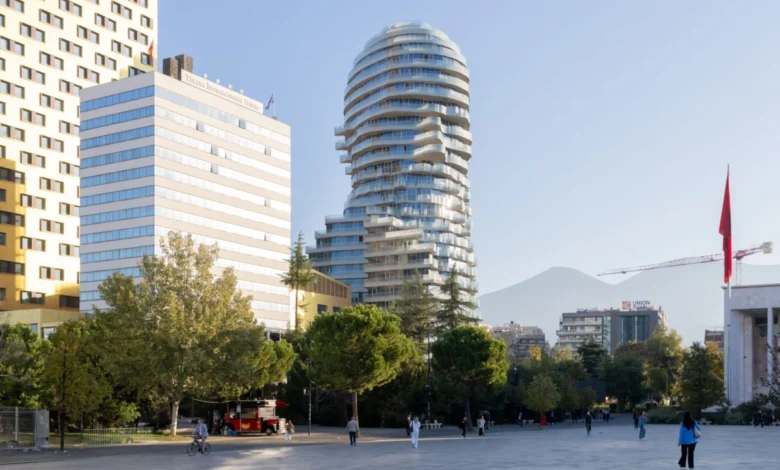
The skyline of Tirana, the capital of Albania, is undergoing a profound metamorphosis. In a city of approximately 600,000 residents, the landscape is being rapidly populated by avant-garde skyscrapers, "vertical forests," and structures that push the boundaries of conventional urban design. Spearheaded by Prime Minister Edi Rama—a former professional basketball player and practicing artist who has held power for 13 years—this massive architectural endeavor has turned the city into an open-air laboratory for global "starchitecture." However, this aesthetic evolution has not occurred in a vacuum; it is unfolding against a backdrop of escalating civil unrest, allegations of corruption, and deep-seated local frustration regarding the marginalization of domestic architects.

A Legacy of Global Design
Since his tenure as Mayor of Tirana beginning in the late 1990s, and subsequently as Prime Minister, Edi Rama has championed a development model that relies heavily on international talent. According to data from the National Territorial Planning Agency, the government has facilitated over 50 major international architectural competitions for public and private projects. In a striking statistic, 48 of these competitions were won by foreign firms, often with local firms relegated to secondary execution roles.
The resulting urban fabric is a collage of international signatures. The skyline now features a vertical forest skyscraper by Italian architect Stefano Boeri, a bright red Marriott hotel by Archea Associati, and the iconic Tirana Pyramid—a former relic of the Enver Hoxha dictatorship—which has been repurposed by the Dutch firm MVRDV. Perhaps most controversial is the MVRDV-designed residential complex that mimics the shape of a human head, which some locals interpret as a monument to Rama himself, though the architect claims it represents a generic historical figure.

Chronology of Conflict
The tension between the government’s modernization agenda and public sentiment reached a breaking point in 2024. The friction is not merely aesthetic; it is deeply political.
- May 2024: Protests erupted following reports that the government would facilitate luxury resort development on protected land by companies linked to the family of Jared Kushner and Ivanka Trump. This announcement coincided with an international architecture conference hosted by the government, drawing the ire of activists who coined the term "Flamingo Revolution" to protest what they perceive as the selling off of Albania’s public wealth.
- June 2024: The "Starchitects go home!" movement gained momentum during the government-sponsored architecture summit, where protesters picketed the arrival of international design luminaries.
- October 2024: Civil unrest escalated into violence. Protesters targeted government infrastructure, including the destruction of paving stones on the Boulevard of Martyrs and the burning of a public information kiosk in Skanderbeg Square.
- November 2024: The government moved to a secure location on the city’s outskirts as the protests grew more intense, with police deploying tear gas and rubber bullets against demonstrators.
The Debate Over Domestic Competence
A central point of contention in the architectural discourse is the perceived sidelining of Albanian professionals. Local architects have long expressed concern that the reliance on foreign firms deprives domestic talent of the opportunity to define their own country’s identity.

Prime Minister Rama has been vocal in his defense of the policy, often framing it as an educational necessity. He argues that the presence of high-profile firms like Herzog & de Meuron and Diller Scofidio & Renfro provides a "masterclass" for local architects, suggesting that just as China utilized foreign architects to elevate its own domestic capabilities two decades ago, Albania is experiencing a similar knowledge transfer.
However, many local practitioners reject this characterization. Critics, including protest organizers like Gent Progni, argue that the government uses the prestige of international names to bypass transparency and environmental regulations. "My opposition is not to foreign architects but to the way Edi Rama uses prestigious international names to legitimize controversial development projects, often without transparency, meaningful public consultation, or accountability," Progni stated in a recent interview.

Economic and Ethical Implications
The building boom has raised significant questions regarding the economic stability of these projects. Anneke Abhelakh, in her analytical work The Albanian Files, notes that while over 500 projects have been proposed by 60 foreign firms, only about 10% have actually been realized. The city is currently dotted with partially completed structures or buildings that have been significantly altered during construction—often involving the replacement of high-end materials with cheaper alternatives to save costs.
Allegations of money laundering within the real estate sector have further clouded the narrative. In a small, developing economy, the sudden influx of large-scale, luxury-focused foreign investment is often viewed by the public with skepticism. The suspicion that these buildings serve as vehicles for capital flight or speculative laundering has become a rallying cry for the opposition, turning architecture into a symbol of a wider struggle against perceived corruption and the concentration of executive power.

Official Stance and Future Outlook
Despite the intensity of the protests and calls for his resignation, Prime Minister Rama maintains an unyielding stance. He views the architectural transformation as a necessary "medicine" for a society that has spent decades in the shadow of isolationism. During an interview amidst the unrest, Rama reflected on the power of the built environment: "Architecture has the power to change societies. It’s like a strong medicine. It can heal, or it can kill."
Looking ahead, the government shows no signs of slowing down its urban planning initiatives. Rama has proposed the creation of a "Museum of Dreams," a repository for the designs and models generated by the 60 foreign firms currently operating in the country. He envisions this as a central archive of the country’s modern architectural aspirations.

Whether this "store of dreams" will be seen as a testament to progress or as a monument to a government that grew disconnected from its people remains to be seen. For now, the city of Tirana remains a fractured mirror: on one side, a gleaming vision of European modernity; on the other, a populace struggling with the economic and democratic consequences of that very vision. The intersection of these two realities defines the current Albanian experience, where every new facade serves as both a landmark of growth and a target for political dissent.
As the country moves forward, the success of these developments will be measured not just by the aesthetics of the skyscrapers, but by the ability of the government to restore the social contract that currently lies in tatters on the streets of the capital. The "architectural experiment" of Edi Rama is far from concluded, but the cost of the project is increasingly being calculated in social stability as much as in concrete and steel.