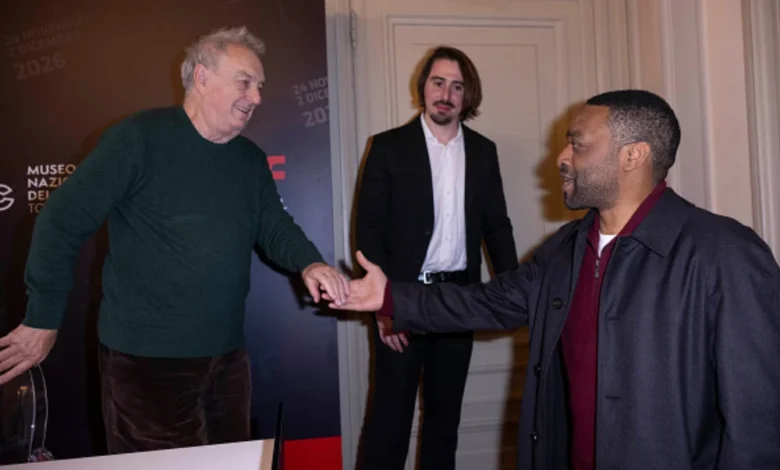
The 41st Torino Film Festival served as a grand stage for reflection and celebration as acclaimed British actor, writer, and director Chiwetel Ejiofor accepted the prestigious Stella della Mole award for lifetime achievement. During a wide-ranging conversation with festival attendees and press, Ejiofor delivered candid insights into his remarkable trajectory within the entertainment industry. Looking back on a career spanning nearly three decades, the Academy Award nominee shared memories of starting at the very pinnacle of cinematic prestige, transitioning from the rigorous demands of the British stage to international film stardom, and eventually carving out a path behind the camera as a visionary director.
The retrospective atmosphere of the Italian festival highlighted several cornerstones of Ejiofor’s filmography. Alongside the honors bestowed upon him, the festival showcased key works from his career, including Stephen Frears’ celebrated 2002 thriller Dirty Pretty Things and Steve McQueen’s 2013 historical masterpiece 12 Years a Slave, for which Ejiofor earned an Oscar nomination for best actor. These screenings provided a thematic backdrop for discussions on artistic evolution, the unpredictable nature of the entertainment business, and the enduring importance of human dignity in storytelling.
A Cinematic Debut with High Stakes
For most performers, working with a legendary filmmaker represents a hard-earned career milestone. For Chiwetel Ejiofor, however, it was the very starting point. At the tender age of 19, while still training at the London Academy of Music and Dramatic Art (LAMDA), Ejiofor was cast by Steven Spielberg in the historical legal drama Amistad (1997). Portraying James Covey, a Mende interpreter in a film boasting an ensemble cast that included Morgan Freeman, Anthony Hopkins, and Djimon Hounsou, the young actor was immediately thrust into the upper echelons of Hollywood filmmaking.
Rather than viewing the opportunity solely as a blessing, Ejiofor confessed that the experience initially induced profound anxiety. At the Torino Film Festival, he admitted to fearing that he had peaked too early in his professional life.
"I was definitely worried about it at the time," Ejiofor told the audience. "You feel that there are stages to how you develop as an actor and the opportunities you get, and you think they might follow a very linear path. But of course, my first film role was with Steven Spielberg. I realized then, very early on, that it’s a deeply unpredictable profession. You can either feel disquiet or anxiety about that, or you have to go with it."
This early baptism by fire taught the young actor a vital lesson in resilience and adaptability. He noted that the trajectory of a creative life rarely moves in a straight line. Opportunities emerge sporadically from unexpected directions, requiring artists to possess the flexibility to navigate uncharted waters. This philosophy has guided Ejiofor through a multifaceted career defined by bold choices, genre shifts, and an unwillingness to be pigeonholed.
From West End Stages to the Poetry of Cinema
Despite his high-profile Hollywood debut, Ejiofor did not immediately view himself as a cinematic actor. For many years, his heart and professional identity remained rooted in the theatrical traditions of Great Britain. He spent his formative years building a formidable reputation on the stage, working extensively with the Royal National Theatre, major West End venues, and various off-West End companies.
His theatrical prowess culminated in critical acclaim and numerous accolades. In 2008, Ejiofor achieved a monumental milestone by winning the Laurence Olivier Award for Best Actor for his searing portrayal of the title character in Michael Grandage’s production of Othello at the Donmar Warehouse. For a long time, the stage remained his primary artistic home, while film was treated as an occasional departure.
The definitive turning point in his artistic identity arrived with Stephen Frears’ Dirty Pretty Things, a gritty, London-set thriller exploring the underground lives of undocumented immigrants. Frears, who was also honored at the Torino Film Festival, directed Ejiofor in a critically lauded performance as Okwe, a Nigerian doctor working as a night-porter in a London hotel. The film screened to enthusiastic audiences during the festival, reminding critics of the raw power Ejiofor brought to the screen alongside visionary cinematographer Chris Menges.
"I think it was around that time when I started to fall in love with film as well, with film acting and the rhythm and poetry of cinema," Ejiofor recalled. "A lot of that had to do with Stephen Frears and Chris Menges, who was the cinematographer on that film. It became something that I started to pursue."
For a considerable period following Dirty Pretty Things, Ejiofor successfully maintained a dual career, balancing demanding stage roles with prestigious international film projects, including Alfonso Cuarón’s dystopian sci-fi drama Children of Men (2006) and Ridley Scott’s space adventure The Martian (2015).
Stepping Behind the Camera: Directing and Writing
As his career matured, Ejiofor’s creative ambitions expanded beyond performance. His involvement in writing and directing began to consume the time and energy he had historically dedicated to theatrical productions. This evolution marked a natural progression for an artist deeply invested in narrative structure and character depth.
Ejiofor has successfully translated his cinematic vision to the director’s chair with two feature films: The Boy Who Harnessed the Wind (2019) and Rob Peace (2024). The Boy Who Harnessed the Wind, adapted from William Kamkwamba’s memoir, was widely praised for its authentic portrayal of ingenuity and resilience in a drought-stricken Malawian village. More recently, Rob Peace examined the tragic, complex life of a brilliant Yale graduate from Newark, New Jersey, further cementing Ejiofor’s reputation as a thoughtful and socially conscious filmmaker.
Despite the demands of writing and directing, Ejiofor’s passion for live theater remains undiminished. Addressing the festival attendees, he revealed that a return to the stage is imminent. While coordinating schedules presents a logistical challenge, Ejiofor confirmed he is currently in active discussions regarding a theatrical production targeted for late next year.
A Profound Encounter with History: 12 Years a Slave
Among the myriad highlights celebrated during the Torino Film Festival retrospective, few films hold as much historical and emotional weight as Steve McQueen’s 12 Years a Slave (2013). The movie, which swept the Academy Awards and won Best Picture, featured Ejiofor in a career-defining performance as Solomon Northup.
Northup was a free African American man living in Saratoga, New York, who in 1841 was lured to Washington, D.C., abducted, and sold into chattel slavery in the deep South, enduring twelve years of brutality before regaining his freedom. When the script first landed in Ejiofor’s hands, the history was largely unknown to him, despite its immense cultural significance.
"I hadn’t heard of his story at all. When I was sent the script, I was incredibly moved and shocked by it. Then I read Northup’s own memoir. I thought it was an extraordinary story, an extraordinary tale," he shared prior to the festival screening.
Ejiofor praised McQueen’s uncompromising approach to depicting a "very tragic period of absence of humanity." Collaborating with a filmmaker of McQueen’s caliber required absolute dedication, characterized by meticulous attention to detail and a profound emotional core. The global acclaim and Academy recognition that followed were, for Ejiofor, gratifying validations of a collective effort to bring long-buried truths to light.
"It felt very profound to me. I was just deeply moved," Ejiofor reflected. "Steve McQueen is a phenomenal filmmaker, incredibly passionate, detailed and thorough, with a wonderful vision and cinematic heart. It was incredibly gratifying to see the film being received the way that it was, globally and by the Academy. At its heart, it was always a story about human respect and human dignity."
Broader Implications and Future Horizons
The recognition bestowed upon Chiwetel Ejiofor at the Torino Film Festival underscores the enduring trajectory of a truly global artist whose work bridges continents, mediums, and genres. From his adolescent collaboration with Steven Spielberg to commanding the West End stage as Othello, and from anchoring harrowing historical dramas to directing socially resonant independent films, Ejiofor’s career serves as a masterclass in artistic longevity.
As the entertainment landscape continues to evolve through shifting distribution models and changing audience habits, performers of Ejiofor’s caliber demonstrate the vital importance of adaptability. By embracing the unpredictable nature of the profession rather than resisting it, he has maintained a rare relevance across both commercial blockbusters and deeply personal independent cinema.
Looking forward, the dual promise of a return to the theater stage next year and the ongoing evolution of his directing career signal that Ejiofor’s artistic journey is far from complete. Whether performing before a live theater audience, anchoring a major cinematic release, or shaping a narrative from behind the camera, Chiwetel Ejiofor remains a defining force in contemporary storytelling—one whose commitment to human dignity continues to elevate every project he touches.