Africa’s Underexplored Ecological and Cultural Frontier
Few regions on Earth command the collective human imagination quite like the Congo Basin, a sprawling expanse of dense tropical rainforests, winding tributaries, and extraordinary biodiversity spanning Central Africa. Spanning a landmass roughly equivalent to the size of India, the basin encompasses approximately 150 distinct ethnic groups and serves as one of the planet’s most critical ecological carbon sinks, acting as a vital counterbalance to global climate change. Yet, despite its monumental geographic and environmental significance, the region has long endured a severe deficit in scientific research funding and institutional conservation efforts.

The allure of the Congo Basin has historically oscillated between profound scientific curiosity and notorious colonial exploitation. Today, however, modern infrastructure, sustainable ecotourism initiatives, and digital media are reshaping how the outside world engages with this remote equatorial landscape. As contemporary travelers, adventurers, and documentary-makers turn their lenses toward its rivers, the region faces a delicate balancing act: opening its doors to responsible tourism while fiercely guarding its ecological sovereignty and rich cultural heritage.
Historical Context and the Evolution of Exploration
The modern Western conception of the Congo Basin was largely forged in the crucible of late-19th-century European expansionism, an era defined by aggressive territorial acquisition, resource extraction, and relentless geographical discovery. Welsh explorer Henry Morton Stanley provided the first detailed modern documentation of a trans-basin crossing following a grueling three-year trek from 1874 to 1877, famously characterizing the territory as "a region of fable and mystery."

This very mystery magnetized a young Polish sailor named Józef Korzeniowski. Having gazed upon a map of Africa—then largely rendered as an unchartered blank space—Korzeniowski vowed to journey there. In the late 1880s, he realized that ambition by securing a captaincy on a steamboat navigating the Congo River. His official mission was to collect an upcountry trading agent named Klein, who was stationed in the interior under the employ of a brutal Belgian trading monopoly.
What Korzeniowski witnessed along the riverbanks profoundly shocked him, exposing the unvarnished brutality of unchecked colonization and resource pillaging. He subsequently condemned the campaign as "the vilest scramble for loot that ever disfigured the history of human conscience and geographical exploration." These harrowing experiences catalyzed his transformation into the celebrated author Joseph Conrad. Transforming his journal entries and firsthand horrors into fiction, Korzeniowski became Joseph Conrad, the trading agent Klein morphed into the haunting literary figure Mr. Kurtz, and the resulting manuscript cemented Heart of Darkness into the bedrock of global literary history.
Modern Expeditions: From Digital Spectacle to Accessible Tourism

More than a century after Conrad’s transformative passage, the Congo Basin continues to summon modern-day explorers seeking high-stakes adventure. Among the latest figures to capture global attention is Welsh extreme athlete Ash Dykes. Utilizing digital platforms, Dykes documented his grueling attempt to paddle 400 miles down the Sangha River—a major tributary of the Congo River—generating millions of views on TikTok.
While Dykes’s digital broadcasts frequently amplify physical perils, logistical anxiety, and survivalist spectacle for social media audiences, travel analysts note a stark contrast between his dramatized narrative and the reality on the ground. When navigating his state-of-the-art inflatable watercraft, Dykes is routinely met by local residents casually operating traditional wooden pirogues with effortless skill. Furthermore, cultural experts point out that the milestones featured prominently in Dykes’s journey—such as accompanying the Indigenous Ba’aka people on traditional forest hunts, observing forest elephants at clearings like Dzanga Bai, or tracking western lowland gorillas—do not require extreme athletic endurance. Instead, these experiences are entirely accessible to mainstream travelers through established, responsible ecotourism operators.
Navigating the Rivers: Luxury Cruising Versus Traditional Freight

For decades, navigating the inland waterways of the Congo Basin meant enduring the grueling conditions aboard daka-dakas—flat-topped cargo barges overloaded with commercial goods, passengers, and livestock, chugging slowly between Kinshasa and Kisangani amid billowing clouds of acrid black smoke.
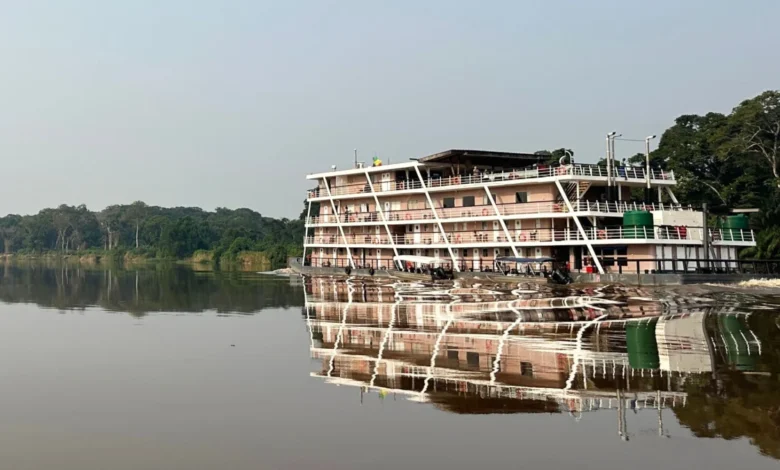
In recent years, however, the travel landscape has evolved. The introduction of the Princesse Ngalessa, a multi-level passenger riverboat operated by Ducret Expeditions, has introduced a new tier of accessibility to the region. Departing from the Republic of Congo’s capital, Brazzaville, the vessel serves as the basin’s premier passenger cruise ship. Equipped with modern amenities, air-conditioned cabins, private bathrooms, and observation decks, the ship offers a stark contrast to commercial freight transit.
Cruising along the river brings a dual dynamic. While the vessel commands curious glances from isolated riverbanks, its regular arrival is frequently celebrated as a major community event in riverside settlements. The ship facilitates localized commerce, delivers essential goods, and bridges communication gaps between isolated interior communities and the urban centers.

Ecological Wealth and Scientific Realities
The environmental stakes in the Congo Basin have never been higher. As the world’s second-largest rainforest, the basin plays an indispensable role in regulating global weather patterns and absorbing atmospheric carbon dioxide. However, recent scientific assessments indicate mounting environmental pressures. Studies published by environmental science organizations reveal that parts of Africa’s tropical forest ecosystems are facing unprecedented stress, with certain sectors transitioning from carbon sinks to net carbon emitters due to localized deforestation, industrial mining, and climate-induced warming.
Despite these environmental alarm bells, the region continues to suffer from chronic international underfunding for scientific research and localized conservation initiatives. Conservationists emphasize that safeguarding the basin requires direct financial investment and policy support channeled through regional governments, non-governmental organizations, and Indigenous communities who have acted as stewards of the forest for millennia.

Cultural Immersion and Indigenous Stewardship
Travelers journeying deep into the river networks encounter a vibrant mosaic of cultural traditions that remain largely untouched by mass tourism. In the riverside village of Ngabe, visitors witness traditional ceremonies featuring the Ejengi, a towering forest spirit constructed from woven palm fronds that performs intricate dances amid drumming, chanting, and community celebration. Along the Alima River, travelers can kayak through seasonally flooded forests while engaging in peaceful commerce with local fishermen who paddle their slim pirogues alongside larger vessels to trade fresh fruit and smoked catch.
Further upstream at the Sangha Lodge in the Central African Republic—operated by pioneering eco-tourism advocates like Rod Cassidy—visitors gain rare access to collaborative conservation models. Working alongside the Ba’aka people, conservation programs leverage Indigenous tracking expertise to monitor wildlife populations, including forest elephants and lowland gorillas, while protecting sustainable hunting traditions.

The Broader Implications of Sustainable Travel
The resurgence of interest in the Congo Basin signals a shift in how remote destinations are perceived by the international community. No longer viewed simply as a hostile frontier to be conquered or an exotic backdrop for tales of colonial dread, the basin is increasingly recognized as a dynamic, independent ecosystem inhabited by resilient communities who welcome mindful travelers.
As modern expeditions and sustainable river cruises continue to open access to the region’s interior waterways, industry stakeholders emphasize the absolute necessity of ethical tourism. True exploration in the Congo Basin is no longer measured by the personal endurance of the traveler, but by the preservation of the environment and the economic empowerment of the local populations. For those fortunate enough to witness a sudden equatorial downpour sweep across the upper deck of a drifting riverboat, the enduring magic of Central Africa remains a powerful reminder of the planet’s remaining wild frontiers.