Four years after NASA executed the groundbreaking Double Asteroid Redirection Test (DART) mission—intentionally crashing a spacecraft into the asteroid Dimorphos to test planetary defense capabilities—new data from the European Space Agency (ESA) reveals that the kinetic impact achieved far more than a simple localized cratering event. The arrival of ESA’s Hera spacecraft at the Didymos-Dimorphos binary asteroid system has provided the first high-resolution forensic view of the crash site, confirming that the impact fundamentally reshaped the 500-foot-wide asteroid, leaving it tumbling wildly through space and surrounded by hundreds of migrating boulders.
The initial DART experiment, conducted in September 2022, was designed as a proof-of-concept for kinetic impactor technology, a leading strategy for deflecting potentially hazardous near-Earth objects. Traveling at a staggering velocity of more than 13,700 miles per hour (6.14 kilometers per second), the solar-powered DART probe delivered roughly 10 billion joules of energy into Dimorphos. Ground-based and space telescopes quickly confirmed that the strategy was a resounding success. By shortening Dimorphos’s 12-hour orbital period around its larger companion, Didymos, by approximately 33 minutes, the mission exceeded the most conservative scientific expectations by a factor of 25.
However, the catastrophic nature of the collision meant that DART itself was destroyed upon impact. While the spacecraft transmitted detailed imagery during its final descent, the immediate aftermath could only be observed from millions of miles away through terrestrial and space telescopes, alongside a fleeting glance from a tiny Italian-built CubeSat that captured the initial impact flash. Essential questions regarding the internal composition of Dimorphos, the exact mechanics of the crater formation, and the long-term dynamical stability of the asteroid remained unanswered, setting the stage for a follow-up reconnaissance mission.
The Chronology of a Planetary Defense Milestone
The journey toward understanding the DART impact spans several decades of theoretical orbital mechanics and international cooperation, culminating in a multi-year operational timeline:
- November 2021: NASA launches the DART spacecraft aboard a SpaceX Falcon 9 rocket from Vandenberg Space Force Base in California, setting a trajectory toward the Didymos binary system.
- September 26, 2022: DART successfully impacts Dimorphos at 7:14 PM EDT, altering its orbital period and ejecting a massive plume of dust and debris visible to telescopes across Earth and space, including the Hubble and James Webb Space Telescopes.
- October 2024: ESA successfully launches the Hera spacecraft from Cape Canaveral, Florida, embarking on a complex, two-year interplanetary cruise designed to rendezvous with the modified asteroid system.
- October to November 2026: Hera arrives at the Didymos-Dimorphos system, approximately 120 million miles (193.5 million kilometers) from Earth, initiating close-range imaging campaigns and releasing its hyperspectral and navigation instruments to map the terrain.
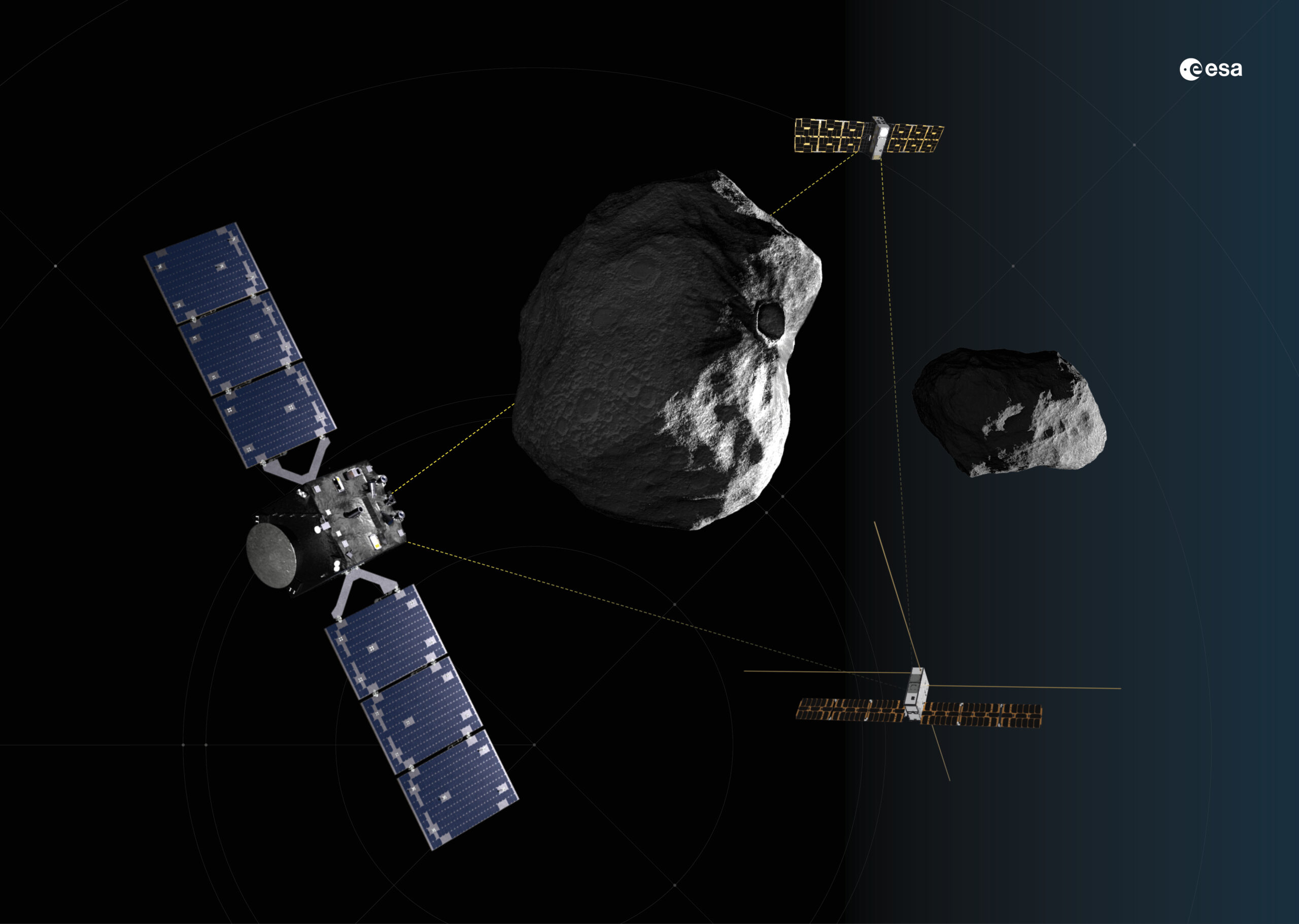
- Late 2026 to mid-2027: Hera prepares to deploy two miniaturized CubeSats—Juventas and Milani—to attempt close proximity operations, surface proximity mapping, and radar soundings of Dimorphos’s internal structure.
Unprecedented Debris Fields and Structural Deformation
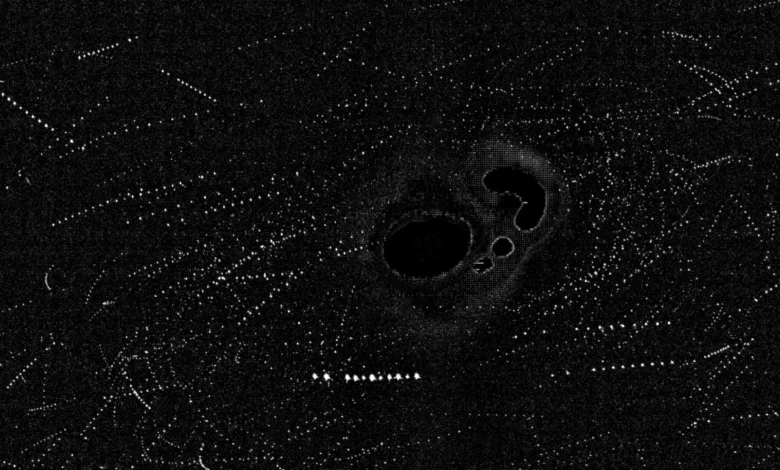
As Hera closed the distance to the binary system this month, mission scientists were met with an unexpected visual landscape. High-resolution composite images compiled from 11 long-exposure frames captured by Hera’s Hyperscout-H instrument revealed a vast swarm of rocky debris. By digitally subtracting the bright cores of Didymos and Dimorphos, researchers uncovered hundreds of dot trails representing boulders ranging in size from footballs to washing machines, all orbiting in a slow-motion dance around the system.
This discovery vastly expanded upon earlier observations made by the Hubble Space Telescope, which had hinted at a trailing plume of material shortly after the 2022 impact. Planetary scientists note that while some of these rocks were undoubtedly blasted free by the DART impactor, the sheer density and distribution of the debris cloud have raised new questions. Because Hera is the first spacecraft to conduct a sustained, close-range study of a binary asteroid system, researchers are actively investigating whether some of these boulders are ancient relics from the primordial formation of Dimorphos rather than products of the artificial collision.
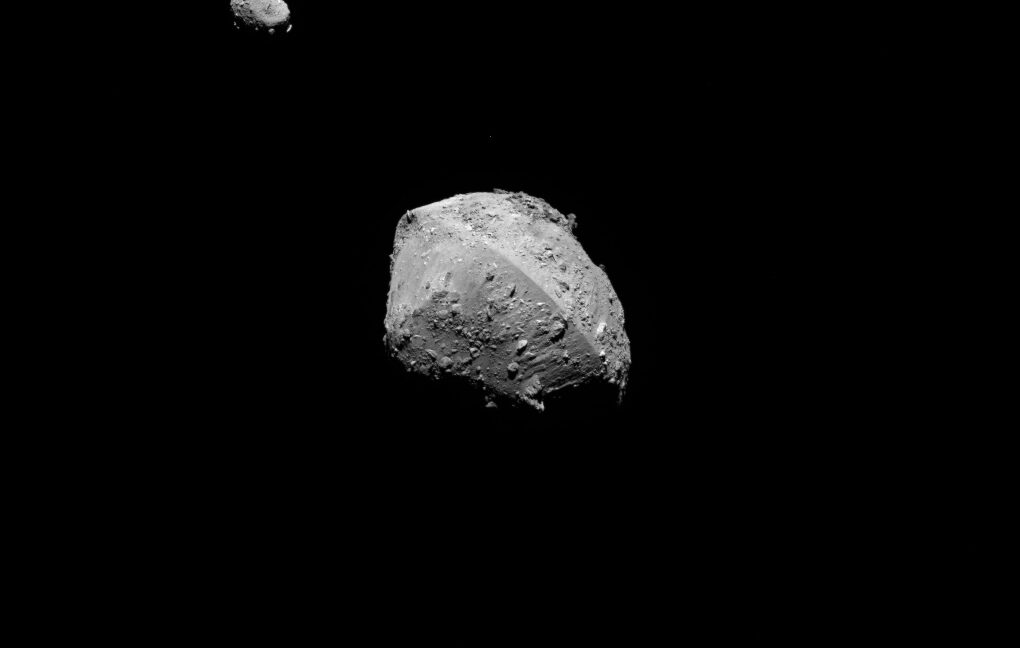
The physical state of Dimorphos itself has also stunned the scientific community. While the primary body, Didymos, continues to rotate smoothly on its axis, Dimorphos is now tumbling erratically. Patrick Michel, Hera’s principal investigator from the Côte d’Azur Observatory in Nice, France, noted that mission planners had theorized two primary outcomes prior to Hera’s arrival: either DART would carve a traditional impact crater, or it would entirely deform the asteroid’s morphology.
"In fact, we did both because the crater is so large that the shape has changed," Michel explained. "Therefore, we are in a sort of a transition between just cratering and global transformation, and we are still not sure how this can happen."
Official Responses and Scientific Implications
The collaborative nature of the DART-Hera campaign represents a major milestone in international planetary defense initiatives, coordinated largely through frameworks established by NASA and the European Space Agency.
Sabina Raducan, a planetary scientist at the International Space Science Institute in Bern, Switzerland, reflected on the immediate post-impact phase: "We knew right away that the impact was successful, that DART made a really, really large mess. However, we didn’t really know what kind of mess. We were still missing pieces of the puzzle."
Michael Kueppers, ESA’s Hera mission scientist, emphasized the dynamic nature of the target: "As Hera returned more images, it became clear that the DART impact has left Dimorphos tumbling wildly in its orbit."
Naomi Murdoch, a planetary scientist at the Institut Supérieur de l’Aéronautique et de l’Espace in Toulouse, France, highlighted the surprise of finding a densely populated neighborhood surrounding the binary system. "As we approached Didymos and Dimorphos, we quickly realized the asteroids were not alone," Murdoch said. "In fact, they had a lot of company… Hera came to visit two asteroids, and we found hundreds of companions."
Broader Impact and Future Outlook
The implications of the Hera mission extend far beyond the Didymos-Dimorphos system. Near-Earth asteroids vary widely in their physical composition, internal porosity, density, and structural integrity. Some are solid rock monoliths, while others—such as Dimorphos—are colloquially known as "rubble piles," loosely held together by weak gravitational forces.
By utilizing Hera and its forthcoming deployable CubeSats, Juventas and Milani, scientists hope to map the internal mass distribution, radar reflectivity, and surface mechanical properties of Dimorphos. This empirical data will serve as an essential calibration tool for global predictive computer models.
Ultimately, these models will allow space agencies worldwide to refine kinetic impact strategies, ensuring that if a threatening near-Earth asteroid is ever detected on a collision course with our planet, deflection maneuvers can be tailored precisely to the target’s unique physical characteristics. As Patrick Michel summarized, unlocking the complete physical dynamics of the DART impact represents the definitive breakthrough required to secure long-term planetary defense capabilities.