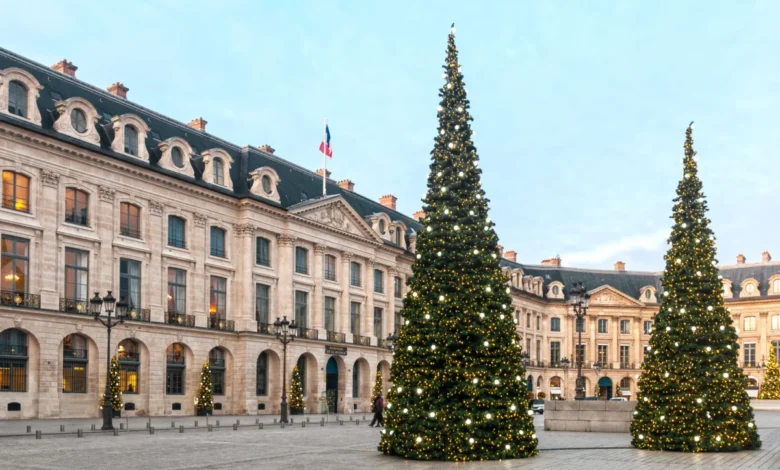
While Strasbourg holds the historical distinction of being France’s holiday capital with the nation’s oldest Marché de Noël, Paris transforms into an unrivaled winter wonderland when the festive season arrives. The French capital shines brighter with each passing year, deploying thousands of sustainable LED lights to illuminate its grandest squares, historic boulevards, and architectural landmarks—most notably the Champs-Élysées, widely celebrated as one of the world’s most beautiful avenues.

Holiday cheer permeates all 20 arrondissements, turning the metropolis into a tapestry of larger-than-life evergreen garlands, towering fir trees heavy with ornate baubles, and intricate sculptural light installations. Traditional wooden chalets pop up across the city, dispensing steaming cups of vin chaud (mulled wine) and regional holiday specialties such as rich foie gras spread generously over subtly sweet pain d’épices (traditional French gingerbread).
The Evolution and Chronology of Parisian Holiday Traditions
The celebration of Christmas in Paris is steeped in a rich history that bridges centuries-old religious observances with modern commercial artistry. Long before the era of illuminated grand boulevards, Parisian winters were marked by midnight masses (la Messe de Minuit) and modest neighborhood markets.

In the post-World War II era, the city’s economic recovery ushered in a new golden age for holiday retail and public spectacles. By the late 20th century, the municipality of Paris, in collaboration with merchants’ associations along the Champs-Élysées and major department stores, institutionalized the grand holiday lighting ceremonies. Today, these illuminations are officially inaugurated in mid-November by a designated celebrity guest, setting off a six-week period of intense economic activity and cultural celebration that culminates in early January.
Culinary Institutions and Seasonal Delicacies
Gastronomy remains central to the Parisian holiday experience. Alongside the ubiquitous vin chaud and gingerbread, traditional winter items dominate local menus. Fresh oyster stands become as much a fixture of the Parisian holidays as the Christmas markets themselves, frequently set up on sidewalks outside brasseries and seafood markets. Sourced primarily from Brittany and Normandy, these oysters are traditionally consumed with a splash of mignonette sauce and a crisp white wine.

Visitors looking to celebrate the season in true French fashion can embark on a movable feast, dining and drinking at the city’s most iconic establishments. These range from historic Left Bank cafés—where legendary writers, philosophers, and artists once gathered to escape the winter chill—to legendary palace hotels huddled around the prestigious Place de la Concorde and Place Vendôme.
Local restaurateurs and hospitality groups have reported a steady surge in seasonal reservations, noting that culinary tourism plays a vital role in sustaining the city’s hospitality sector during what would otherwise be a traditional shoulder season. According to regional tourism boards, international and domestic visitors consistently cite Parisian gastronomy as a primary motivating factor for winter travel.

Retail Therapy and the Art of the Holiday Window Display
Parisian department stores—known locally as grands magasins—elevate holiday visual merchandising to a fine art. Retail institutions such as Galeries Lafayette, Printemps, Le Bon Marché, and BHV Marais unveil their elaborate holiday window displays (vitrines de Noël) in early November. Executed with the same meticulous style, theatrical precision, and narrative depth as a haute couture fashion show, these displays attract millions of spectators annually, rivaling and often surpassing similar holiday spectacles in New York City, London, and Tokyo.
Behind each display lies months of engineering, artistic design, and mechanical craftsmanship. Visual artists, puppet makers, and lighting technicians collaborate year-round to construct immersive narrative tableaus that animate the facades of these historic buildings. Industry analysts note that these window displays serve a dual purpose: they drive immediate foot traffic to the retail floors and reinforce the global brand identity of Paris as the undisputed capital of style and elegance.

Economic Impact and Tourism Trends
The winter holiday season represents a critical financial window for the city of Paris, particularly following years of economic volatility and shifting travel patterns. According to data compiled by the Paris Convention and Visitors Bureau, the weeks surrounding Christmas and New Year generate billions of euros in economic output, directly benefiting retail, hospitality, transport, and cultural sectors.
City officials and tourism economists emphasize that the influx of holiday travelers helps buffer the local economy against seasonal slumps. Hotel occupancy rates experience a sharp spike throughout December, driven by a balanced mix of regional European travelers, domestic tourists, and long-haul visitors from North America and Asia.

Moreover, municipal investments in energy-efficient holiday lighting—utilizing low-consumption LED technology and timer-controlled systems—demonstrate a concerted effort to balance traditional festive pagearness with contemporary environmental standards. Paris City Hall has continuously optimized its energy consumption for the Champs-Élysées illuminations, reducing overall power usage by a significant margin compared to standards from a decade prior, without diminishing the visual impact of the displays.
Cultural Significance and Social Integration
Beyond commerce and tourism, the holiday season in Paris serves an important social function for local residents. Neighborhood markets, communal ice-skating rinks set up near prominent civic landmarks, and community-led charitable food drives foster a sense of shared civic identity.

While the city may not experience reliable natural snowfall during the winter months, the festive spirit remains robust, matching the atmosphere found on the ski slopes of the French Alps. The integration of alpine chalets, regional culinary pop-ups, and festive programming across diverse neighborhoods ensures that the holiday spirit is equitably distributed, rather than confined solely to affluent commercial districts.
Urban planners and sociologists observing the transformation of Paris during December note that public spaces are successfully repurposed to encourage pedestrian engagement. Closing certain streets to vehicular traffic and expanding pedestrian walkways around markets and department stores promotes a walkable, community-oriented urban model that aligns with broader municipal goals for sustainable city living.

Conclusion and Outlook
As Paris continues to adapt to evolving global tourism trends and environmental imperatives, its approach to celebrating Christmas remains deeply rooted in heritage while embracing modern innovations. Whether visitors choose to explore the historic wooden chalets of the traditional markets, admire the haute couture-inspired window displays of the grand boulevards, or sample fresh seasonal oysters at a classic Left Bank café, the City of Light offers a multifaceted holiday experience.
For travelers planning a winter excursion to France, the capital provides a wealth of distinct activities that capture the essence of the season. As official winter programming expands and refines itself year after year, Paris solidifies its reputation not merely as a warm-weather destination, but as a premier global capital for winter magic, architectural splendor, and culinary excellence.