The Prati neighborhood of Rome, characterized by its wide boulevards and fin-de-siècle architecture, has long served as a bridge between the Vatican’s ecclesiastical grandeur and the bustling commercial energy of the modern city. It is within this historic enclave that Roman designer Ludovica Malagò and her partner Gaia Rebecchini, founders of Studio Malià, have completed a sophisticated restoration of a residence that serves as both a private home and a testament to the city’s enduring creative spirit. The project, centered in a building dating back to 1927, represents a growing movement among young Italian creatives who are seeking to reconcile Rome’s millennia-old historical weight with a vibrant, contemporary aesthetic.

The apartment, located in what locals traditionally refer to as the "artists’ condominium," was originally designed by the celebrated architect Mario De Renzi. De Renzi, a prominent figure in the Italian Rationalist movement, is perhaps best known for his work on the Palazzo delle Poste in Rome, and his influence is visible in the apartment’s rigorous yet elegant proportions. For decades, the space functioned as an active atelier, most notably serving as the studio for architect Cesare Rovatti. When Malagò and Rebecchini first encountered the property in early 2023, it had sat largely untouched and technically abandoned for several years, yet it retained an undeniable gravitational pull for those attuned to architectural history.

A Legacy Reclaimed: The History of Mario De Renzi’s Atelier
The building’s façade, adorned with elegant rustication, frescoes, and expansive stained-glass windows, stands as a premier example of early 20th-century Roman residential design. However, the interior had suffered from years of neglect and previous, less-sensitive renovations that had obscured its original character. The acquisition of the property required more than just a financial transaction; it necessitated a shared vision between the past and the present. Cesare Rovatti, the previous long-term occupant, reportedly agreed to the sale only after reviewing Studio Malià’s comprehensive plans for the space, ensuring that the atelier would continue its legacy as a site of artistic production rather than being partitioned into a standard residential unit.

The renovation began in earnest in January 2023. The designers’ primary objective was to peel back the layers of the 20th century to reveal the architectural "bones" of the De Renzi era. During the demolition phase, the team uncovered several fortuitous elements that had been hidden behind wallpaper and drop ceilings, including intricate floral wall moldings and original historical motifs. These discoveries prompted a shift in the project’s scope, moving from a standard modernization toward a meticulous restoration that integrated these vintage details with high-performance modern materials.

Structural Innovation: The Interplay of Light and Levels
One of the most significant challenges of the renovation was the apartment’s original layout, which featured a dark, cramped entryway constrained by heavy load-bearing walls. To address this, Malagò and Rebecchini focused on a strategy of "chromatic illumination." Instead of structural demolition, which was limited by the building’s protected status, they utilized color and light-reflective materials to transform the foyer. The result is a striking sunburst mosaic floor, rendered in 12 distinct colors, which immediately signals the apartment’s transition from a historic exterior to a contemporary interior.

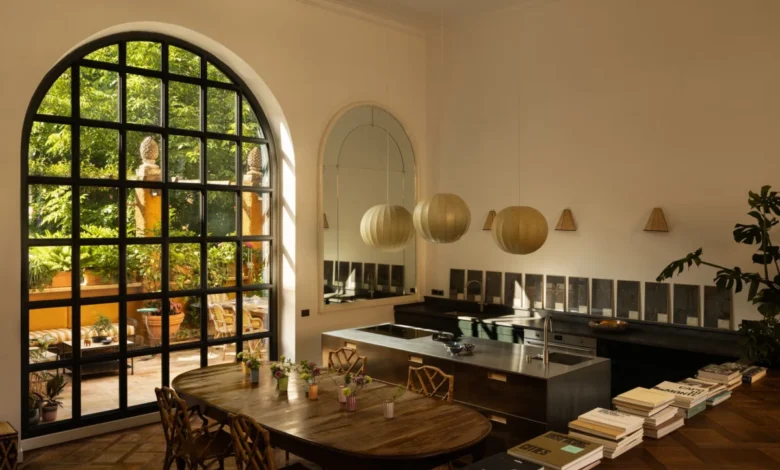
The heart of the home is a voluminous, open-plan space that integrates the kitchen and living areas. To define these zones without the use of walls, the designers employed a split-level floor plan. The living room sits on a platform raised several feet above the kitchen, creating a physical hierarchy that separates the utility of food preparation from the relaxation of the lounge. This elevation also allows the living area to better capture the light streaming through the large, iron-paned windows. These windows were custom-made to replace non-original fixtures, their design a direct tribute to De Renzi’s original blueprints, which the designers recovered from the historical archives of the City of Rome.

Materiality and Craftsmanship: Bridging the Vintage and the Contemporary
The interior design of the apartment is a masterclass in the juxtaposition of textures and eras. Studio Malià’s philosophy leans heavily on the collaboration with local artisans, including carpenters, blacksmiths, and stoneworkers, to ensure that every new addition carries the same weight of craftsmanship as the original structure. In the kitchen, a sleek, industrial-style steel island by Boffi stands in sharp contrast to a 19th-century Piedmontese wooden dining table. Above this assembly hang three vintage spherical pendant lights by the legendary Achille Castiglioni, their planetary forms providing a mid-century counterpoint to the room’s classical proportions.

The living area continues this dialogue between periods. It is anchored by a vintage French wooden chest of drawers, above which hangs a large-scale photograph by Massimo Vitali depicting the Scala dei Turchi in Sicily. The seating arrangement features a pair of 1960s SZ01 armchairs in iron and straw by Martin Visser, facing a custom sofa upholstered in neutral tones. This mix of high-modernist furniture and rustic, natural materials like straw and raffia is a recurring theme throughout the residence, reflecting a desire to create a space that feels curated over time rather than decorated in a single moment.

The Private Quarters: Color, Texture, and Intimacy
The transition to the more intimate areas of the apartment is marked by a dramatic hallway featuring a mirrored ceiling and deep grape-colored carpeting. This sensory shift prepares the visitor for the bedrooms, which are designed as colorful sanctuaries. In the principal bedroom, an olive-green lacquered iron staircase leads to a lofted study, serving as a functional sculpture within the room. The bed itself is a custom linen piece, complemented by a burgundy headboard crafted by local artisans and a bedspread made in Egypt by Madu Cairo.

The walls of the private quarters are decorated with botanical motifs and works of art that evoke a sense of pastoral romanticism. Malagò, who also owns the apartment, personally created a series of paintings with Japanese motifs for the bedroom walls. These artistic touches are echoed in the ensuite bathroom, where green cement tiles by Emery & Cie are decorated with delicate leaf patterns. The bathroom’s vanity, custom-made from bamboo and raffia, further reinforces the connection to natural textures, while vintage 1950s wicker mirrors add a touch of mid-century Italian charm.

A Green Oasis: The Urban Terrace
Extending from the kitchen through a large iron-and-glass arched window is a lush terrace that functions as an outdoor living room. In a city as densely built as Rome, private green space is a significant luxury, and Studio Malià treated the terrace with the same architectural rigor as the interior. The landscaping is a curated mix of Japanese maples, climbing plants, evergreens, and tropical species, designed to provide privacy while blending into the Roman skyline.

The terrace is divided into distinct zones for dining and relaxation. The furniture, provided by Unopiù, is upholstered in high-performance fabrics from Loro Piana and Rubelli, bridging the gap between indoor luxury and outdoor durability. The dining chairs, designed by Maison Drucker—the oldest artisanal manufacturer of rattan chairs in France—feature colorful weaves that echo the vibrant sunburst mosaic of the apartment’s entryway. This consistency of color and material creates a seamless flow between the interior "garden" of botanical moldings and the literal garden of the terrace.

Broader Impact: Rome’s Changing Design Identity
The restoration of the De Renzi atelier is more than a private residential project; it is a case study in the revitalization of Rome’s historic center. For years, cities like Milan have been the primary focus of Italy’s contemporary design scene, while Rome was often viewed as a living museum, resistant to change. However, projects like this one by Studio Malià suggest a shift. By engaging with the city’s historical archives and collaborating with traditional craftsmen, a new generation of designers is proving that Rome’s architectural heritage can serve as a foundation for modern living rather than a constraint.

Data from the Italian real estate market suggests a growing demand for "turnkey" renovations in historic neighborhoods like Prati and Trastevere, where buyers are looking for the prestige of a period building combined with the amenities of a modern smart home. The success of the Malagò-Rebecchini project lies in its ability to satisfy this demand without sacrificing the soul of the original architecture. Their work emphasizes the importance of "adaptive reuse"—a sustainable approach to urban development that prioritizes the restoration of existing structures over new construction.

As Rome continues to attract international creatives and digital nomads, the "artists’ condominium" in Prati stands as a beacon of what is possible when history is treated with both reverence and imagination. By weaving together vintage finds, artisanal craftsmanship, and bold contemporary colors, Studio Malià has created a space that is quintessentially Roman yet entirely of its time—a magical, pastoral world tucked away in the heart of the Eternal City.