In the heart of Rome, a city often defined by its layers of ancient history, a new generation of creatives is redefining what it means to live and work within the capital’s architectural heritage. Among the leaders of this movement is Ludovica Malagò, a Roman designer who, alongside her partner Gaia Rebecchini, founded Studio Malià. Their most recent project—a meticulously restored apartment in the prestigious Prati neighborhood—serves as a definitive case study in how to harmonize contemporary aesthetics with the weight of Italian history. The space, which Malagò now calls home, is not merely a residence but a revived sanctuary for artistic expression, reclaiming its identity nearly a century after its inception.

The Prati district, where the apartment is located, represents a unique era of Roman urban planning. Developed in the late 19th and early 20th centuries after the unification of Italy, Prati was designed to be a modern, secular counterpoint to the papal architecture of the nearby Vatican. Its wide, gridded streets and Art Nouveau (Liberty style) buildings have long attracted the city’s professional and creative elite. The apartment in question, housed within a building dating back to 1927, was originally designed by the celebrated architect Mario De Renzi. De Renzi is a pivotal figure in Italian architectural history, known for his contributions to Italian Rationalism and his work on landmark structures such as the Palazzo delle Poste in Marmorata.

The Legacy of the Artists’ Condominium
Locally, the building is known as "the artists’ condominium," a moniker earned through decades of hosting some of Rome’s most influential creative minds. Before Studio Malià began its intervention, the unit served as the long-time studio of architect Cesare Rovatti. For years, the halls were frequented by painters, sculptors, and fellow architects, making it a hub of intellectual and artistic exchange. However, by the time Malagò and Rebecchini first visited the site in January 2023, the space had been technically abandoned for several years, preserved in a state of suspended animation.

The acquisition of the property was as much a matter of shared vision as it was a financial transaction. Rebecchini recalls that Rovatti was hesitant to part with the studio that had defined his professional life. It was only after reviewing Studio Malià’s comprehensive plans for a respectful transformation that he agreed to the sale. The designers’ goal was clear from the outset: the atelier had to return to its roots as a home for artistic creativity, rather than being stripped of its character for a conventional modern renovation.

Chronology of Restoration and Architectural Discovery
The restoration process, which spanned most of 2023, was characterized by a series of fortuitous discoveries. As layers of old wallpaper and subsequent renovations from the 1970s and 80s were stripped away, the original 1927 details began to emerge. The designers uncovered hidden floral wall moldings and historical motifs that had been obscured for decades. One of the most significant finds was a concealed spiral staircase, which the duo restored to provide access to a lofted study, reinforcing the apartment’s verticality and its original function as a multi-level workspace.

A primary challenge of the renovation was the apartment’s lighting. Despite the grand proportions of the building, certain areas, such as the entryway, were originally dark and constricted by heavy load-bearing walls. Malagò and Rebecchini chose to address this through a bold use of color and materiality rather than structural demolition. The result is a vibrant entryway anchored by a custom sunburst mosaic floor. Rendered in 12 different colors, the mosaic transforms the previously somber corridor into a celebration of light and movement.

Structural Fluidity and Historical Fidelity
The architectural layout of the apartment is divided across two levels. The lower floor retains a more traditional Roman residential structure, while the upper level offers an intimate retreat. The center of the home is a sprawling open-plan area that integrates the kitchen and living room. To define these distinct functions without the use of walls, the designers employed a physical elevation change; the living area sits on a platform raised a few feet above the kitchen.

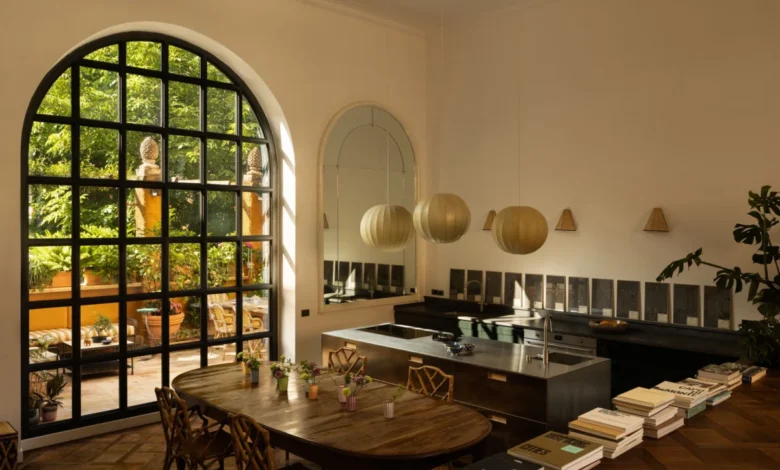
This sense of volume is enhanced by soaring ceilings and the installation of new, iron-paned windows. These windows were not a modern whim but a meticulous "tribute to the façade’s original design," according to Rebecchini. The design team conducted extensive research in the historical archives of the City of Rome to ensure the new frames matched the architect Mario De Renzi’s original vision from 1927. This commitment to historical fidelity ensures that while the interior feels contemporary, it remains in constant dialogue with the building’s exterior.

A Curation of Italian and International Design
The interior design of the apartment is a masterclass in eclectic curation, blending high-end Italian manufacturing with vintage European finds and custom artisanal pieces. The living room is anchored by a vintage French wooden chest of drawers, above which hangs a photograph by Massimo Vitali. Vitali, renowned for his large-scale beach panoramas, provides a contemporary Italian perspective that complements the room’s neutral-toned custom sofa.

Furniture choices reflect a deep appreciation for mid-century modernism. A pair of 1960s SZ01 armchairs in iron and straw by the Dutch designer Martin Visser face the seating area, providing a textural contrast to the more polished surfaces. The use of natural materials like straw, raffia, and bamboo is a recurring theme throughout the home, used to soften the industrial elements.

In the kitchen, the aesthetic shifts toward the sleek and functional. A stainless-steel island by Boffi, a titan of Italian kitchen design, stands as a centerpiece. Above it, three vintage spheres by Achille Castiglioni—one of the most influential Italian designers of the 20th century—hang at varying heights. The walls are adorned with an Uchiwa wall sconce by Ingo Maurer, while striped Murano glass vases by France Thierard add pops of color to a 19th-century Piedmontese wooden table.

The Integration of Nature: The Terrace Oasis
One of the apartment’s most striking features is its seamless connection to the outdoors. A large, arched iron-and-glass window in the kitchen leads to a lush terrace that functions as an outdoor living room. In a city as dense as Rome, such green spaces are highly coveted, and Studio Malià treated the landscaping with as much detail as the interior.

The terrace is a "green oasis" designed to blend into the Roman urban landscape. It features a sophisticated mix of Japanese maples, tropical species, climbing plants, and evergreens. The furniture is a blend of luxury and tradition: Unopiù outdoor pieces are upholstered in custom fabrics from Loro Piana and Rubelli—two of Italy’s most prestigious textile houses. The dining chairs, produced by Maison Drucker (the oldest artisanal manufacturer of rattan chairs in France), feature colorful weaves that echo the botanical motifs found inside the home.

Materiality and the Artisan’s Touch
Throughout the apartment, there is a palpable sense of craftsmanship. Rebecchini emphasizes that almost every piece in the home resulted from a direct collaboration with local carpenters, blacksmiths, and stoneworkers. This "artisan-first" approach is particularly evident in the private quarters.

In the principal bedroom, an olive-green lacquered iron staircase serves as a sculptural anchor. The bed is dressed in linens from Madu Cairo and pillows by Society, while the wall features a series of paintings by Malagò herself, depicting Japanese motifs. The ensuite bathroom continues the botanical theme with green cement tiles by Emery & Cie, complemented by a custom cabinet made of bamboo and raffia.

The hallway, perhaps the most daring space in the home, features a mirrored ceiling and grape-colored carpeting. This iridescent environment serves as a gallery for works by M. Galimberti and custom velvet poufs designed by Studio Malià. The wardrobe doors in this area are decorated with hand-painted botanical designs by interior designer Maria Restivo, further blurring the line between the interior decor and the "pastoral world" of the terrace.

Broader Impact and Design Implications
The transformation of this 1927 atelier reflects a broader trend in the European luxury real estate market: the move toward "hyper-personalization" and "heritage storytelling." Modern homeowners in historic cities are increasingly moving away from "white-box" minimalism in favor of spaces that tell a specific story of place and provenance.

By restoring the "artists’ condominium" to its former glory, Studio Malià has contributed to the preservation of Rome’s 20th-century architectural identity. The project demonstrates that historical preservation does not require a sacrifice of modern comfort or aesthetic boldness. Instead, by layering contemporary art, industrial steel, and vibrant color over a Rationalist architectural foundation, Malagò and Rebecchini have created a home that is uniquely Roman yet thoroughly global.

The success of this project also highlights the enduring value of the "Made in Italy" brand. The integration of Boffi, Loro Piana, and Murano glass alongside the work of local Roman craftsmen reinforces the idea that the future of luxury design lies in the support of traditional artisanal skills. As Rome continues to attract a new generation of international creatives, projects like this serve as a blueprint for how the Eternal City can evolve without losing its soul. The apartment in Prati is no longer just a relic of 1927; it is a living, breathing testament to the power of restorative design.