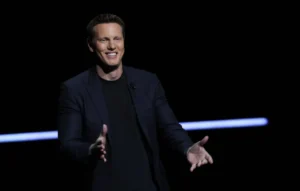
Fresh from his role in the highly anticipated Star Wars: Starfighter, actor Daniel Ings is embarking on a new cinematic journey, joining Jessica Brown Findlay, known for her compelling performances in Peaky Blinders and Downton Abbey, in Olivia Grant’s directorial debut, the short film The Two Week Wait. This intimate drama promises to shed light on a deeply personal and often unspoken aspect of reproductive health, marking a significant step for Grant, who is transitioning from a celebrated acting career to filmmaking.
The ensemble cast also features notable talents such as Fenella Woolgar (Call the Midwife), Rick Warden (Happy Valley), and Sophie Colquhoun (Captain America). The narrative centers on a woman in her late thirties, portrayed by Brown Findlay, who grapples with a series of dissociative experiences as her mental health deteriorates under the emotional strain of in vitro fertilization (IVF). Her journey is compounded by her relationship with her boyfriend, played by Ings, depicted as well-intentioned but ultimately out of his depth.
The Two Week Wait, written by Grant herself, is a co-production between her newly established production banner, Cavalry Films, and Symphony Films, a venture helmed by actor-producers Rebecca Night (Wuthering Heights) and Harry Hadden-Paton (The Crown). The film is slated for its premiere on Tuesday at the prestigious Indy Shorts Film Festival, an event that has become a vital platform for emerging filmmakers and a crucial incubator for cinematic talent.
From Actor to Director: Olivia Grant’s Artistic Evolution
Olivia Grant, a familiar face on screen with acclaimed roles in Stardust, Lark Rise to Candleford, and Indian Summers, revealed to The Hollywood Reporter that her transition to directing was fueled by a confluence of timing and a profound personal impetus. "I’ve wanted to make my own work for a while now," Grant explained, "and, like many actors, had a feature script I’d been quietly writing for a couple of years. However, there was always enough acting work to prevent me from focusing exclusively on writing, and I was ambivalent about what I would write about."
The seismic shift in her creative focus, Grant stated, was catalyzed by the COVID-19 pandemic. "Firstly, it cleared time to focus on generating new work," she elaborated, "and secondly, it coincided with my personal struggles with IVF and its mental toll. As a way to hold onto my sanity, I ended up writing a 30,000-word diary documenting the rollercoaster of grappling with my infertility and transcribing the arguments my husband and I were having, which felt very specific to the process and uniquely gendered."
This intensely personal experience provided Grant with the raw material and the urgent motivation to translate her lived reality into a cinematic narrative. "It was only as the world opened up again, and I was able to reconnect with more women and couples, that it became clear that many elements of my mental anguish were remarkably universal," Grant shared. "My shame around not being able to have a child and what that meant was normal; my partner’s difficulty salving that particular wound for me was perhaps predictable, and the intense sense of dissociation that permeated that period was again part of the experience for many. Like a lot of women, I did not share the experience with my close friends and family, and suddenly felt there was a real need to shed some light on what can be the profound interpersonal effects of this remarkably successful, albeit oft-harrowing, process."
Thematic Resonance and Production Details
The short film The Two Week Wait serves as a powerful proof of concept for Grant’s ambitious feature-length narrative, tentatively titled Baby Mine, which is slated for release in 2027. Both Daniel Ings and Jessica Brown Findlay are attached to reprise their roles in the feature, underscoring their commitment to the project and Grant’s vision. Amy Hubbard, a casting director with a distinguished career, is also on board, ensuring that the talent behind and in front of the camera aligns with the film’s artistic integrity.
Daniel Ings, reflecting on his involvement, expressed his admiration for Grant’s emerging talent. "Olivia is a singular new voice in British filmmaking, with a lot to say on some fairly universal themes affecting many women," Ings commented. "Getting to work with her, Nanu Segal [cinematographer], and Jessica Brown Findlay on this beautiful film was an embarrassment of creative riches. You haven’t heard the last of Olivia Grant."
Rebecca Night, co-head of Symphony Films, echoed Ings’ enthusiasm, describing Grant’s script as "so instantly unique, compelling, and beautiful." Night elaborated, "[The script] deals with the choices we make, the relationships we foster, and people seeking love and connection as they journey together through life’s struggles. Full of drama, yes, but so witty and heart-wrenching too." This sentiment highlights the film’s dual capacity to provoke thought and evoke deep emotional responses from its audience.
The "Two Week Wait" Phenomenon: A Growing Conversation
The "two-week wait" is a universally recognized, yet often intensely private, period in the IVF process. It refers to the time between embryo transfer and when a pregnancy test can reliably detect conception. This interval is fraught with anxiety, hope, and a profound sense of uncertainty, as individuals and couples anxiously await results that can significantly alter their future. The emotional toll of this period is well-documented, with studies indicating high levels of stress, anxiety, and depression among individuals undergoing fertility treatments.
According to a 2021 report by the American Society for Reproductive Medicine (ASRM), approximately 30% of women undergoing IVF experience symptoms of moderate to severe depression, and a similar percentage report elevated levels of anxiety. The psychological burden is not limited to the individual undergoing treatment; partners also report significant emotional distress and a feeling of helplessness. The societal pressure to conceive, coupled with the medicalization of reproduction, can exacerbate these feelings, leading to isolation and strain on relationships.
Grant’s film directly addresses this often-overlooked aspect of fertility treatments, aiming to destigmatize conversations around infertility and the mental health challenges associated with it. By portraying the dissociative experiences and the unique gendered dynamics of this journey, The Two Week Wait seeks to foster greater understanding and empathy. The film’s premise taps into a growing societal awareness of mental health issues, particularly those that are deeply personal and not always visible.
Broader Implications and Future Outlook
The emergence of The Two Week Wait at a prominent film festival like Indy Shorts signifies a positive trend towards greater representation of diverse human experiences in cinema. The film’s focus on the emotional and psychological impact of IVF has the potential to resonate deeply with a significant portion of the population, both those who have direct experience with fertility treatments and those who are seeking to understand the complexities faced by loved ones.
The success of this short film could pave the way for further exploration of these themes in longer formats, potentially contributing to a broader cultural dialogue about reproductive health, mental well-being, and the societal pressures surrounding parenthood. The collaboration between established actors and emerging directorial talent, supported by experienced producers, suggests a robust foundation for future projects.
The decision by Cavalry Films and Symphony Films to invest in such a personal and potentially challenging narrative underscores a commitment to storytelling that prioritizes emotional authenticity and social relevance. As Grant moves forward with the feature-length Baby Mine, the anticipation for her unique perspective on the human experience of fertility will undoubtedly grow. The film’s premiere at Indy Shorts will serve as a crucial benchmark, offering an early indication of its critical and audience reception, and potentially setting the stage for wider distribution and continued critical acclaim. The artistic and thematic ambitions of The Two Week Wait position it as a noteworthy contribution to contemporary cinema, poised to initiate important conversations and offer solace and recognition to many.