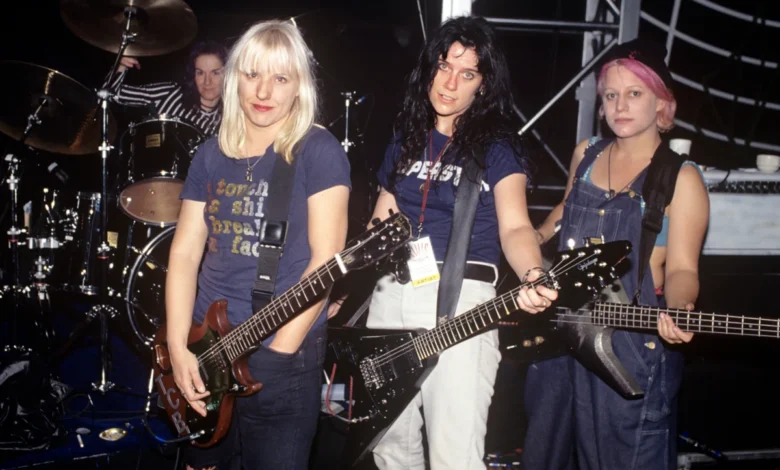
This story was originally published in the August 11, 1994 issue of Rolling Stone.
The scene is Gladstone’s, a renowned seafood restaurant gracing the Santa Monica, California, beachfront. Here, the members of L7 indulge in what they term "Godzilla food"—platters laden with lobster, clams, mussels, and shrimp, a veritable feast fit for an emerging nation. Their sustenance arrives courtesy of a waitress, whose attire sparks a brief, characteristic observation from the band. "Ever since we signed to a major label, whenever we have any kind of meeting, we make them take us out for lobster," explains L7 vocalist Donita Sparks with a disarming cheerfulness, framing this indulgence as a distinctly "punk thing to do."
Bassist Jennifer Finch, whose own cropped top mirrors a relaxed approach to fashion, wryly notes, "Our waitress doesn’t have enough clothes on." Combined with a pierced navel, a constellation of tattoos, and a solid frame, Finch embodies a confrontational aesthetic rather than a conventionally alluring one. L7, it’s clear, embraces their role as the distinct outliers in any setting, Gladstone’s included. Drummer Dee Plakas sports vibrant green hair, a bold statement against the prevailing trends. Guitarist Suzi Gardner, meanwhile, showcases a jacket adorned with a patchwork of multicolored leather, a nod to the resurgent ’70s revival, yet worn with an undeniable L7 edge.
Emerging into an era shaped by grunge and the burgeoning riot grrrl movement, L7’s foundation remains firmly rooted in old-school punk rock. This DIY ethos, a defiant "fuck-you" spirit, is palpable in their music and attitude. Influences like the Ramones, Sex Pistols, and X resonate in their sound: an inspired, almost insanely energetic sloppiness, characterized by mean, squealing, and subversive guitar riffs wielded by Sparks and Gardner as potent weapons. Their lyrics are equally uncompromising, articulating a ferocious, Thelma & Louise-esque feminism that champions defiance and self-determination.
The anthemic refrain of "Shirley," from L7’s then-recent album Hungry for Stink, encapsulates this spirit. The song is a tribute to champion drag racer Shirley Muldowney, famously responding to a reporter’s question about a woman racing in a male-dominated sport with a simple, powerful declaration: "Winning." L7 loops this declaration throughout the track, a mantra of unwavering success. "It was so ironic, because in the beginning, we used to get a lot of questions like that," Finch reflects, referencing the predictable inquiries about women in a "man’s world." L7 is adamant about distancing themselves from labels like "foxcore" or pigeonholing them as simply "riot grrrls."
Challenging Genre Boundaries
"To create genre out of gender is just horrible to me," Finch states emphatically. "I think journalism perpetuates that. I hope the story angles for L7 will eventually be the same as for Nirvana or Cracker. There’s a uniqueness in being a woman, but not that much." Despite their desire to be recognized for their music above all else, L7 has not shied away from using their gender to provoke and challenge. A notorious incident occurred at England’s Reading Festival in 1992, when Sparks removed her tampon onstage and tossed it into the stunned audience, a visceral act of defiance. While Tampax has yet to capitalize on this unique endorsement opportunity, Midol, whose products are a staple on L7’s concert rider, once sent the band a substantial quantity of merchandise.
Beyond their provocative performances, L7 operates with a fierce camaraderie akin to a professional sports team. Their unity is evident in their shared interests—cigarettes, politics, and an unwavering solidarity. There are no individual stars within L7; they eschew individual interviews and photo shoots, preferring to present a united front. This cohesive approach is further highlighted by their ability to finish each other’s sentences, weaving a tapestry of shared experience and inside jokes.
A History Forged in the L.A. Underground
The band’s journey began in the mid-1980s, a formative period for the Los Angeles punk scene. Practicing at the opulent home of Maxine Nazworthy, an heiress and patron of the arts, L7 found an unlikely sanctuary. Nazworthy, often described as benevolent and free-spirited, provided crucial support to a generation of L.A. punk bands, including the Chemical People, Redd Kross, and Down by Law. "It was funny driving to Beverly Hills to rehearse," Finch recalls with a wry smile, highlighting the inherent irony of their circumstances.
While Finch is the sole native Angeleno in the group, Sparks and Plakas hail from Chicago, and Gardner grew up in Sacramento. Gardner’s departure from her hometown was fueled by a dissatisfaction with the local music scene. "All these losers that were in my hometown playing rock & roll, they didn’t have a clue," Gardner asserts. "I knew I had to get out." Her past is tinged with a darker narrative, as Sparks interjects, "Suzi was involved in the River’s Edge scandal." Gardner elaborates, explaining the film’s depiction of a true crime incident resonated deeply with her own experiences and the milieu she inhabited. "I nearly was that body," Gardner confesses, a chilling testament to the volatile environment she navigated.
Fortunately, Gardner’s path converged with Sparks’, and after navigating through several less-than-ideal collaborators, they found their rhythm section in Finch and Plakas. L7’s recording career began with a 1988 release on Epitaph, followed by a 1990 EP, Smell the Magic, on Sub Pop. It was their 1992 album, Bricks Are Heavy, and its unexpectedly successful single, "Pretend We’re Dead," that propelled them into wider public consciousness, selling over 250,000 copies and significantly boosting their CD sales.
Their artistic reach extended to the silver screen when they portrayed the fictional band Camel Lips in John Waters’ 1994 film Serial Mom. "Babes in Toyland couldn’t do it," Finch quips, expressing their honor at participating in a project by a director they had long admired.
Hungry for Stink: A Statement of Intent
Now, L7 stands poised for a significant summer, marked by their inclusion in the Lollapalooza festival and the anticipated commercial success of Hungry for Stink. This album is a testament to stripped-down energy and a refusal to conform to fleeting trends, a quality that seemingly demands widespread recognition. While the album does feature occasional introspective tracks like "Andres," a poignant ballad showcasing Sparks’ remarkably expressive vocal range—a dynamic blend of squeals, growls, and soaring notes—it is the underlying current of deep defiance that elevates the record. Sparks’ declaration, "People like you just fuel my fire!" on the track of the same name, backed by a driving, almost chaotic rhythm section, encapsulates the album’s aggressive yet joyous spirit.
The sentiment of "People Like You" can be interpreted as a broad indictment of oppressive forces, including conservative political factions and general antagonists. However, L7’s most prominent political engagement remains through Rock for Choice, a pro-choice organization they co-founded in 1991. Their ambition for the summer is to see Rock for Choice represented with a booth at Lollapalooza.
Rock for Choice: Advocacy and Action
"When we started Rock for Choice," Sparks explains, "one of the things that concerned us the most was that Bush was in office representing a huge contingent to take away women’s rights." The organization’s mission has evolved to address more immediate, grassroots needs. Currently, funds raised by Rock for Choice are allocated to purchasing surveillance equipment and bulletproof vests for clinic workers, essential protective gear costing approximately $2,500 each.
Rock for Choice benefit concerts across the country have been instrumental in raising substantial funds for the Fund for the Feminist Majority. "More than our goal," Sparks reports. However, the challenges of activism were starkly illustrated during a large-scale show in Pensacola, Florida, featuring Pearl Jam. Despite the event’s magnitude, minimal funds were raised due to exorbitant production costs and stringent demands from local law enforcement for an extensive security detail. "It’s good-old-boy territory," Sparks notes, implying that the show was nearly canceled under duress.
The "good old boys" occasionally surface at L7’s performances. "There will be an occasional something like, ‘Show us your tits,’" Finch mimics in a perfect Beavis and Butt-head-esque drawl. "But we’re the ones with a microphone. To battle us is ridiculous."
Financial Realities and Fanaticism
Back at Gladstone’s, the remnants of their seafood feast, lovingly encased in tinfoil creatures of dubious identity, represent a return to L7’s less glamorous realities. "I just insulted the aluminum-foil artist by calling his whale a turkey," Plakas laments. Finch speculates on the artist’s professional aspirations, wondering if his "foil art is suffering at home because he has to do it at work."
Despite their rising profile, L7’s financial situations remain grounded. Gardner wistfully speaks of her 1973 Cadillac, which requires a significant $2,500 in repairs. Plakas navigates daily life in a bumper-sticker-adorned clunker. "My dad still drives us to the airport," Finch shares. "He’s the band dad in a way… But when we go to these guys’ towns, Suzi’s mom takes us to a buffet, and Dee’s mom cooks for us. Donita’s mom cooks for us." This familial support underscores their enduring connection to their roots.
L7 has, however, experienced the burgeoning intensity of their global fanbase. Tours in Brazil and Japan in support of Bricks Are Heavy offered a glimpse into their escalating stardom. "At first, it’s novel, and then it’s a pain in the ass," Gardner admits. "Brazilian fans are way more aggressive. In Japan, they’ll sit in front of your hotel for hours…" The contrast between the respectful patience of Japanese fans and the fervent pursuit of Brazilian admirers is striking. "In Brazil, they’ll rip your hair out," Plakas adds. Finch attempts a diplomatic approach: "You just tell them to calm down, and they usually listen." Sparks quickly refutes this, "Not in Brazil." The language barrier and sheer determination of Brazilian fans led to them chasing the band’s bus, even collecting discarded cigarette butts.
Their growing celebrity has also led to more confident interactions with other public figures. Finch recounts a peculiar encounter with Angelyne, the iconic L.A. personality. Finch requested Angelyne’s autograph for Lollapalooza, only to receive a vague response about an interview and an offer of video production services. "It was really weird," Finch muses. Reflecting on the encounter, Finch laughs, "I liked her. I saw a lot of us in her, in 20 years, with her pink Corvette…" This observation, delivered with a characteristic L7 blend of humor and self-awareness, suggests a shared understanding of navigating the fringes of celebrity and public perception.