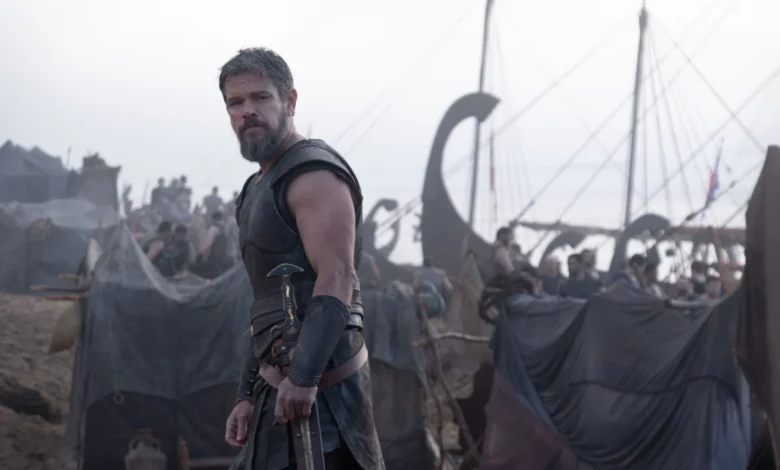
Following the critical and commercial triumph of the Academy Award-winning Oppenheimer, writer-director Christopher Nolan has returned to the silver screen with a production of unprecedented scale: a visceral, live-action adaptation of Homer’s The Odyssey. In a cinematic landscape increasingly dominated by digital environments and generative imagery, Nolan and his long-time collaborator, Oscar-nominated production designer Ruth De Jong, have executed a creative mandate that prioritizes physical reality over computer-generated artifice. The production, which spanned 91 days and six countries, represents a significant pivot back toward the "Golden Age" of epic filmmaking, utilizing massive practical sets and remote geographical locations to ground the supernatural elements of Greek mythology in tangible reality.
The ethos of the project was established early in the pre-production phase. Speaking on the design philosophy, De Jong emphasized that both she and Nolan share a deep-seated commitment to building entire environments from the ground up. This approach is intended to serve the actors, who are spared the disorientation of working against blue or green screens, as well as the audience, who are presented with a world that possesses genuine texture and atmospheric depth. When De Jong initially queried Nolan regarding the geographic parameters of the shoot, the director’s response was characteristically ambitious: "The entire world." This directive set the stage for a production that would eventually traverse the rugged terrains of Europe, Africa, and North America to capture the 20-year journey of Odysseus.

A Global Production Timeline and Logistics
The 91-day filming schedule was a logistical feat that required the coordination of international crews and the transportation of massive set pieces across oceans. The production began with the fall of Troy and moved through the various islands of the Mediterranean, eventually concluding with the hero’s return to Ithaca. To maintain the film’s grounded aesthetic, the production team avoided the use of "volume" stages or digital backlots, opting instead for a grueling travel itinerary that included Scotland, Iceland, Morocco, Greece, Italy, and the United States.
Industry analysts note that a production of this magnitude, involving such a high volume of location shooting, is rare in the modern era. By comparison, most contemporary blockbusters utilize a centralized hub—such as London’s Pinewood Studios or Atlanta’s Trilith Studios—for the majority of their principal photography. Nolan’s decision to move the entire unit across six countries reflects a "Lawrence of Arabia" approach to filmmaking, where the environment serves as a primary character in the narrative.
Reconstructing the Bronze Age: The Dual Nature of Ithaca
One of the most complex challenges for De Jong was the creation of Ithaca, the home of Odysseus (played by Matt Damon) and the site of the film’s emotional climax. The production required a location that could convey the isolation of the island kingdom while providing the architectural grandeur of a Bronze Age palace.

For the exterior shots of the palace, the team selected the 15th-century Castle of Santa Caterina, situated atop the island of Favignana in western Sicily. The location demanded physical stamina from both the cast and the crew, who were required to hike up a 900-foot incline daily to reach the set. The castle’s weathered stone and panoramic views of the Mediterranean provided a "skeletal" framework that De Jong’s team then augmented to reflect the aesthetic of the Mycenaean period.
However, the interior of the palace—specifically the megaron, or Great Hall—required a level of control that a historic site could not provide. To capture the tension as Penelope (Anne Hathaway) is besieged by the suitors, including the villainous Antinous (Robert Pattinson), the production moved to a massive soundstage in Los Angeles. This set, which spanned the length of two football fields and rose three stories high, was designed to integrate seamlessly with the Sicilian exteriors. De Jong’s team focused on "the ins and outs," ensuring that every doorway and window reflected the lighting and textures of the Italian location, effectively erasing the line between the studio and the natural world.
The Siege of Troy and the Practical Trojan Horse
The film’s opening act, the Trojan War, was staged primarily in the Ouarzazate province of Morocco. This region, often referred to as the "Hollywood of Africa," provided the mud-brick architecture necessary to depict the ancient city of Troy. De Jong described the city as the "New York City of the ancient world," a bustling, dense metropolis that required a set spanning two-and-a-half acres.

The construction of Troy included:
- The Temple of Athena, featuring functional gates and massive stone stairs.
- A network of narrow streets designed for high-speed pursuit and combat choreography.
- The importation and planting of mature olive trees to create an authentic Aegean environment.
The centerpiece of this sequence, the Trojan Horse, was a masterclass in practical engineering. Unlike previous adaptations that relied on CGI to depict the hollow wooden statue, Nolan’s team designed and built the structure in Los Angeles. It was then shipped to Essaouira, Morocco, for the beach sequences. In a display of commitment to realism, the actors—including Tom Holland as Telemachus—were physically packed into the belly of the horse while it sat half-submerged in the freezing Atlantic waters. To add a unique Nolan-esque touch, the director opted to forgo the traditional wheels on the horse, presenting it instead as a heavy, imposing monument that felt as though it had been dragged through the sand by brute force.
Nautical Engineering and the Hero Ship
Odysseus’s journey home is defined by the sea, and for Nolan, this meant filming on open water. The production required a fleet of sea-worthy vessels that could withstand the unpredictable waves of the Mediterranean and the Atlantic.

The "hero ship," a 115-foot-long vessel, was sourced from Stavanger, Norway. The production team undertook a comprehensive renovation of the boat, transforming it into a Greek trireme-style warship. This involved:
- Adding custom bronze decaling and ornamentation to the prow and stern.
- Installing functional oars and period-accurate sails.
- Ensuring the vessel met modern maritime safety standards while maintaining its ancient appearance.
The ship itself mirrored Odysseus’s journey, traveling from the stormy coasts of Scotland to the sun-drenched shores of Morocco. By filming on the open sea, the production captured the genuine physical strain of the actors as they rowed and navigated, a detail that De Jong believes is essential for the audience’s immersion.
Mapping the Supernatural: Scotland, Iceland, and Morocco
While The Odyssey is grounded in physical sets, it also features encounters with the supernatural. To represent these "otherworldly" realms, the production sought out locations with extreme natural textures.

- Circe’s Island (Scotland): The rugged cliffs and temperamental weather of the Scottish Highlands stood in for the island of the sorceress Circe (Samantha Morton). The natural mist and grey stone provided a sense of mystery and danger without the need for digital atmospheric effects.
- Hades (Iceland): For Odysseus’s descent into the Underworld, the production utilized the black sand beaches of Iceland. The stark, monochromatic landscape created a naturally desolate environment that felt appropriately subterranean and grim.
- Calypso’s Grotto (Morocco): The remote, pristine coastline of Morocco served as the home of the sea nymph Calypso (Charlize Theron). The contrast between the harshness of Troy and the lush, isolated beauty of this coast highlighted the temptation Odysseus faced to abandon his journey.
Industry Impact and the Legacy of the Epic
The scale of The Odyssey has drawn comparisons to mid-century epics like Ben-Hur and Spartacus. In an era where "spectacle" is often synonymous with visual effects, Nolan’s insistence on practical scale is viewed by many in the industry as a corrective measure.
Financial analysts suggest that while the upfront costs of a six-country practical shoot are significantly higher than a studio-bound production, the longevity and "prestige value" of a physically realized film often result in higher long-term returns. Furthermore, the use of practical sets provides a "tactile" quality that ages better than digital effects, which can become dated as technology evolves.
For Ruth De Jong, the project was the culmination of a career-long dedication to architectural integrity in film. "This movie is like the Lawrence of Arabia of our times," she remarked, reflecting on the sheer audacity of the 91-day shoot. The production serves as a testament to the fact that even in the digital age, the most powerful way to transport an audience to a world of monsters and gods is to build that world with wood, stone, and the "entire world" as a backdrop.

As The Odyssey arrives in theaters, it stands not just as a retelling of an ancient poem, but as a landmark in production design. The collaboration between Nolan and De Jong has demonstrated that the "hero’s journey" is most effective when the path beneath the hero’s feet is real. Through the hike up Sicilian cliffs, the freezing waters of Morocco, and the vast soundstages of Los Angeles, the production has successfully revived the tradition of the "Big Picture," offering a cinematic experience that is as enduring as the myth itself.