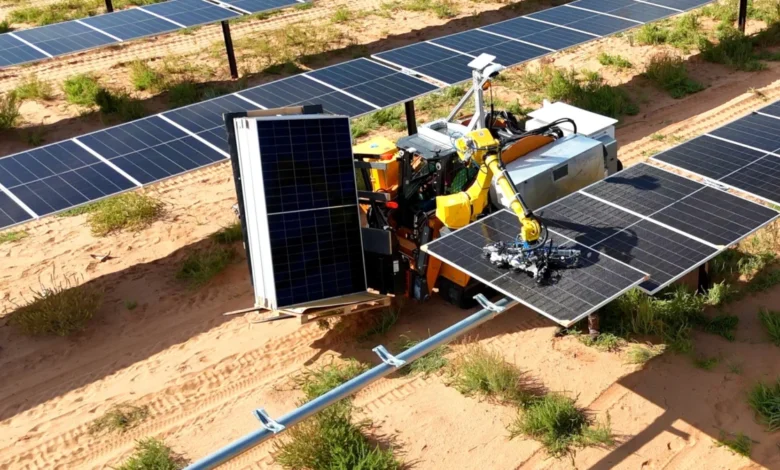
The global imperative to transition towards clean energy sources has ignited an unprecedented build-out of solar infrastructure, a monumental undertaking central to achieving energy independence and mitigating the existential threat of climate change. This rapid expansion, however, confronts a significant bottleneck: a pronounced shortage of skilled labor to meet the escalating demand for solar panel and battery installation. Traditional industrial robotics, historically confined to structured factory environments, have largely been ill-suited for the chaotic, dynamic conditions of construction sites. Yet, a new generation of artificial intelligence models is poised to fundamentally alter this equation, enabling robots to navigate and perform complex tasks in previously inaccessible outdoor settings.
At the vanguard of this technological shift is Gritt, a nascent startup founded by two Carnegie Mellon-trained roboticists, CEO Puneet Puri and CTO Vishal Dugar. The company officially emerged from stealth on Tuesday morning, announcing a substantial $26 million Series A funding round. This significant investment was spearheaded by Obvious Ventures, with additional participation from prominent firms including Union Square Ventures and Active Impact Investment. This latest injection of capital elevates Gritt’s total funding to $34 million, building upon an earlier seed round that drew support from First Round Capital, Climactic, Congruent Ventures, and VSC Ventures. Gritt’s ambitious mission, articulated by Puri, is to develop an intelligent system designed to "help civilization build infrastructure faster," starting with the critical domain of solar energy.
The urgency of this mission is underscored by the current state of global energy demand and climate targets. According to the International Energy Agency (IEA), solar PV alone accounted for two-thirds of the increase in renewable electricity capacity globally in 2023, reaching a record 510 gigawatts (GW) of new installations. The United States, a key market, saw solar power become the largest source of new electricity generation capacity for the fifth consecutive year. Projections indicate that the U.S. solar industry will need to grow its workforce by hundreds of thousands in the coming decade to meet aggressive decarbonization goals, such as those outlined in the Inflation Reduction Act. However, the solar industry, like many sectors, faces intense competition for labor. Data from the Solar Energy Industries Association (SEIA) and The Solar Foundation consistently highlight the need for more installers, electricians, and project managers, with surveys often pointing to recruitment and retention as top challenges for solar companies. The physical demands of the job, which often involve repeatedly lifting heavy, cumbersome panels – each weighing upwards of 50-75 pounds – overhead in varying weather conditions, contribute to high turnover rates and a limited pool of willing workers.
Gritt’s innovative approach sidesteps the costly and time-consuming process of designing and manufacturing robots from scratch. Instead, the company leverages readily available, off-the-shelf industrial hardware, such as rented skidders and robotic arms from established manufacturers like Kawasaki. The true ingenuity lies in Gritt’s proprietary AI models, which serve as the "brain" controlling these machines. This strategy allows Gritt to focus its engineering prowess entirely on developing the sophisticated software intelligence that enables these platforms to operate autonomously and effectively in complex, unstructured outdoor environments. As Puri explained to TechCrunch, "Our thesis is that if we truly want to speed up construction, you need an intelligence which can work in the outdoor, chaotic environments of these construction sites, and it has to be generalizable enough that it can work in these varied environments."
The initial application of Gritt’s systems targets one of the most labor-intensive and physically demanding tasks in solar farm construction: the handling and precise positioning of large glass solar panels. Gritt’s robots are programmed to autonomously unload panels from delivery vehicles, transport them across the construction site to the designated metal frames, and then accurately position them on these frames with sub-millimeter precision. This critical accuracy allows human workers to then efficiently fasten the panels, significantly streamlining the installation process.
The impact of this automation on productivity is already evident. Gritt reports that a typical eight-person human crew can install approximately 800 solar panels per day. However, when the same crew is augmented by Gritt’s intelligent systems, their daily installation capacity skyrockets to between 3,000 and 4,000 panels. This represents a staggering 375% to 500% increase in productivity, a transformation that could dramatically accelerate the pace of solar farm deployment. Such efficiency gains are not merely incremental; they are foundational to meeting ambitious global climate targets, which demand an unprecedented speed of renewable energy infrastructure development.
Andrew Beebe, the partner at Obvious Ventures who led Gritt’s Series A round, lauded the founders for their pragmatic and impact-driven approach. He drew a distinction between innovators who operate with "infinite budget for the smallest little part" and those who understand "what it means to get into dirty, dull, and dangerous jobs and scale them like mad." Beebe firmly placed Puri and Dugar in the latter category, recognizing their unique combination of "technical chops, the AI, and the machine vision skills to make it work" within the demanding realities of the construction sector. This perspective underscores a growing recognition among venture capitalists that successful robotics solutions for real-world problems require not just advanced technology, but also a deep understanding of operational realities and cost-effectiveness.
Gritt’s systems are not merely theoretical; two of their platforms are currently deployed in the field, actively collecting data that continuously refines and improves their AI models’ behavior and decision-making capabilities. The company has already secured contracts to assist in the installation of 2.8 gigawatts of solar panels over the next 18 months, a testament to the immediate demand for their solutions. Their client roster notably includes three of the top ten power construction companies in the United States, indicating strong validation from major industry players. Gritt projects an aggressive expansion, aiming to have 48 of its intelligent systems operational within the next six months.
The benefits extend beyond mere speed. A Gritt customer, who chose to remain anonymous for competitive reasons, expressed enthusiastic approval of the system’s ability to enhance their operations. This customer anticipates that Gritt’s technology will simplify work at remote construction sites, which often struggle to attract and retain workers due to their isolated locations and challenging conditions. Crucially, the customer also foresees a significant reduction in worker injuries, as the robots will shoulder the physically strenuous and repetitive task of lifting heavy solar panels overhead. This addresses a critical safety concern in the construction industry, which consistently ranks among the most hazardous occupations globally. The Occupational Safety and Health Administration (OSHA) frequently cites musculoskeletal disorders and falls as leading causes of injury and fatality on construction sites, many of which are exacerbated by manual material handling.
Gritt operates within an emerging competitive landscape, facing off against other innovative companies developing their own panel-installing robots, such as Luminous Robotics, Cosmic, and China’s Trinabot. A key strategic differentiator lies in Gritt’s aforementioned approach of utilizing off-the-shelf hardware, whereas its competitors are largely focused on building proprietary robotic hardware from the ground up. This distinction could prove pivotal in shaping which company achieves faster scalability and a leaner cost structure as the demand for automated solar installation solutions continues its steep ascent. Gritt’s asset-light model, prioritizing software intelligence over hardware manufacturing, allows for greater agility and potentially lower capital expenditure, enabling them to integrate new hardware advancements more easily as they emerge.
Looking ahead, Gritt’s vision extends far beyond merely positioning solar panels. The company plans to incrementally expand the capabilities of its intelligent systems to encompass additional manipulation tasks integral to solar farm construction, including fastening panels, drilling posts, and even assembling the support racks upon which the panels sit. The long-term ambition is to tackle a broader spectrum of common, labor-intensive construction tasks. Puri highlighted the generalizable nature of their AI platform, noting that training the system to stack cinder blocks took several weeks, but a similar demonstration for rebar tying—a complex task of binding steel reinforcement bars before concrete pouring—was achieved in just a single day using the same underlying software. This rapid adaptability underscores the power of their AI-centric approach, where the "intelligence" can be quickly retrained and repurposed for diverse applications.
The foundational enabler of Gritt’s expansive vision is unequivocally the recent surge in advanced AI models. Puri emphasized that while developing a specialized robotic system for a singular solution might have been feasible five years ago, today’s AI breakthroughs are making that work inherently generalizable. The same core AI pipeline can be reused and continuously improved across a multitude of distinct tasks, driving down development time and increasing operational flexibility. This represents a paradigm shift from brittle, task-specific automation to flexible, intelligent autonomy.
Beyond the physical execution of construction tasks, the founders envision Gritt’s systems evolving into a comprehensive layer of "physical AI" that can enhance site management and decision-making. Equipped with a suite of sensors and sophisticated intelligence, these robots could do more than just install panels; they could actively monitor the construction environment and provide critical insights. For instance, a Gritt system might detect an open trench as a storm approaches, automatically alerting workers to cover it before rain can cause damage to components or create safety hazards. Similarly, the system could flag missing inventory in real-time, preventing costly delays and optimizing supply chain management. Puri encapsulated this dual functionality: "Gritt becomes now this layer of physical AI, which is doing this dextrous, labor-intensive task, plus it can help you take decisions on the site."
The broader implications of Gritt’s technology are profound. By accelerating solar deployment, Gritt directly contributes to national energy independence, reducing reliance on volatile fossil fuel markets and strengthening national security. This expedited build-out is also a critical component in achieving global climate goals, allowing countries to decarbonize their energy grids at the pace required to avert the worst impacts of climate change. For the construction industry, traditionally slow to adopt automation, Gritt represents a significant step towards modernization, addressing longstanding issues of productivity lags, safety concerns, and workforce shortages. The infusion of AI-powered robotics promises to create new categories of jobs, shifting human workers from physically arduous roles to supervisory, maintenance, and technical positions that require different skill sets, potentially leading to an upskilled and safer workforce. As the world races to build a sustainable energy future, companies like Gritt, leveraging the latest advancements in AI and robotics, are proving to be indispensable catalysts in this monumental global transformation.