The Evolution of Tennis Architecture
The history of tennis architecture is a reflection of shifting societal values. Originating in 12th-century France as jeu de paume, the sport moved from monastic cloisters to the manicured lawns of the Victorian era. As the sport gained professional prominence in the 20th century, the design of courts shifted from functional backyard additions to monumental stadiums capable of housing tens of thousands of spectators.

The modern stadium, such as Arthur Ashe Stadium in New York, functions as a technological hub. Its massive retractable roof—the largest of any tennis venue—represents a significant engineering feat, weighing approximately 5,000 tons and requiring complex structural integration to shield the surface from inclement weather without compromising the court’s integrity. However, the most compelling developments in recent years have occurred outside the stadium-centric model, focusing instead on the symbiotic relationship between the playing surface and its surrounding topography.
.jpg)
A Geography of Seclusion: Design Beyond the Stadium
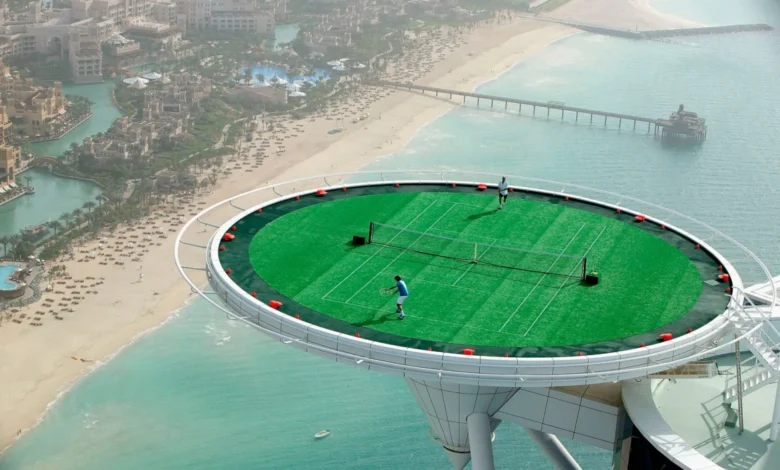
The allure of unconventional tennis venues often lies in their defiance of standard spatial logic. Architects commissioned to design these spaces are tasked with balancing the strict geometry of the 78-by-27-foot court with the irregular contours of natural landscapes.

On the Amalfi Coast, architects have utilized traditional dry-stone walling techniques to carve courts directly into cliff faces. These designs not only prevent erosion but also provide a vertical aesthetic that frames the horizon, turning a standard set into a dramatic visual performance. Similarly, in the Maldives, courts constructed on reclaimed land or over-water platforms utilize advanced composite materials to resist the corrosive effects of salt spray, blending synthetic turf with the vibrant blues of the Indian Ocean. These projects demonstrate a shift toward "biophilic sports design," where the player’s psychological well-being is enhanced by direct exposure to natural vistas, thereby reducing the stress of competitive play.

Statistical Significance and Global Growth
The global tennis infrastructure market is currently undergoing a period of rapid expansion. According to industry data, the valuation of global sports facility construction is expected to reach $20 billion by 2030, with a notable uptick in private-sector investment for residential and boutique resort tennis amenities.

Data shows that while public park courts remain the backbone of community tennis, the "luxury experiential" segment is growing at a compound annual growth rate (CAGR) of 4.2%. This growth is fueled by high-net-worth individuals and hospitality groups seeking to create "destination courts." For these investors, the court is no longer a peripheral amenity but a centerpiece of property value, often designed by high-profile architectural firms that prioritize sustainable drainage systems, eco-friendly lighting solutions, and spectator integration.

Chronology of Iconic Venue Development
- 1922: The opening of the current Wimbledon site in Church Road, London, set the global standard for traditional grass court design.
- 1978: The move of the US Open to Flushing Meadows, New York, signaled the era of the mega-stadium, shifting focus from intimate settings to massive capacity.
- 1990s: The rise of synthetic, high-performance acrylic surfaces (such as DecoTurf) allowed for more consistent play, prompting architects to design courts that could withstand extreme thermal expansion and contraction.
- 2010–Present: The "Boutique Era." Recent developments have focused on context-sensitive design, where courts are integrated into heritage sites, cliffside terrains, and private eco-resorts, prioritizing architectural aesthetic as much as ball bounce.
Expert Perspectives on Sports Infrastructure
Industry experts and sports facility architects emphasize that the design of a court is inherently linked to the performance of the athlete. "A court is not just a rectangle," notes a lead consultant in sports facility planning. "It is a micro-climate. When you place a court in a challenging landscape, such as a mountain pass or a beach, you are managing wind patterns, light reflection, and humidity. Good design is invisible; the player should be focused on the serve, not the glare or the uneven ground."

This perspective is supported by players who note that the aesthetic of a venue can influence focus. For professional athletes, the familiarity of standardized surfaces is a comfort; for recreational players, the sensory input of an architecturally stunning court provides a sense of novelty and prestige that defines the luxury experience.

Broader Implications: Sustainability and Future Trends
The future of tennis architecture is increasingly tethered to sustainability. As the climate crisis alters local environments, designers are looking for ways to reduce the carbon footprint of court construction. Key trends include:

- Permeable Sub-surfaces: New drainage technologies allow courts to absorb heavy rainfall, mitigating the impact on the local water table and preventing erosion in sensitive landscapes.
- Renewable Lighting: Many modern, remote, or high-end courts are now being fitted with solar-powered LED lighting arrays, allowing for evening play without the need for grid-tied electricity.
- Adaptive Reuse: There is a growing trend of repurposing industrial ruins or underutilized urban spaces into tennis facilities, minimizing the need for new concrete pouring and preserving historical footprints.
The Cultural Impact of Elite Venues
The cultural impact of these facilities extends beyond the sport itself. Tennis courts have long served as social hubs, and those with unique architectural merit are increasingly used as settings for high-fashion photography, cinematic backdrops, and architectural tourism. They represent a rare instance where a purely functional athletic space is elevated to a piece of cultural heritage.

As spectators look toward the US Open, it is worth considering that while the professional tour highlights the endurance of the human body, the courts themselves—whether in the heart of a bustling metropolis or perched on a distant cliff—serve as the silent, essential partners in the game. These spaces prove that architecture, when executed with precision and creativity, can transform a simple game of volley into a truly transcendent experience. By prioritizing design, these facilities do not merely host tennis; they curate the environment in which the sport is remembered, enjoyed, and ultimately, perfected.

In summary, the 30 most beautiful tennis courts in the world are not just points on a map; they are milestones in the evolution of modern design. They challenge the status quo, proving that the most prestigious matches are not always played in the largest stadiums, but often in the most thoughtfully curated spaces. As the sport continues to evolve, these architectural landmarks will remain the standard-bearers for how we perceive, play, and experience the game of tennis.