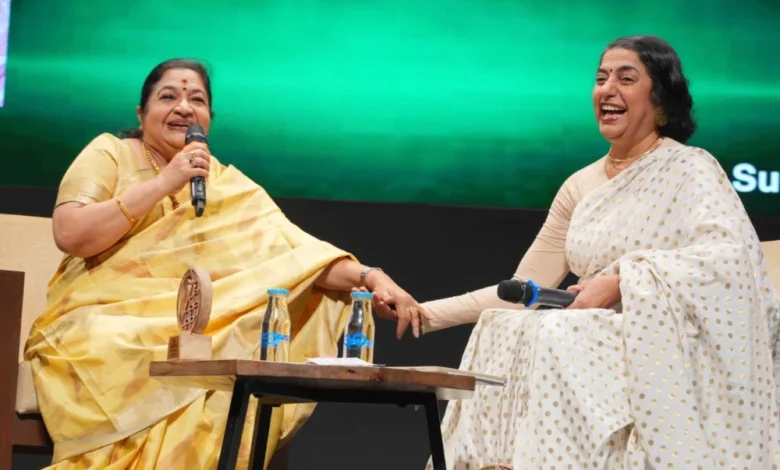
The 57th International Film Festival of India (IFFI), held annually along the picturesque coastal landscapes of Goa, provided a poignant platform this year to honor two of the most monumental figures in the history of Indian cinema and music. During a dedicated tribute session, renowned playback singer K.S. Chithra and accomplished actor-filmmaker Suhasini Maniratnam reflected upon the remarkable lives, staggering contributions, and enduring legacies of Asha Bhosle and S. Janaki. Both iconic vocalists passed away earlier this year—Bhosle in April at the age of 92, and Janaki in July at 88—leaving behind a vast musical void that spanned generations of cinematic history.
The tribute took place during the annual Lata Mangeshkar Talk: The Voice That Echoes Forever, a special segment named in honor of Bhosle’s legendary elder sister, Lata Mangeshkar. The session drew cinema enthusiasts, musicologists, and industry professionals from across the country to celebrate the golden era of Indian playback singing and to examine how these pioneering women fundamentally shaped the cultural fabric of South Asian music.
Main Facts and the Emotional Tribute in Goa
The memorial conversation offered attendees a rare glimpse into the personal and professional lives of artists who defined the soundscapes of Indian films for over half a century. K.S. Chithra, whose own legendary career spans nearly five decades with more than 25,000 recorded songs across multiple languages, opened up about the profound influence that Bhosle, Janaki, and Mangeshkar had on her formative years.
Chithra shared intimate recollections, noting that she used to mimic Janaki’s distinctive vocal stylings during her childhood, even while recognizing that the veteran singer possessed a vocal agility that was utterly unique and impossible to replicate. She also highlighted the immense emotional depth found within Mangeshkar’s devotional repertoire, which served as a constant source of inspiration throughout her journey in the music industry.
Suhasini Maniratnam brought a filmmaker’s and insider’s perspective to the stage, recounting personal anecdotes that highlighted the adaptability and sheer professionalism of Bhosle and Janaki. The dialogue moved fluidly between lighthearted backstage memories and deep technical analysis of what it took to record songs in an era before digital pitch-correction and multi-track separation were standard studio practices.
Chronological Context and Career Milestones
To understand the magnitude of the loss felt at IFFI, one must examine the monumental timelines of the artists being celebrated. Asha Bhosle’s career began in the 1940s, a period when the Indian film industry was transitioning from classical theater-influenced acting and singing to a more modern cinematic grammar. Over a career spanning more than seven decades, Bhosle recorded upwards of 12,000 songs, working with virtually every major music director from O.P. Nayyar and Khayyam to R.D. Burman and A.R. Rahman. Her incredible versatility allowed her to transition effortlessly from soulful ghazals and classical compositions to sultry cabaret numbers and western-influenced pop. Internationally, her crossover appeal was cemented by her two Grammy nominations and her cultural immortalization in Cornershop’s 1997 global hit single, Brimful of Asha.
Similarly, S. Janaki—affectionately revered by millions as the Nightingale of South India—carved out a legendary status primarily across Tamil, Telugu, Malayalam, Kannada, and Hindi cinema. Over a career that spanned nearly six decades, Janaki recorded tens of thousands of tracks, celebrated for her astonishing range, which allowed her to switch effortlessly from mature, romantic ballads to the mischievous voices of young children or teenage boys with absolute technical perfection.
K.S. Chithra herself represents a direct continuation of this royal lineage of Indian playback singing. Having entered the industry in the late 1970s and early 1980s under the mentorship of legendary South Indian composers, Chithra established a pristine, crystalline vocal identity that earned her six National Film Awards and numerous state honors, bridging the gap between the golden era pioneers and contemporary vocalists.
Behind the Scenes: Anecdotes of Genius
Among the most engaging segments of the IFFI session were the firsthand stories shared by Suhasini and Chithra regarding the studio discipline and playful humanity of these musical titans.
Suhasini recounted a fascinating behind-the-scenes episode from the production of the critically acclaimed 1997 Tamil film Iruvar, directed by her husband, Mani Ratnam. Academy Award-winning composer A.R. Rahman had envisioned a specific musical texture for a track, requesting Asha Bhosle to channel the exuberant, distinct playback style of Tamil cinema icon L.R. Eswari. However, Rahman reportedly found himself hesitant to explain the precise cultural reference to Bhosle directly.
Stepping in to bridge the communication gap, Suhasini demonstrated Eswari’s characteristic vocal inflections to Bhosle. Demonstrating the supreme professionalism and open-mindedness that marked her decades-long career, Bhosle immediately absorbed the nuances, stepped up to the microphone, and delivered the memorable track Venilla Venilla with characteristic flair and precision.
Chithra added depth to the portrait of Bhosle by discussing her immense versatility, noting that Bhosle was determined to carve out her own distinct musical identity rather than live permanently in the shadow of her famous sister, Lata Mangeshkar. Chithra recalled their first meeting, during which the senior vocalist playfully questioned Chithra about her preference for singing in such a high register—a testament to Bhosle’s sharp ear for vocal arrangement.
Turning to S. Janaki, Suhasini emphasized the late singer’s extraordinary theatricality, noting that Janaki could genuinely inhabit the psychology of a film character through her vocal phrasing alone. Chithra shared a touching childhood memory of Janaki’s deep reverence for Lata Mangeshkar. Long before she became a star herself, Janaki would tune into radio broadcasts of Mangeshkar’s songs, lower the volume during the vocal sections, and record herself singing along in real-time—what Chithra charmingly described as "like a karaoke on her own." Beyond her professional brilliance, Chithra recalled Janaki’s warmth and maternal kindness in private life, remembering how the senior singer would personally feed her by hand during visits to her home.
Supporting Data and Interactive Elements of the Tribute
The tribute session was designed to be much more than a traditional retrospective panel; it was an interactive celebration of vocal art. Throughout the hour-long event, Chithra interspersed her spoken memories with live vocal snippets, treating the audience to brief renditions of classic numbers popularized by both Bhosle and Janaki, alongside selections from her own extensive catalog.
In a crowd-pleasing closing quiz designed to test both memory and musicality, the festival organizers played vintage film clips stripped of their original background scores. Chithra was challenged to identify each film and song purely from visual cues and immediately perform the vocal line. Demonstrating her encyclopedic knowledge of Indian cinema and her peerless musical ear, Chithra successfully identified all five featured compositions.
The emotional climax of the event arrived when Chithra performed Paadariyen, a celebrated number from the 1985 musical drama Sindhu Bhairavi, directed by K. Balachander with a score by Ilaiyaraaja. The song holds profound historical significance, as it earned Chithra the very first of her six National Film Awards. As Chithra’s crystal-clear voice filled the auditorium, Suhasini—who had starred in the film—joined her on stage, gracefully lip-syncing the lyrics to a deeply moved and appreciative audience.
Broader Impact and Industry Implications
The heartfelt remembrance at the 57th IFFI underscores a growing cultural imperative within the Indian film industry: preserving, celebrating, and passing down the institutional memory of the artists who laid the foundational stones of regional and national cinema. As the industry rapidly modernizes, shifting toward digital-first production models, algorithmic composition, and heavily processed vocal tracks, forums like the Lata Mangeshkar Talk serve as vital bridges connecting modern audiences with the organic brilliance of the past.
The passing of Asha Bhosle and S. Janaki within months of one another marks the definitive close of a golden chapter in South Asian musical history—an era defined by intensive riyaz (practice), orchestral recording sessions with dozens of musicians playing live in studios, and vocalists who could bring cinematic narratives to life with a single breath. By honoring these icons, IFFI not only paid homage to their individual achievements but also reinforced the message that their artistic contributions remain timeless, continuing to instruct and inspire the modern generation of Indian musicians and filmmakers.