Northern Ireland endured a night of profound frustration at Windsor Park as a dominant, energetic display against a higher-ranked Hungary side yielded only a 0-0 draw in their UEFA Nations League Group B2 campaign. Despite carving out the clearer opportunities and controlling large swathes of the encounter, Michael O’Neill’s charges failed to find the clinical edge required to turn their supremacy into three points, which would have secured a flawless start to their latest international tournament cycle.
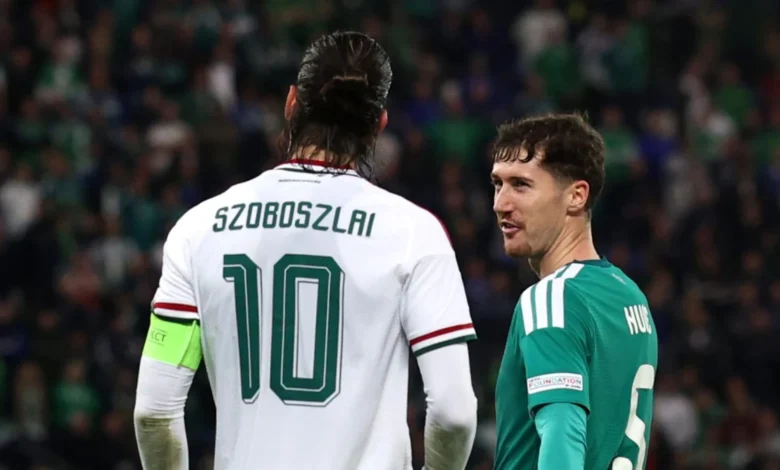
The scoreless deadlock leaves both sides searching for attacking fluency early in the group stage, though the overarching narrative from Belfast was one of missed opportunities for the hosts. Northern Ireland consistently pinned back a Hungarian outfit boasting star quality like Liverpool midfielder Dominik Szoboszlai, whose most significant impact on the pitch was limited to orchestrating the home crowd rather than unlocking a resolute green-and-white defense.
While the defensive unit stood firm to secure another clean sheet—highlighting a formidable home record under O’Neill—the inability to capitalize on a first-half onslaught and late-game openings ultimately left the Windsor Park faithful reflecting on two points dropped rather than one gained.
The Match Chronology and Flow of Play
The fixture arrived hot on the heels of Northern Ireland’s dramatic, last-gasp 1-0 victory away to Georgia in Tbilisi just days prior. Returning to Belfast for the first time in 315 days, the home side fed off the fervent energy of the partisan crowd, launching into an aggressive high press from the opening whistle that immediately unsettled the visiting Hungarian defense.
In the early exchanges, Ethan Galbraith and Isaac Price buzzed with intent, forcing hurried clearances and turnovers in dangerous areas. Trai Hume signaled Northern Ireland’s attacking ambitions early on with a rasping drive from the edge of the penalty area that flashed narrowly wide of Balazs Toth’s goal.
As the first half developed, Northern Ireland began to assert territorial dominance, with Barnsley midfielder Patrick Kelly emerging as the focal point for their most dangerous attacking forays. Just after the half-hour mark, Price slipped a clever ball through the Hungarian backline, sending Kelly clean through. The midfielder attempted a delicate chip over Blackburn Rovers goalkeeper Balazs Toth, but he failed to generate sufficient elevation, allowing the desperate defense to recover.
Kelly went close again shortly afterward. Tom Atcheson flicked on a trademark long throw from Ciaron Brown. Although Shea Charles was unable to connect cleanly amid a physical duel with Bournemouth’s Milos Kerkez, the ball dropped kindly to an off-balance Kelly, whose improvised loop drifted agonizingly onto the top of the crossbar.
Hungary, visibly rattled by the intensity and physicality of the hosts, struggled to mount any meaningful offensive pressure during the opening forty-five minutes. Frustrations boiled over as the half drew to a close. Jamie Donley became the third Northern Ireland player to enter referee Ricardo De Burgos’s notebook, swiftly followed by manager Michael O’Neill, who received a yellow card for vehement dissent on the touchline. The half culminated in a fiery confrontation after Shea Charles caught Daniel Lukacs in a heavy aerial challenge.
The second half saw a tactical recalibration from the visitors. Hungary began to establish a stronger foothold in possession, pushing bodies forward in search of a breakthrough. Kevin Schade and Andras Schafer began to find pockets of space, with Schafer firing a snapshot wide inside the area before missing the target entirely from a long-range free-kick opportunity. Donat Barany also squandered a decent chance, heading over the crossbar from a Hungarian corner kick.
Northern Ireland found it increasingly difficult to sustain the high-tempo press of the first half as fatigue set in. However, they continued to pose a threat on the counter-attack. From a well-constructed set-piece floated into the penalty area, Price executed a clever spin away from his marker Kerkez, only to see his low, goal-bound effort parried away at the near port by Toth.
As the clock wound down, the spotlight shifted back to the Northern Ireland rear-guard. Substitute Ruairi McConville produced a heroic, body-on-the-line block to deny Willi Orban from close range. Moments later, goalkeeper Pierce Charles—standing tall in competitive fixtures—pulled off a sharp save to repel a ferocious drive from Alex Toth, preserving his fifth clean sheet in seven competitive international appearances and securing the hard-fought point.
Supporting Data and Statistical Overview
The cold, hard statistics from the Windsor Park clash underline Northern Ireland’s territorial and tactical superiority, while simultaneously highlighting their ongoing Achilles’ heel in the final third: conversion rate.
Throughout the ninety minutes, Northern Ireland restricted Hungary—a side traditionally known for their tactical organization and technical flair under established management—to a mere single shot on target. This defensive resilience is becoming a hallmark of Michael O’Neill’s second tenure. With this result, Northern Ireland have now suffered defeat in just one of their last ten competitive matches on home soil in Belfast, reinforcing Windsor Park’s status as a fortress.
Conversely, the inability to test Balazs Toth more frequently remains a statistical concern. Despite creating multiple high-value scoring chances—particularly through Kelly and Price—Northern Ireland failed to register the necessary precision. The shot count favored the hosts in the opening period, but Hungary gradually leveled the possession metrics as the match progressed, finishing with a marginal advantage in overall ball retention while failing to translate that possession into genuine scoring opportunities.
Discipline also emerged as a noteworthy statistical talking point. Referee Ricardo De Burgos brandished yellow cards liberally, penalizing the hosts for their aggressive, front-foot approach. Shea Charles, Jamie Donley, Isaac Price, and Ethan Galbraith were all cautioned, alongside manager Michael O’Neill. This high count of disciplinary infractions reflects the combative, physical nature of the contest, as Northern Ireland sought to physically overpower a technically proficient opponent.
Official Responses and Post-Match Analysis
Speaking in the immediate aftermath of the fixture, manager Michael O’Neill cut a figure of nuanced satisfaction mixed with understandable disappointment. While acknowledging the defensive fortitude and the impressive defensive metrics—noting the clean sheet and the containment of high-profile opponents like Dominik Szoboszlai—O’Neill expressed clear regret over missed opportunities to claim all three points.
"We played with incredible energy, especially in the first half, and we executed our tactical plan to disrupt their build-up play," O’Neill observed. "Against a side of Hungary’s quality, you have to take your chances when you are on top. Patrick [Kelly] had two wonderful opportunities, and on another night, those go in and we are talking about a completely different game."
The Northern Ireland boss also addressed the officiating and the mounting yellow cards, emphasizing that while physical commitment is non-negotiable at this level, his side must learn to navigate strict refereeing interpretations more astutely as the campaign progresses.
From the Hungarian camp, acknowledgement was given to the hostile atmosphere and the intensity of the Windsor Park reception. Hungarian coaching staff noted that their side failed to match the initial physical output of the hosts, forcing a reactive tactical shift at halftime to stabilize the midfield and prevent further damage. The containment of Szoboszlai—hailed as the creative heartbeat of the visiting team—was credited largely to the disciplined, collapsing defensive blocks deployed by Northern Ireland’s midfield trio, who denied him the space required to dictate the tempo.
Broader Impact and Group B2 Implications
The 0-0 draw carries significant weight as the landscape of UEFA Nations League Group B2 begins to take shape. With only a handful of fixtures completed in this phase of the competition, every point is magnified, particularly in a tightly contested group where goal differentials could ultimately decide promotion and relegation fates.
For Northern Ireland, the result builds upon the momentum generated by their opening-day triumph in Tbilisi. Sitting comfortably in the upper echelons of the group standings after two matches, O’Neill’s squad has demonstrated that they can compete physically and tactically with teams positioned higher in the official FIFA rankings. The defensive solidity provides a stable platform for future fixtures, proving that the youthful core of the team—featuring players like Pierce Charles, Shea Charles, and Isaac Price—can handle the physical and mental demands of senior international football.
However, the fixture also exposes the fine margins governing international success. As Northern Ireland prepares for upcoming tests, the overarching takeaway from the Hungary encounter is the urgent need for clinical finishing. Dominating possession, pressing effectively, and restricting elite opponents to zero shots on target for long stretches represent elite-level defensive execution; translating those foundational strengths into goals will define whether this promising campaign ultimately culminates in tournament progression.
As the squad disperses back to their respective club environments before the next international window, O’Neill and his coaching staff will take heart from the resilience, tactical discipline, and undeniable progress visible on the pitch at Windsor Park, even as they analyze the missed chances that kept them from achieving a perfect start.