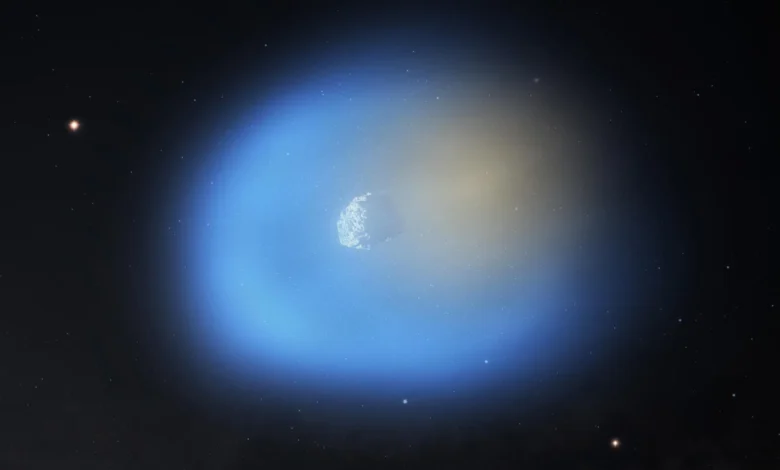
Astronomers analyzing fresh observational data collected by the Atacama Large Millimeter/submillimeter Array (ALMA) have discovered that the interstellar visitor Comet 3I/ATLAS contains an extraordinarily high concentration of methanol. This groundbreaking finding places the rare celestial object among the most methanol-rich icy bodies ever studied, offering scientists an unprecedented chemical fingerprint of a planetary system located far beyond our own solar neighborhood. The research, which highlights the distinct compositional differences between our solar system and those orbiting distant stars, sheds crucial new light on the diverse chemical environments present across the Milky Way.
ALMA, a premier radio astronomy facility operated as an international partnership including the U.S. National Science Foundation’s National Radio Astronomy Observatory (NSF NRAO), targeted the incoming interstellar comet as it continued its trajectory closer to the Sun throughout late 2025. As solar radiation began to heat the frozen surface of the comet, trapped gases and microscopic dust particles escaped from its nucleus, forming a vast, luminous shroud known as a coma. By tuning into the faint submillimeter-wavelength signatures radiating from molecules within this coma, the research team was able to decode the intricate chemical composition of matter forged in an entirely different star system.
A Chemical Fingerprint From Deep Space
Describing the significance of the observations, Nathan Roth, lead author of the research and a professor at American University, emphasized the rare diagnostic value of the data. Observing 3I/ATLAS is like taking a fingerprint from another solar system, Roth explained, noting that the detailed molecular breakdown reveals a celestial body bursting with methanol in proportions rarely observed among native comets originating in our own solar system.
To uncover these secrets, the scientific team utilized ALMA’s Atacama Compact Array located in the high-altitude desert of northern Chile. Observations were carefully coordinated across multiple dates in late 2025 as the comet navigated the inner solar system. Researchers focused specifically on the distinct spectral lines of two organic compounds: methanol, chemically designated as CH3OH, and hydrogen cyanide, denoted as HCN, which serves as a standard benchmark molecule frequently detected in comets.
The resulting data revealed striking disparities. When calculating the ratio of methanol to hydrogen cyanide, researchers recorded values of approximately 70 and 120 on two separate observation dates. These exceptionally high ratios definitively categorize 3I/ATLAS as a hyper-methanol-rich object, far exceeding the typical chemical distributions found in the vast majority of comets native to the Kuiper Belt or Oort Cloud of our solar system.
Chronology of Discovery: Tracking 3I/ATLAS
The detection of anomalous methanol levels represents the latest milestone in a rapidly unfolding scientific campaign following the discovery of Comet 3I/ATLAS. As only the third confirmed interstellar object ever detected passing through our solar system—following the historic discoveries of 1I/’Oumuamua in 2017 and 2022’s 2019/2I Borisov—3I/ATLAS has commanded intense global attention from the astronomical community since its initial identification.
Following its initial detection, telescopes across the globe and in space quickly pivoted to monitor the interstellar traveler. Earlier in its inbound journey, observations conducted with the James Webb Space Telescope (JWST) revealed that the comet’s outer coma was unusually dominated by carbon dioxide while the object was still situated at a great distance from the Sun. These initial findings immediately signaled to researchers that 3I/ATLAS possessed a fundamentally distinct volatile inventory compared to typical solar system comets.
As the comet continued its descent toward perihelion through late 2025, ALMA joined the observational effort. The high-resolution submillimeter imaging capabilities of the array not only confirmed the overwhelming presence of methanol but also allowed scientists to map the spatial distribution and kinematic behavior of the escaping gases with remarkable precision. This temporal progression from JWST’s early infrared observations of carbon dioxide to ALMA’s high-resolution radio mapping of complex alcohols has provided a comprehensive, multi-wavelength chronology of an interstellar visitor’s transformation under solar heating.
Unraveling Complex Outgassing Physics
Beyond establishing the raw abundance of methanol, ALMA’s advanced imaging resolution enabled researchers to track the precise geographic and physical origin of the molecules as they dissociated from the comet. This spatial analysis uncovered a fascinating behavioral divergence between methanol and hydrogen cyanide within the expanding coma.
Data indicated that hydrogen cyanide emanates primarily and directly from the solid central nucleus of the comet. This behavior aligns closely with standard outgassing models observed in domestic solar system comets, where thermal energy penetrates the icy matrix and liberates trapped gases from the core. Methanol, however, demonstrated a much more complex and dispersed origin.
Astronomers discovered that methanol is liberated not only from the primary nucleus but also continuously from microscopic ice grains drifting outward within the coma itself. As these tiny, liberated ice particles are carried away from the main body and subjected to increasing solar radiation, they undergo secondary thermal sublimation, effectively acting as millions of miniature, distributed comets. While analogous distributed outgassing has been documented in select native solar system comets under specific conditions, 3I/ATLAS marks the first time researchers have been able to trace the intricate microphysics of this phenomenon in an object originating from interstellar space.
Implications for Planetary System Formation
The identification of unique chemical signatures within interstellar interlopers like 3I/ATLAS carries profound implications for our understanding of planetary genesis throughout the galaxy. Comets are widely regarded by astrophysicists as pristine time capsules, preserving the raw, unaltered chemical materials that existed in the protoplanetary disks surrounding young stars billions of years ago.
The fact that 3I/ATLAS formed with such vastly elevated levels of methanol—and maintained a carbon-dioxide-dominated volatile profile during its distant approach—suggests that the protosolar nebula or stellar disk from which it originated experienced thermodynamic and chemical conditions drastically different from those that shaped our own solar system. Whether these anomalies stem from exposure to intense cosmic ray bombardment, unique molecular cloud chemistry, or specific thermal processing stages during the object’s birth remains a central question for ongoing theoretical research.
Astrophysicists emphasize that every confirmed interstellar visitor acts as a natural cosmic probe, bridging the observational gap between our local planetary environment and distant stellar nurseries. By comparing the isotopic ratios, organic inventories, and structural behaviors of objects like 1I/’Oumuamua, 2I/Borisov, and now 3I/ATLAS, scientists are slowly constructing a unified, galactic-scale model of how planetary systems assemble their building blocks.
Future Outlook and Collaborative Research
As data from ALMA continues to be thoroughly analyzed, institutional partners and independent research groups are already preparing for subsequent observation phases. The NSF NRAO, alongside international astronomical networks, anticipates that the insights gleaned from 3I/ATLAS will inform observation protocols for future interstellar discoveries.
Although interstellar objects are notoriously difficult to detect due to their high velocities and hyperbolic trajectories, advancements in sky-mapping technologies—such as the upcoming legacy surveys conducted by the Vera C. Rubin Observatory—are expected to dramatically increase the rate at which these visitors are identified. Each new detection will test existing models of chemical distribution in the galaxy and help determine whether methanol-rich compositions like that of 3I/ATLAS are anomalous or represent a common archetype in extrasolar systems.
Ultimately, the revelation of Comet 3I/ATLAS’s methanol abundance underscores the immense scientific value of international radio astronomy facilities like ALMA. By peering into the faint molecular whispers of a visitor from another star, humanity gains a clearer, more expansive perspective on our place within a chemically rich and remarkably diverse universe.