Sweden’s general election has devolved into a historic and hyper-competitive nail-biter, with provisional tallies and public broadcaster projections indicating an effective dead heat between the incumbent centre-right governing coalition and the centre-left opposition bloc. As ballots continue to be processed across the country, updated models from Sweden’s public broadcaster SVT and the official Swedish Election Authority point to a dramatic parliamentary divide: the centre-left opposition bloc stands projected at 175 seats, narrowly edging out the incumbent government’s 174 seats in the 349-seat Riksdag.
With margins this tight—representing a difference of roughly 20,000 votes and a mere 0.1 percentage point split in overall vote share—political leaders, analysts, and international observers have cautioned that the final outcome may remain unresolved until late postal and overseas ballots are fully tallied, potentially stretching the suspense out to Wednesday.
Main Facts and Current Projections
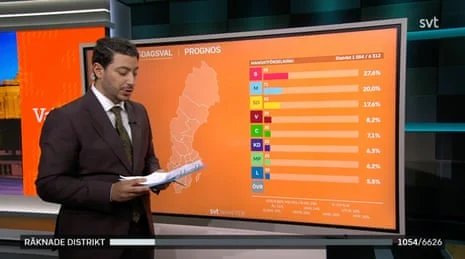
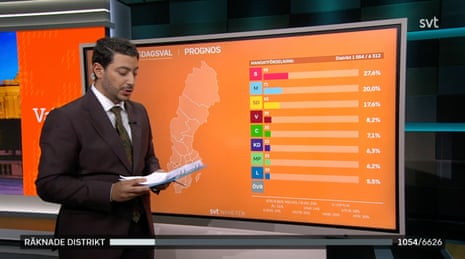
The high-stakes parliamentary vote follows an exceptionally fierce electoral cycle defined by intense polarization, debates over national economic direction, and heightened scrutiny over immigration and law enforcement policy. According to the latest revised figures released by SVT based on partial district returns and comprehensive exit polling:
- Social Democratic Party (S): 27.6%
- Moderates (M): 20.0%
- Sweden Democrats (SD): 17.5%
- Left Party (V): 8.2%
- Centre Party (C): 7.1%
- Christian Democrats (KD): 6.3%
- Green Party (MP): 6.2%
- Liberals (L): 5.5%
These percentages place the aggregate centre-left opposition bloc (comprising the Social Democrats, Left Party, Centre Party, and Green Party) at approximately 49.3% of the vote share, compared to 49.2% for the incumbent governing bloc, which includes the Moderates, Christian Democrats, Liberals, and their external legislative partners, the Sweden Democrats.
If these figures hold through the completion of the count, the opposition would claim a bare majority of 175 seats, enough to unseat Prime Minister Ulf Kristersson’s administration and position former Prime Minister Magdalena Andersson to return to power. However, the exact razor-thin margin means that even minor shifts as remaining regional and international votes are tabulated could alter the balance of power.

Chronology of the 2026 Electoral Campaign
The path to Sunday’s cliffhanger election has been marked by a shifting political landscape over the past four years:
- October 2022: Following the previous general election, Prime Minister Ulf Kristersson’s conservative Moderates broke a longstanding political taboo by forming a three-party minority government backed by the right-wing, anti-immigration Sweden Democrats via the Tidö Agreement. This pact granted the far-right substantial influence over national policy regarding crime and immigration.
- Early to Mid-2026: For much of the parliamentary term, Magdalena Andersson’s Social Democrats maintained a comfortable and consistent lead in national opinion polls, frequently polling in the mid-30s, leading many analysts to anticipate a clear transition of power.
- April 2026: In a significant policy pivot, the ruling right-leaning coalition announced it would offer formal ministerial positions to the Sweden Democrats if victorious, elevating the far-right party from an external support role into direct government participation for the first time.
- Late August 2026: Early voting commenced on August 26, eventually drawing over 3.5 million voters eager to cast their ballots ahead of election day to avoid long queues. Concurrently, opinion polls began to narrow significantly, driven by a surge in late-deciding voters and strong campaign performances by smaller parties like the Liberals.
- September 10–12, 2026: The final days of campaigning saw intense personal clashes between Kristersson and Andersson over criminal penalty discounts and economic management. Final pre-election polls showed the opposition lead shrinking drastically, bringing the gap down to fractions of a percentage point.
- September 13, 2026: Polling stations opened at 8:00 AM local time, experiencing heavy turnout and extended wait times across major urban centers such as Stockholm and Umeå. Polls closed at 8:00 PM, immediately followed by the release of initial exit polls and late-night projections showing the historic one-seat divergence.
Supporting Data and Historical Parallels
The current deadlock evokes deep historical resonance within Swedish electoral history. Sweden last experienced a parliamentary stalemate of this magnitude during the 1973 general election, when the two major political blocs finished in a literal tie of 175 seats each. That crisis prompted constitutional reforms that expanded the Riksdag to an odd number of 349 seats ahead of the subsequent election to prevent future permanent ties.
The reform proved its utility six years later in the 1979 general election, when the centre-right bloc similarly secured victory by a single seat, 175 to 174.
Analysts have also noted unique intra-bloc dynamics during the current election. For the second consecutive electoral cycle, the prime minister’s party—Kristersson’s Moderates—managed to increase its individual vote share (rising from 19.1% in 2022 to 20.0% in the latest projections), while several of its coalition allies experienced diminished support. Meanwhile, the Liberal party achieved a dramatic, unexpected surge above the 4% parliamentary threshold after polling dangerously low weeks prior, driven in part by strategic voting among centre-right constituents.
Official Responses and Political Reactions
As the night wore on and the parliamentary math solidified around the one-seat margin, party leaders addressed supporters with measured caution rather than definitive victory speeches.
Christian Democratic leader and Deputy Prime Minister Ebba Busch addressed the public holding a red ace of hearts as a prop, characterizing the election as "a real nailbiter" and asserting that the governing parties were making late gains. She emphasized that "every single vote must be counted," warning citizens that the ultimate government composition might remain unknown until Wednesday’s final verification of overseas and postal ballots.
Liberal leader Simona Mohamsson celebrated what she termed "a historic comeback" for her party, praising the grassroots campaign that kept the liberal faction viable in parliament. Similarly, Green Party co-leaders Amanda Lind and Daniel Helldén welcomed the competitive returns while acknowledging that final certainty would likely wait until mid-week.
Neither Prime Minister Ulf Kristersson nor opposition leader Magdalena Andersson immediately claimed victory, opting instead to monitor the incoming district results as election authorities worked through the remaining ballots.
Broader Impact and Implications
The outcome of this election carries profound implications not only for Sweden’s domestic trajectory but also for its international standing. Under Kristersson’s tenure, Sweden completed its historic accession to NATO and implemented stringent legislative crackdowns on immigration and organized crime, heavily shaped by the policy priorities of the Sweden Democrats.
For the centre-left opposition, a victory led by Magdalena Andersson would mark a decisive pivot away from right-wing populist influence, though it would also require managing a diverse and ideologically broad coalition of left-leaning and centrist parties. Conversely, a confirmed victory for the incumbent right-leaning bloc would break a fundamental barrier in modern Swedish politics by integrating a party with historical far-right roots directly into the cabinet.
With the election authority confirming the provisional one-seat differential and thousands of outstanding late votes still to process, Sweden enters a tense waiting period, bracing for a resolution that will define the nation’s political direction for the next four years.