Deep beneath the crushing pressures of the western Pacific Ocean, in the perpetually dark and frigid abyss of the Mariana Trench, researchers have uncovered an astonishing biological oasis. Operating nearly six miles below sea level, a Chinese manned submersible has documented thousands of mollusks, tubeworms, and bivalves thriving in what is now recognized as the deepest animal colony ever observed on Earth.
The breakthrough discovery, detailed in a landmark study published in the prestigious journal Nature, fundamentally challenges existing scientific models regarding deep-ocean carbon cycling, the physiological limits of life, and the ecological dynamics of hadal trenches—the deepest regions of the world’s oceans. While scientists have long hypothesized that these remote geological formations could harbor life sustained by chemical energy rather than sunlight, capturing empirical documentation of such vast, complex communities has historically proven exceedingly rare.
The expedition, which utilized the advanced Chinese manned submersible Fendouzhe, explored not only the Mariana Trench but also the Kuril-Kamchatka Trench and the western Aleutian Trench. According to the research team from the Institute of Deep-sea Science and Engineering at the Chinese Academy of Sciences, these sprawling chemosynthesis-based communities stretch across a staggering distance of 1,553.4 miles at depths ranging from 3.6 to 5.92 miles beneath the surface.
Decoding the Mechanics of Abyssal Survival
In the absolute darkness of the hadal zone, where sunlight cannot penetrate, traditional photosynthesis is an impossibility. For centuries, the deep sea was viewed as a biological desert where scant organic detritus, known whimsically as "marine snow," drifted down from upper water layers to sustain a sparse population of scavengers. However, the findings from the Fendouzhe expeditions reveal a completely independent, highly productive ecosystem driven by chemosynthesis.
Isotopic analysis conducted by the research team indicates that these thriving communities are sustained by fluids rich in hydrogen sulfide and methane. These chemical-laden fluids are transported upward along massive geological faults that traverse the deep sediment layers of the trenches. The methane itself is produced microbially from organic matter deposited over millennia within the sediment.
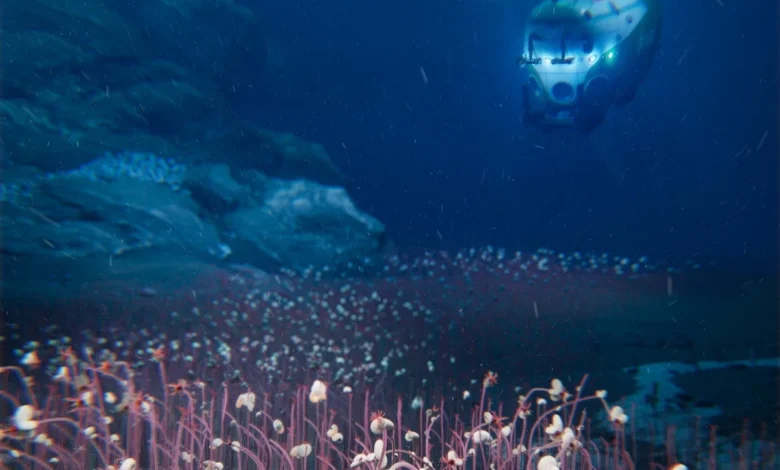
Video footage captured by the submersible revealed fields of siboglinid tubeworms growing up to a foot in length, dense mounds of clams and mollusks, and sprawling snow-like microbial mats. Clustering tightly around these microbial mats, the tubeworms and other invertebrates take advantage of the chemical bounty. Alongside the dominant bivalves and tubeworms, scientists observed free-floating marine worms, spiky crustaceans, sea lilies, sea cucumbers, and various other invertebrates, painting a picture of a vibrant, interconnected food web operating under extreme environmental duress.
A Chronological Leap in Deep-Sea Exploration
To understand the magnitude of this discovery, it is necessary to examine the timeline of human exploration in the planet’s deepest trenches.
The threshold of the Mariana Trench was first breached on January 23, 1960, when oceanographer Jacques Piccard and U.S. Navy Lieutenant Don Walsh descended to the bottom inside the bathyscaphe Trieste. Their brief historical visit opened humanity’s eyes to the possibility of life at extreme depths, though the technology of the era limited extensive observation.

More than half a century passed before another human returned. In March 2012, filmmaker and deep-sea explorer James Cameron completed a historic solo descent to the Challenger Deep, the deepest point of the Mariana Trench, famously describing the alien landscape as desolate and stark. While these early expeditions confirmed that life—primarily microscopic or simplistic in nature—could exist under intense hydrostatic pressure, they did not reveal complex, large-scale ecosystems.
Over the subsequent decade, the development of advanced robotic and manned submersibles shifted the paradigm. Remotely operated vehicles (ROVs) began identifying isolated pockets of life, such as marine invertebrates living inside hydrothermal vents located 1.24 miles beneath the Pacific floor.
The turning point arrived last year when the Fendouzhe submersible completed 23 successive dives into the western Pacific’s Mariana Trench. During these methodical descents, researchers mapped the extensive distribution of the chemosynthetic colonies, culminating in the publication of the comprehensive data in mid-2025. Marine geochemist and study co-author Mengran Du described the experience of diving in the submersible as akin to traveling through time, unveiling a hidden world layer by layer.
Broader Implications for Oceanography and Conservation
The identification of these extensive chemosynthetic communities carries profound implications for multiple scientific disciplines, ranging from astrobiology to marine geology. Lead author Xiatong Peng noted that given the widespread geological similarities shared among the world’s hadal trenches, similar chemosynthesis-based communities are likely far more prevalent than previously anticipated. This suggests that the deep ocean may host robust biological networks operating independently of surface solar energy on a global scale.
However, the timing of this discovery coincides with a period of intense geopolitical and environmental debate regarding the future of the ocean floor. As researchers celebrate the resilience of deep-sea life, policymakers and international bodies are actively debating the viability and regulation of deep-sea mining.
The International Seabed Authority has faced mounting pressure to finalize rules governing the extraction of valuable polymetallic nodules and minerals from the ocean floor. Environmental organizations and ocean scientists have repeatedly warned that commercial mining operations in these pristine, little-explored zones could cause irreversible devastation to fragile marine ecosystems. Because hadal trenches and abyssal plains are intimately connected through oceanographic currents and geological processes, toxic sediment plumes or physical destruction caused by heavy machinery could wipe out undiscovered oases before science even has the opportunity to document them.
Looking Ahead: Unlocking Earth’s Final Frontier
The revelation that complex, large-scale animal life can flourish nearly six miles beneath the surface underscores how little humanity truly understands about Earth’s biosphere. As researchers continue to analyze the data recovered by the Fendouzhe submersible, attention is turning toward future expeditions aimed at mapping adjacent trenches in the Pacific and Indian oceans.
The findings from the Mariana, Kuril-Kamchatka, and western Aleutian trenches serve as a powerful reminder of nature’s adaptability. Yet, they also highlight a critical conservation imperative: as human technology reaches deeper into the abyss, our capacity to explore must be balanced with a rigorous commitment to protecting the fragile, hidden ecosystems that sustain the health of the global ocean.