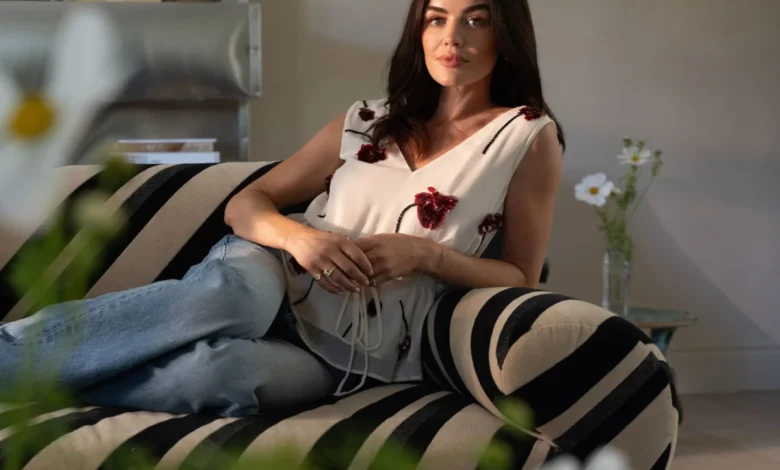
The evolution of a home often mirrors the internal transformation of its inhabitant, a phenomenon clearly evidenced by the recent redesign of actor Lucy Hale’s Los Angeles residence. Acquired in 2019, shortly after the conclusion of her long-running tenure on the hit series Pretty Little Liars, the 1940s Spanish-style property initially underwent a conventional, neutral renovation. However, as Hale navigated the complexities of her thirties, public scrutiny, and a significant personal journey toward sobriety in 2022, her aesthetic preferences shifted. The resulting transformation, executed by Ashley Drost and Marie Trohman of the design firm Proem, represents more than a mere interior update; it is a manifestation of the actor’s journey toward self-actualization and domestic peace.
.jpg)
A Chronology of Transformation
The project began in earnest as Hale sought to align her physical surroundings with her burgeoning sense of self. Having spent the majority of her twenties in the high-pressure environment of television production, the actor entered a period of introspection that necessitated a change in her living space. By 2022, the transition from a "farmhouse-y" aesthetic to a bolder, more personalized environment became a priority.
.jpg)
The design team at Proem—known for their work on high-profile, eclectic projects such as Emma Chamberlain’s residence—spent three years collaborating with Hale to refine this vision. The partnership was defined by an intuitive understanding of the actor’s personality, which the designers characterized as "moody femme" with a distinct, "witchy" sensibility. This shift away from safe, neutral tones toward deep plums, vibrant pinks, and textured materials allowed the home to evolve alongside the homeowner.

Architectural Nuance and Design Elements
The residence, tucked away in a quiet Los Angeles canyon, serves as a sanctuary for the actor. To reclaim the home’s original Spanish-style architectural integrity, Drost and Trohman introduced structural modifications, including the addition of wood ceiling beams, which provide necessary depth and character to the living spaces.

The interior palette functions much like an artist’s color wheel, utilizing bold, saturated tones that signify a departure from her previous, more conservative choices. Key features include custom sofas upholstered in Kelly Wearstler and Pierre Frey fabrics, and an aluminum bookshelf from Haos, which creates a striking contrast against antique rugs. In the primary bedroom, the design reaches a pinnacle of sophistication with linen wall coverings by French firm Élitis, designed to mimic intricate molding, offering a tactile, jewel-box quality.

The Symbolic Power of Decor
The home is replete with items that hold deep personal significance, underscoring the narrative of healing. The entryway, for instance, features a lifesize sheep sculpture—fondly named George—and cowgirl-themed artwork that reflects Hale’s unique interests. The use of pomegranates, chosen for their cultural symbolism of prosperity and abundance, appears in the custom door surround crafted by local plaster artist Marli Arizona and in a matching door knocker from DeVol.

These choices are not merely decorative; they act as totems of the actor’s past and present. The meditation room stands as a testament to this, housing an altar dedicated to departed loved ones. It is here that Hale keeps photographs of her late grandmother and her father, Preston Hale, who passed away in July. The inclusion of these personal artifacts ensures that the home remains a living tribute to her history, fostering an environment where she feels connected to her roots while moving forward in her career and personal life.

The Role of Professional Collaboration
The success of the project relied heavily on the synergy between the homeowner and her creative team. Proem’s methodology, which focuses on identifying the underlying "spirit" of the client, allowed for a design that feels cohesive despite its eclectic influences. Designers Drost and Trohman prioritized pieces that balanced romanticism with an edgy, modern sensibility.

The procurement process involved an international search for vintage and bespoke items. From the 1980s Italian Murano chandelier in the dining room to the custom-made burl wood vanity in the bathroom, every element was selected to provide a sense of discovery. This meticulous approach to sourcing ensures that the home does not feel like a catalog-ordered space, but rather a curated collection of experiences.

Economic and Cultural Implications
The redesign of high-profile homes like Hale’s offers a window into broader trends in luxury interior design. There is a noticeable pivot toward "personality-driven" interiors where the objective is not resale value or current market trends, but rather the psychological well-being of the occupant. The move toward bold, dark colors and maximalist textures suggests a shift in the cultural zeitgeist, where individuals are increasingly prioritizing personal comfort and creative expression over minimalist uniformity.

Furthermore, the involvement of specialized artisans—such as the "Glass Cowboy" Ben Tuna for stained glass or local plaster artists—highlights the growing demand for bespoke craftsmanship in the high-end residential market. By investing in these artisans, the project not only elevates the aesthetic quality of the home but also supports the local creative economy in Los Angeles.

Analysis of the "Sanctuary" Concept
The concept of a "sanctuary" in the context of celebrity real estate is often subject to scrutiny, yet in Hale’s case, the evidence suggests a genuine need for a controlled, predictable environment. For an individual who grew up in the public eye, the ability to curate one’s own space represents a form of agency. The design decisions—such as the low-profile bed to accommodate her Maltipoos, Elvis and Ethel—illustrate a lifestyle where the home is designed for the user’s specific daily reality rather than for entertainment or public display.

Hale’s assertion that she may not stay in this house forever, but will always own it, speaks to the emotional security she has anchored in the property. This reflects a trend among homeowners who view their primary residence as a foundational pillar of their identity, a place that supports their evolution throughout different phases of life.

Conclusion: A Legacy of Self-Discovery
As the project reached its completion, the consensus among the design team and the homeowner was clear: the house had developed a character of its own. It is a space that facilitates introspection, honors the deceased, and provides a backdrop for the daily rituals of the living. By embracing what she terms her "good witchy style," Lucy Hale has successfully translated her internal growth into a physical environment that is as complex and vibrant as the woman who inhabits it.

The result is a home that does not shy away from emotion. It is a space that has witnessed heartbreak, sobriety, and the eventual stabilization of a life lived in the spotlight. In this, the house succeeds in its primary function: it is a container for the human experience, a place that meets its owner exactly where she is, and provides the foundation for where she intends to go. Through this, the residence serves as an enduring reminder of the power of design to facilitate personal transformation, proving that a home is most valuable when it serves as a true, uncompromised extension of its occupant.