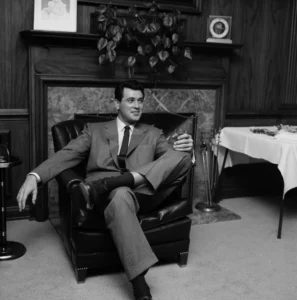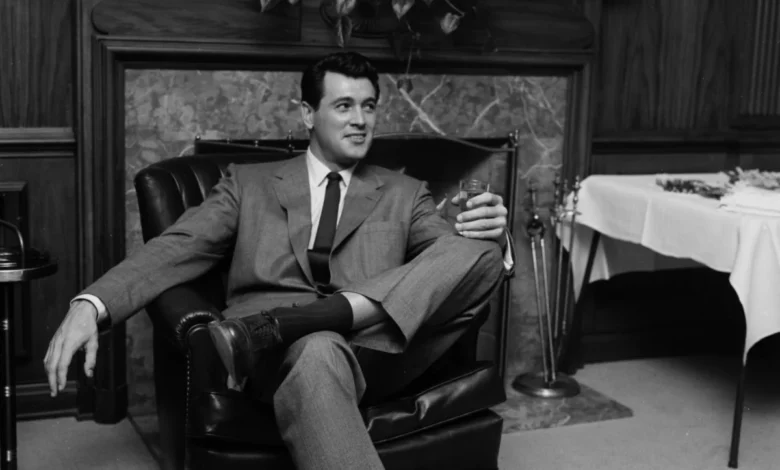
Though he remains an indelible pillar of Tinseltown’s Golden Age, a cinematic titan whose towering presence graced the silver screen in classics such as Giant, Pillow Talk, and Lover Come Back, Rock Hudson was defined by a stark contrast between his public persona and his private existence. Born Roy Harold Scherer Jr. on November 17, 1925, the future legend emerged from modest, even cramped, beginnings. His early childhood was marked by a reality far removed from the glamour of the Hollywood Hills; he spent his formative years living with his maternal grandparents in a one-bedroom bungalow on 719 Center Street in suburban Chicago. The home served as a dwelling for six adults and five children, a crowded environment that necessitated a singular, shared bathroom—a far cry from the sprawling estates that would eventually serve as his retreats from the relentless gaze of fame.

As his career ascended to dizzying heights, Hudson increasingly viewed his residences not merely as assets, but as essential fortresses of solitude. In his biographical account, Rock Hudson: His Story, the actor articulated the profound necessity of these spaces: "My house is the only place I really have any privacy. Outside the house, everything I do is watched and talked about, but once I come in those gates, I can relax and let go. I love to work on my house; to tear down walls and lay bricks." This physical labor—the tactile act of construction and renovation—offered him a groundedness that the ephemeral nature of celebrity could not provide.
The Early Years of Cohabitation and Identity
The trajectory of Hudson’s domestic life began in the early 1950s, a period marked by both professional breakthrough and the quiet navigation of his private identity. In 1952, photographs captured Hudson and fellow actor Bob Preble residing in a shared home in Los Angeles. Over the course of three years, the pair cohabitated across four different properties. Their final residence, located on Avenida del Sol, was an exercise in mid-century modernism, featuring futuristic glass fixtures and sweeping vistas of the valley and surrounding mountains.

Historical scrutiny has long suggested that this living arrangement was more than platonic. In retrospect, these years represented a period of experimentation within the constraints of a closeted era. Preble, reflecting on the relationship in later years, described their dynamic as an exploratory phase, noting that while the situation flirted with boundaries that were then deemed unconventional, the pressure of societal norms eventually led to his marriage to actor Yvonne Rivero. This transition underscores the era’s rigid expectations, where even the most prominent figures were often forced to conform to heteronormative structures to maintain their career viability.
The Marriage to Phyllis Gates and the Warbler Place Estate
By 1955, the narrative of Hudson’s domestic life shifted with his marriage to Phyllis Gates, a secretary and interior designer. The union, often categorized by biographers and historians as a strategic arrangement designed to shield the star’s homosexuality from public scrutiny, was marked by the acquisition of a two-bedroom ranch-style home at 9151 Warbler Place.

The property near Sunset Boulevard was a modest start for a burgeoning superstar. Hudson had invested a significant portion of his capital into the acquisition, leading to a memorable lack of furniture in the living room, which he initially outfitted with redwood lawn chairs. Gates, who later characterized her feelings for Hudson as genuine, managed the domestic sphere, earning a reputation for a kitchen defined by classic American comfort food. However, the marriage was ultimately unsustainable. When the couple divorced in 1958, the settlement included $250 a week in alimony for a decade and the transfer of the Warbler Place home, then valued at $35,000, to Gates. This period serves as a critical case study in the high costs—both financial and emotional—of maintaining a public facade during the height of the studio system’s power.
The Malibu Coastal Retreat
Following the dissolution of his marriage, Hudson transitioned to a beach house in Malibu, a structure perched on stilts over the ocean. This residence served as his primary home during the filming of the 1959 hit Pillow Talk. The environment was markedly different from his previous inland homes; at high tide, the surf would crash beneath the floorboards. During this period, Hudson cultivated a circle of friends, including fellow actors and stuntmen, who engaged in an active, outdoor lifestyle involving swimming, sailing, and scuba diving. This chapter of his life highlighted a fleeting sense of communal living before his eventual move to Newport Beach in the summer of 1959.

The Castle: A Sanctuary of Self-Expression
The most defining residence of Hudson’s life was located at 9402 Beverly Crest Drive. Initially leased to him by Universal Studios in 1961 while he filmed Lover Come Back, the property belonged to prominent agent and producer Sam Jaffe. The three-and-a-half-acre estate, characterized by Spanish-style architecture—red-tile roofs, stucco walls, and dark wood beams—was nestled against dramatic cliffs.
Hudson’s desire to own the home became a central point in his professional negotiations. In 1962, as his contract with Universal expired, the studio leveraged the purchase of the home for $167,000 as a condition for his re-signing. The title was officially transferred to Hudson five years later, and he immediately embarked on an extensive, years-long renovation project.

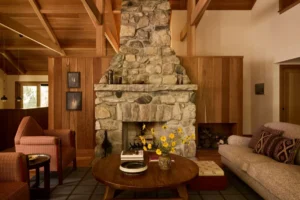
Drawing inspiration from books on Mexican colonial architecture, which he dubbed his "Bibles," Hudson transformed the property into what he called "The Castle." He incorporated stone archways, hand-painted tiles, and ceilings crafted from tree limbs. The interior was a reflection of a deeply personal, eclectic aesthetic: zebra skins, African masks, and towering four-foot-tall pewter candlesticks adorned the rooms. The estate featured significant amenities, including a 40-foot pool, a private theater, and an outdoor fireplace, creating a resort-like atmosphere that catered to his desire for both entertainment and absolute privacy.
An Open-Door Philosophy
Despite his public reputation for being guarded, friends and household staff noted that Hudson maintained an "open-door" policy at The Castle. Actor George Nader noted that Hudson often left his doors unlocked, driven by an interest in the "excitement of the unknown." His housekeeper, Joy, famously remarked that the actor’s obsession with connection—whether through fan mail or the telephone—was such that he would "answer the phone from the casket." This contradiction—a man who fiercely protected his privacy yet invited the world to his doorstep—remains one of the most compelling aspects of his legacy.

The Horticultural Passion
Beyond the architecture, the grounds of The Castle served as a testament to Hudson’s intense work ethic. He inherited the property’s gardener, Clarence Morimoto, and became deeply involved in the cultivation of the estate’s extensive gardens. The greenhouse was home to a diverse array of flora, including orchids, tulips, and roses. Furthermore, the land was productive; he harvested his own limes for daiquiris, peaches for homemade ice cream, and a variety of vegetables including corn, squash, and tomatoes. Hudson often described the physical act of gardening as his primary method for processing career decisions, once musing that had he not become an actor, he likely would have pursued a career as a landscape architect.
Legacy and Property Valuation
The Castle remained Hudson’s home until his passing from AIDS-related complications on October 2, 1985. The residence was the site of his memorial service, attended by 300 guests, including his lifelong friend and co-star, Elizabeth Taylor. At the time of his death, the estate was appraised at $3 million.

The subsequent history of the property reflects the shifting tides of the Southern California real estate market. In 1997, Microsoft co-founder Paul Allen purchased the home for $9 million. Allen held the estate until his death in 2018. In 2021, the estate of Paul Allen listed the property for $55.5 million, an astronomical increase that highlights not only the inflation of the Los Angeles luxury market but also the enduring, almost mythic, appeal of properties associated with the stars of Hollywood’s Golden Age. The evolution of 9402 Beverly Crest Drive—from a modest rental to an architectural marvel and finally a high-value historical asset—mirrors the arc of Rock Hudson himself: a man who navigated the complex intersection of private truth and public grandeur.