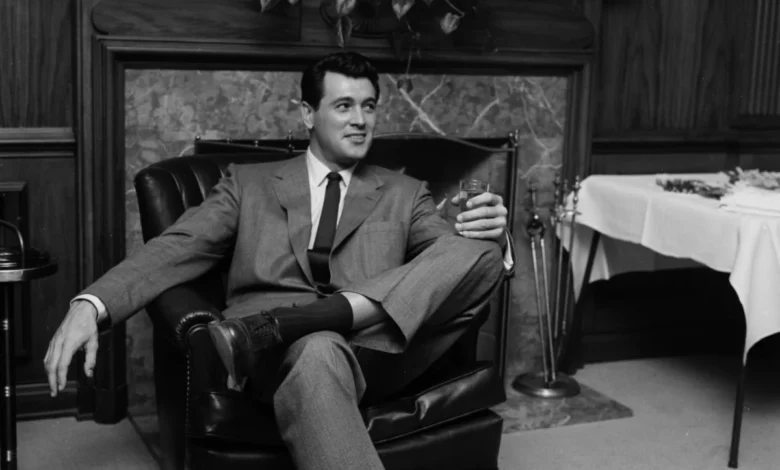
Rock Hudson remains an indelible figure of the Golden Age of Hollywood, a quintessential leading man whose screen presence in classics such as Giant, Pillow Talk, and All That Heaven Allows defined the romantic comedy and dramatic genres of the 1950s and 60s. Yet, behind the carefully curated image of the rugged, handsome matinee idol lay a man whose life was marked by the tension between his public persona and a deeply private, complex reality. For Hudson, his homes were not merely status symbols; they were essential fortresses of solitude. Away from the relentless scrutiny of the press and the artifice of the studio system, these residences served as the only spaces where the actor could truly shed his public mask and engage in the tactile, grounding pursuits of gardening, home improvement, and quiet introspection.

Humble Beginnings and the Search for Privacy
Born Roy Harold Scherer Jr. on November 17, 1925, in Winnetka, Illinois, Hudson’s early life was a far cry from the opulent estates he would later occupy. According to biographical accounts, including Sara Davidson’s definitive work, Rock Hudson: His Story, the future star spent formative years in a cramped one-bedroom bungalow at 719 Center Street. It was a domestic environment shared by six adults and five children, served by a single bathroom. This experience of density and lack of personal space appears to have shaped Hudson’s lifelong obsession with creating expansive, private sanctuaries. As his fame reached a fever pitch, he famously remarked that his home was the only place he felt he possessed any true agency, stating that while the outside world watched and critiqued his every move, behind his gates he could "relax and let go."
A Chronology of Domestic Life
The evolution of Hudson’s living arrangements mirrors his trajectory from an aspiring actor to a global superstar. In the early 1950s, he shared a series of four homes with fellow actor Bob Preble. Their final residence together, located on Avenida del Sol in Los Angeles, was noted for its forward-thinking design, featuring floor-to-ceiling glass fixtures and panoramic views of the valley and mountains. This period was significant not only for the architectural style Hudson gravitated toward but also for the speculation surrounding his personal life. Preble, in retrospect, described their relationship as one of experimentation and emotional complexity, noting that while the barriers of the era made a permanent, public union impossible, their time together represented a formative period of discovery for the young star.

In 1955, Hudson married Phyllis Gates, a union that would later be scrutinized as an attempt to protect his career and reputation. Following the marriage, Hudson purchased a two-bedroom ranch-style home at 9151 Warbler Place, near Sunset Boulevard. The home was modest by Hollywood standards; in fact, Hudson had invested so heavily in the property that the living room was initially furnished with simple redwood lawn chairs. The marriage was short-lived, ending in a 1958 divorce, at which point the property—then valued at $35,000—was awarded to Gates as part of the settlement, along with alimony payments.
The Malibu Years and the Shift to Independence
Post-divorce, Hudson pivoted toward a coastal lifestyle, moving to a Malibu beach house situated on stilts over the ocean. This residence served as his primary home during the filming of the 1959 hit Pillow Talk. The lifestyle here was markedly different from his previous, more formal settings. Friends and fellow actors, including Don Burnett, have described this era as idyllic, characterized by year-round ocean swimming, hiking in the Malibu hills, and a newfound sense of community with local stuntmen and performers. This period highlights a shift in Hudson’s personality toward a more relaxed, physical lifestyle, where he learned to sail and scuba dive, further distancing himself from the rigid expectations of his studio contracts.

The Castle: Architectural Ambition and Identity
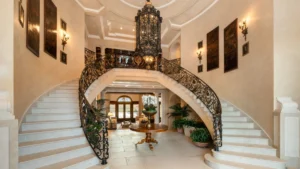
Perhaps the most significant chapter in Hudson’s residential history began in the early 1960s with 9402 Beverly Crest Drive. Initially leased from agent and producer Sam Jaffe, the property became an obsession for the actor. The estate, a sprawling three-and-a-half-acre compound surrounded by dramatic cliffs, featured a classic Spanish-style aesthetic with red-tile roofing, heavy stucco walls, and intricate woodwork.
When Hudson’s contract with Universal Studios came up for renewal in 1962, he utilized the house as a central bargaining chip. The studio eventually purchased the estate from Jaffe for $167,000 as part of the contract renegotiation. Once the deed was transferred to him, Hudson embarked on a multi-year renovation project that transformed the structure into what he affectionately dubbed "The Castle."

Guided by books on Mexican colonial architecture, Hudson personally oversaw the integration of stone archways, hand-painted tiles, and exposed wood ceilings. The interior design was deeply personal, reflecting his eclectic taste: zebra skins, African masks, and four-foot-tall pewter candlesticks were juxtaposed with more provocative art pieces. Notably, he commissioned metal sculptures of the male form by Mexican artist Victor Salmones for the gardens and incorporated a carved nude figure into his own bed’s headboard. These choices suggest a man creating a space that was not merely a house, but an extension of his internal world and identity.
The Open-Door Philosophy and Horticultural Passion
Despite his stated need for privacy, accounts from those close to him, such as actor George Nader, suggest that Hudson maintained a paradoxical open-door policy. He was known to leave his doors unlocked, seemingly drawn to the possibility of unexpected encounters or the excitement of the unknown. His housekeeper, Joy, often remarked on his eagerness to engage with the outside world, whether through fan mail or phone calls—a sharp contrast to the carefully guarded image projected by his publicists.

Beyond the architecture, Hudson found solace in the grounds of The Castle. Inheriting the estate’s gardener, Clarence Morimoto, Hudson became deeply involved in the cultivation of his property. The estate functioned as a self-sustaining oasis, yielding everything from limes for cocktails to fresh peaches and garden vegetables. Hudson viewed gardening as a form of meditative labor; it was here, amidst his pruning and planting, that he worked through career anxieties and script preparations. He often mused that if his acting career had not taken off, he might have found fulfillment as a professional landscape architect.
Legacy and Broader Implications
Rock Hudson resided at The Castle until his passing on October 2, 1985, due to complications from AIDS. The home became the site of his final memorial service, attended by 300 guests, including his lifelong friend and co-star, Elizabeth Taylor. The property itself serves as a testament to the changing value of Hollywood real estate. Appraised at $3 million in 1985, the estate was later purchased by Microsoft co-founder Paul Allen for $9 million in 1997. Following Allen’s death, the property hit the market in 2021 with an asking price of $55.5 million, a figure that underscores both the astronomical appreciation of Los Angeles luxury real estate and the enduring mystique of its former inhabitant.

The story of Hudson’s homes is not merely a record of real estate transactions; it is a vital piece of the puzzle that explains how a major studio star navigated the immense pressures of 20th-century celebrity. His obsession with home-making was an assertion of self in an industry that sought to commodify him. By transforming his environment, from the modest bungalow of his youth to the sprawling, self-designed sanctuary of his final years, Hudson found the only place where he could exist on his own terms. Today, the legacy of The Castle remains as a monument to a man who, while playing the role of the ultimate romantic hero for millions, was quietly building a world of his own design behind the scenes.