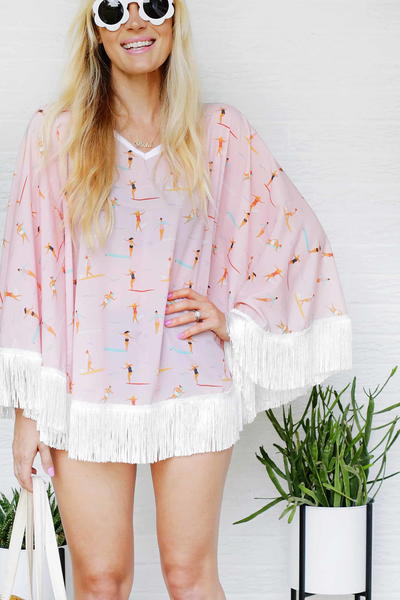
DIY Circle Swimsuit Cover-Up: A Beginner-Friendly Guide to Effortless Beach Style
Crafting your own circle swimsuit cover-up is an achievable and rewarding DIY project for sewers of all skill levels. This versatile garment offers a relaxed silhouette perfect for transitioning from the beach or pool to casual outings. The circular design inherently drapes beautifully and requires minimal fitting, making it an excellent choice for beginners. This comprehensive guide will walk you through the entire process, from selecting materials to finishing touches, ensuring you create a stylish and functional piece that complements your swimwear. Understanding the core principles of this project, particularly the geometric simplicity of the circle, will demystify the sewing process and empower you to customize your cover-up to your exact preferences.
The beauty of a circle swimsuit cover-up lies in its minimal construction. Unlike fitted garments that require precise measurements and complex pattern adjustments, a circle cover-up relies on the natural drape of fabric when cut into a circular shape. This inherent simplicity translates into a project that is not only quick to complete but also forgiving of minor sewing imperfections. The primary advantage of a DIY approach is the ability to select specific fabrics that enhance comfort and style. Lightweight, breathable materials like cotton voile, rayon challis, linen blends, or even sheer georgette are ideal for beachwear. These fabrics allow for excellent airflow, keeping you cool and comfortable in warm weather, and their fluidity complements the graceful drape of the circular cut.
To begin your DIY circle swimsuit cover-up, you will need a few essential supplies. The most crucial element is your fabric. The amount of fabric required will depend on your desired cover-up length and your bust measurement, as this will determine the diameter of your circle. A good rule of thumb is to have enough fabric to create a circle that is roughly twice your bust measurement plus your desired length, plus extra for seam allowances and hem. For example, if your bust measurement is 40 inches and you want a cover-up that falls to your knees (say, 20 inches), you’ll need a circle with a diameter of at least 80 inches (40 x 2) plus 20 inches (length) plus seam/hem allowance. This might translate to needing a fabric width of at least 80-90 inches, or piecing together narrower fabrics. It’s always better to err on the side of having too much fabric than too little.
Next, you’ll need a sewing machine. A standard domestic sewing machine will work perfectly for this project. Ensure you have a universal needle appropriate for your chosen fabric weight. Thread matching your fabric color is also essential for a polished look. For marking and cutting, a fabric marker or chalk and a very long measuring tape are indispensable. A large pair of fabric scissors or a rotary cutter and mat are vital for achieving clean, straight cuts. Lastly, consider a serger if you have one, as it will provide a professional finish to your raw edges and reinforce seams, though it’s not strictly necessary. Pins for holding fabric layers together are also a must-have.
The foundation of your circle swimsuit cover-up is the fabric itself. Prioritize materials that are lightweight, breathable, and have a good drape. Cotton voile is an excellent choice for its airy feel and soft texture. Rayon challis offers a luxurious, fluid drape that moves beautifully. Linen blends provide a more structured yet still breathable option. For a sheerer, more ethereal look, consider chiffon or georgette. When selecting fabric, think about how it will feel against your skin after a dip in the water. Absorbency and quick drying properties are also beneficial. If your fabric is not wide enough to create a single, large circle, you can piece together narrower panels. This will require careful cutting and sewing to ensure the seams lie flat and don’t detract from the overall design. Always pre-wash your fabric before cutting to account for any shrinkage that may occur. This step is crucial to prevent your finished cover-up from unexpectedly shrinking after its first wash.
The most critical step in creating your circle swimsuit cover-up is accurately measuring and cutting your fabric. Lay your fabric flat on a large, unobstructed surface. The simplest way to cut a large circle is to fold your fabric. For a full circle cover-up, you’ll typically fold your fabric twice. First, fold the fabric in half lengthwise. Then, fold it in half again widthwise, creating a quarter-circle shape. The point where all the folds meet will be the center of your circle. Measure from this center point outwards along the folded edges to mark your desired radius. The radius is half the diameter of your desired circle. To calculate the diameter, add your bust measurement (this will form the widest part of your cover-up) to your desired length. Divide that total by two to get your radius. For example, if your bust is 40 inches and you want a 20-inch length, you need a total diameter of 60 inches, so your radius will be 30 inches.
To ensure an accurate circle, use your measuring tape to mark consistent distances from the center point along the folded edges. You can create a simple compass by tying a string to your fabric marker or chalk, securing one end at the center point, and holding the other end at the desired radius. Sweep the marker around the fabric to create a perfect arc. Alternatively, you can use long rulers or measuring tapes, carefully marking dots at the correct radius all around the folded fabric and then connecting them to form the circle. Once your circle is marked, carefully cut along the marked line with your fabric scissors or rotary cutter. Remember to leave an adequate seam allowance (typically 1/2 inch) for the neckline and hem.
Cutting the neckline is the next crucial step. With the fabric still folded into its quarter-circle, measure inwards from the folded corner (which represents the center of your cover-up) to mark your desired neckline. For a simple scoop neck, measure a few inches down and a few inches across, creating a gentle curve. For a V-neck, measure down the center fold and then mark outwards at the shoulder point. The size and shape of your neckline are entirely customizable. Remember that this neckline will be sewn, so factor in your seam allowance here as well. You can also decide to cut a larger opening for a head that can accommodate a hood or a more dramatic neckline. Consider how the cover-up will be worn over a swimsuit and ensure the neckline is comfortable and provides easy access.
Once your fabric circle is cut, unfold it. You will have a large circle with a smaller circle cut out of the center for the neckline. Now it’s time to prepare the edges for sewing. The raw edges of your fabric, particularly the hem and the neckline, will need to be finished to prevent fraying and create a neat appearance. A double-fold hem is a common and effective method for finishing the bottom edge. Fold the raw edge up by about 1/4 inch and press it in place. Then, fold it up again by another 1/2 inch (or your desired hem width) and press firmly. This creates a clean, enclosed edge. For the neckline, you have several options. You can use a similar double-fold hem, or you can opt for a bias tape finish, which offers a more professional and flexible edge, especially for curved necklines. If you’re using a serger, you can also use a rolled hem or a simple serged edge for a very lightweight and casual finish.
The sewing process for a circle swimsuit cover-up is straightforward. Begin by sewing the hem. If you opted for a double-fold hem, stitch along the inner folded edge, close to the raw edge. Ensure you are sewing through both layers of the folded hem. For a bias tape finish on the neckline, unfold one edge of the bias tape, align the raw edge of the bias tape with the raw edge of the neckline opening, right sides together, and stitch along the crease of the bias tape. Trim any excess fabric, then fold the bias tape over the raw edge to the inside of the cover-up and stitch it down. For a double-fold hem on the neckline, follow the same procedure as the bottom hem. If you are sewing a V-neck, you will need to carefully miter the corners to create a clean finish.
If your fabric was not wide enough to cut a single large circle, you will need to piece it together. Before cutting your main circle, cut your fabric panels. You can create panels that are wide enough to accommodate your desired circle diameter when joined. Sew these panels together along their long edges using a straight stitch, ensuring you have a seam allowance of at least 1/2 inch. Press the seams open. Once your pieced fabric is ready, you can then proceed with marking and cutting your large circle as described earlier. The key to successfully piecing is to ensure the seams are as flat as possible and that the fabric remains as fluid as it would be if it were a single piece. Consider the direction of the grain when joining panels to maintain the intended drape of the fabric.
To add sleeves, you can cut out two semi-circular or quarter-circular shapes and attach them to the armhole area. However, a true circle cover-up often omits sleeves, relying on the natural drape and flow of the fabric to create a cape-like effect. If you desire a sleeve, a simple approach is to cut two small circles and attach them as bell sleeves to the sides of the cover-up, or to cut out a larger armhole and attach a gathered sleeve. For maximum ease, consider leaving the sides open, creating a poncho-like garment. If you prefer more coverage, you can sew up a portion of the side seams, leaving slits at the bottom for ease of movement. The extent to which you sew the side seams is a personal preference and will affect the overall silhouette of your cover-up.
Customization is where your DIY circle swimsuit cover-up truly shines. Embellishments can elevate a basic design into a statement piece. Consider adding pom-pom trim along the hem or neckline for a playful touch. Tassels can be added to the corners of any side slits. Delicate lace trim can be sewn along the edges for a romantic feel. Embroidery can add intricate details, either on the fabric itself or on patches that are then applied. Beading can provide subtle sparkle, especially along the neckline. If you’ve chosen a solid color fabric, consider fabric paint to stencil designs or create abstract patterns. When adding embellishments, ensure they are lightweight and will not detract from the drape of the fabric or become a hindrance in or around water. Test any embellishments for colorfastness if you anticipate them getting wet.
Consider adding a tie or belt to cinch the waist and create a more defined silhouette. You can create a simple fabric belt by folding and stitching a long strip of fabric. Alternatively, you can purchase pre-made belts or use a piece of rope or braided cord. This offers an adjustable fit and can transform the cover-up from a relaxed poncho to a more fitted dress. For added functionality, you could also consider adding patch pockets to the front of the cover-up. These are simple to construct and are useful for carrying small essentials like lip balm or keys. Ensure any pockets are securely attached and don’t add too much bulk to the fabric.
When choosing your fabric, think about the occasion. For a casual beach day, a lightweight cotton or linen blend might be perfect. For a more sophisticated resort look, a flowing rayon or a sheer chiffon would be ideal. The color of your fabric can also make a significant difference. Bright, bold colors are perfect for making a statement, while softer pastels or neutrals offer a more understated elegance. Consider how the color will complement your swimwear. If you have a brightly patterned swimsuit, a solid color cover-up might be a good choice. Conversely, a neutral swimsuit could be beautifully accented by a patterned cover-up.
The beauty of the circle swimsuit cover-up lies in its inherent versatility. It’s not just for the beach. With a few simple adjustments, it can be styled for a variety of casual occasions. Wear it over shorts and a tank top for a breezy summer outfit. It can also be layered over leggings and a t-shirt for a comfortable travel ensemble. The key is to choose fabrics that are appropriate for the intended use. For example, a sheerer fabric might be too revealing for everyday wear, while a more opaque fabric would be more suitable. The length of your cover-up can also dictate its versatility. A shorter, tunic-style cover-up can be worn as a dress with appropriate undergarments, while a longer, maxi-style cover-up offers more coverage and can be dressed up or down.
Maintaining your DIY circle swimsuit cover-up is as simple as caring for the fabric you chose. Most lightweight fabrics suitable for cover-ups can be hand-washed or machine-washed on a delicate cycle in cool water. It’s best to avoid harsh detergents and fabric softeners, which can degrade the fabric fibers over time. Always hang your cover-up to air dry. Direct sunlight can cause colors to fade, so dry it in a shaded area. If your fabric is prone to wrinkling, a quick steam or a very low-heat iron can help smooth out any creases. Proper care will ensure your handmade cover-up remains a stylish and functional addition to your wardrobe for seasons to come. By following these steps, you can confidently create a unique and personalized circle swimsuit cover-up that reflects your individual style and enhances your beach or poolside experience.

