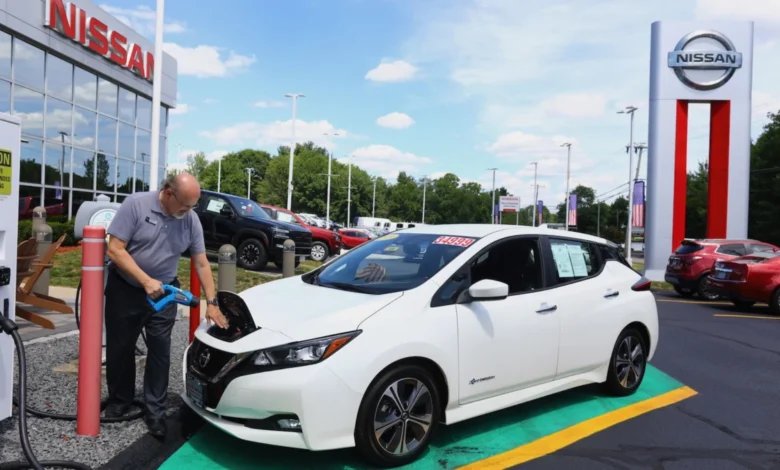
The United States automotive market reached a surprising crossroads in April 2026, as a significant cooling in electric vehicle (EV) sales coincided with a sharp increase in gasoline prices. While traditional economic theory suggests that high fuel costs act as a catalyst for EV adoption, recent data indicates that American consumers are instead retreating toward hybrid technology or remaining with internal combustion engines. This domestic trend stands in stark contrast to international markets, particularly in Europe and China, where electrification continues to accelerate amidst global energy instability.
According to the latest industry reports from Edmunds, a leading automotive research firm, sales of new EVs plummeted by approximately 18 percent between March and April. Cox Automotive, another major industry tracker, provided a slightly more conservative estimate, pegging the decline at 6 percent. Regardless of the specific metric, the consensus among analysts is clear: the anticipated "mass migration" to fully electric transportation has hit a significant financial and psychological wall. While interest in green technology remains high—evidenced by robust online search traffic—this curiosity is not translating into signed contracts at the dealership level.
The Financial Reality of the Electric Transition
The primary deterrent for the average American consumer remains the significant upfront cost associated with battery-electric vehicles. Despite various federal incentives and manufacturer discounts, the average transaction price for an EV in April was $6,214 higher than for a comparable vehicle equipped with an internal combustion engine (ICE). For many households, this "green premium" represents a hurdle that outweighs the long-term benefits of lower fuel and maintenance costs.
Stephanie Brinley, a principal automotive analyst at S&P Global Mobility, noted that the return on investment for an EV is becoming harder for consumers to calculate. "It’s still a cost hurdle," Brinley explained. "You don’t know how long it’s going to take to get that back." The math is indeed daunting for the average commuter. With the national average for regular gasoline reaching $4.56 per gallon in late May, a buyer would need to drive an EV for more than 40,000 miles to offset the initial price gap when compared to a fuel-efficient gasoline car achieving 30 miles per gallon.
While EVs offer substantial savings on routine maintenance—eliminating the need for oil changes, spark plug replacements, and exhaust system repairs—these benefits are often countered by other rising costs. Insurance premiums for EVs remain significantly higher than for their gasoline counterparts, largely due to the high cost of battery replacement and specialized repair requirements following accidents. Furthermore, the necessity of installing a home charging station, which can cost between $500 and $2,000 including labor, adds another layer of immediate expense that many buyers are unwilling to absorb during a period of economic uncertainty.
Hybrids: The Pragmatic Middle Ground
As full EVs struggle to gain traction with the broader public, hybrid vehicles have emerged as the clear winner of the current energy crisis. Hybrids, which combine a traditional gasoline engine with a small battery and electric motor, offer a "best of both worlds" scenario for many drivers. They provide a 25 to 45 percent improvement in fuel economy without the "range anxiety" or charging infrastructure requirements associated with pure EVs.
The shift toward hybrids is not merely a consumer preference but a deliberate strategic pivot by major automakers. Toyota, in particular, has led this charge by aggressively phasing out gasoline-only versions of its most popular models. The 2026 Toyota Camry is now exclusively available as a hybrid, and the 2026 RAV4 has followed a similar path. Honda has seen similar success with its CR-V; while the standard gasoline model achieves 29 mpg, the hybrid variant reaches 37 mpg, making it a highly attractive option as pump prices climb.
Data from Edmunds highlights the scale of this shift: hybrid sales have surged 20 percent year-over-year and nearly 50 percent since February. This growth far outpaces both the EV segment and the traditional gasoline market, which saw a modest 11 percent increase over the same period. Industry experts are now referring to this period as the "Hybrid Moment," a transition phase where consumers seek efficiency without radical changes to their driving habits or significant financial risk.
Geopolitical Tensions and the Impact on Global Fuel Markets
The timing of this automotive shift is closely tied to escalating geopolitical tensions. The surge in hybrid sales began in earnest in February 2026, following the intensification of the U.S.-Iran conflict. With Iran maintaining a strategic and threatening presence over the Strait of Hormuz—a vital artery for global oil shipments—the volatility of the energy market has become a permanent fixture in the minds of American consumers.
As the summer travel season approaches, the threat of $5.00-per-gallon gasoline looms large. Historically, such prices have triggered a rush toward small, fuel-efficient cars. However, the 2026 market is different. Consumers are increasingly wary of the "math" required to justify an EV. Ivan Drury, director of insights at Edmunds, observed that the complexity of the EV purchase process is a deterrent. "It’s very difficult for people to wrap their head around the idea that if they spend $55,000 now, they might save money over five years," Drury said. "It requires a bit more math than most people want to go through."
A Bright Spot in the Secondary Market
While the new EV market is experiencing a cooling period, the used EV market is showing signs of healthy, efficient growth. Sales of pre-owned electric vehicles rose by 3 percent from March to April. More importantly, the price premium for a used EV over a used gasoline vehicle has narrowed to just $1,096. This near-parity has made used EVs an attractive option for budget-conscious buyers looking to hedge against high gas prices.
Stephanie Valdez Streaty, director of industry insights at Cox Automotive, noted that used EVs are currently selling faster than their internal combustion counterparts. "They’re really selling efficiently," she said. The industry anticipates a steady supply of used EVs throughout the remainder of the year as a large volume of three-year leases from the 2023 peak adoption period come to an end. This "glut" of inventory is expected to keep prices stable, providing an entry point for consumers who are curious about electrification but unwilling to pay the "new car" premium.
Global Divergence: The U.S. vs. The World
The stagnation of EV growth in the United States is particularly notable when compared to the rest of the world. In Europe, the same geopolitical pressures and high fuel prices have resulted in a massive surge in EV adoption. European governments have implemented more aggressive mandates and have a more mature charging infrastructure, which has helped decouple the EV purchase from the immediate fluctuations of the oil market.
China also continues to dominate the sector, setting new records for EV exports in April. The Chinese market benefits from a vertically integrated supply chain and a wide range of low-cost EV options that are currently unavailable in the North American market due to trade restrictions and high tariffs. BloombergNEF reports that while the U.S. is hesitating, the global transition to electric mobility is continuing at a record pace elsewhere.
The Psychological Barrier and Future Outlook
In the United States, EV adoption appears to have reached a plateau where only "edge-case" buyers—those who are tech-savvy, have high disposable income, or have dedicated home charging—are making the leap. For the mass market, the "nudge" provided by high gasoline prices is currently only strong enough to move them toward hybrids, not toward full electrification.
"What we’re unlikely to see is a shift in current ICE owners just fundamentally making that change simply because of gas prices," said Stephanie Brinley. The current trend suggests that for the average American driver, the familiarity of the internal combustion engine, combined with the incremental efficiency of hybrid technology, remains the most comfortable response to a volatile world.
As the industry looks toward the second half of 2026, the success of the automotive sector will likely depend on how well manufacturers can bridge the price gap. Until the upfront cost of an EV reaches parity with gasoline vehicles, or until the national charging infrastructure becomes as ubiquitous and reliable as the neighborhood gas station, the "Hybrid Moment" looks set to endure. For now, the American consumer is choosing the middle path—embracing efficiency, but keeping the safety net of a fuel tank firmly in place.