Prime Minister Anthony Albanese has confirmed he intends to directly challenge US President Donald Trump over the future governance and regulation of artificial intelligence during a high-level diplomatic week in New York City. The scheduled face-to-face encounter, set to take place at a presidential gala reception, brings together two leaders with starkly contrasting visions for managing the rapid expansion of emerging technologies.
The impending confrontation comes as Australia navigates a complex international landscape, balancing rapid domestic transformation with shifting geopolitical dynamics. While Canberra prepares to release its landmark Intergenerational Report (IGR)—which warns of a more fractured and uncertain global order—the Albanese government is simultaneously advancing major domestic policy shifts, seeking a seat on the United Nations Security Council, and overseeing high-profile legal proceedings back home.

The Clash of Perspectives on Artificial Intelligence
The debate over artificial intelligence has emerged as a central flashpoint in international policymaking. Treasurer Jim Chalmers is set to release Australia’s seventh Intergenerational Report, warning that while the nation is exceptionally well-positioned to benefit from the "AI revolution," the technology’s profound economic and social implications remain difficult to fully forecast. The report highlights that Australia has witnessed a near-doubling of capital expenditure in data center investments since the previous 2023 review, cementing the country as a leading global destination for digital infrastructure.
However, the rapid acceleration of AI adoption contrasts sharply with the political approach of the United States administration under Donald Trump. President Trump has famously dismissed widespread fears surrounding the technology as a "hoax," arguing that any deliberate slowdown or over-regulation of the US artificial intelligence sector would simply allow strategic competitors, particularly China, to gain an irreversible advantage. Trump has previously floated plans to appoint a specialized "AI chief" and establish an "AI Force" to monitor technological advancements, though detailed implementation plans remain scarce.
Prime Minister Albanese has adopted a markedly different tone, emphasizing the necessity of robust, globally coordinated safeguards. Speaking ahead of his departure for the United Nations General Assembly, Albanese stressed that his advocacy for ethical frameworks would be pursued both publicly and privately.

"We have a view about artificial intelligence that there needs to be appropriate safeguards put in place, and I will advocate that privately, the same as I will publicly," Albanese stated. "I have a very positive and constructive relationship with the president, and I will engage respectfully and constructively with him."
Economic Forecasts and the Intergenerational Report
The release of the seventh Intergenerational Report provides a sobering blueprint of Australia’s long-term economic and demographic trajectory. Treasurer Jim Chalmers emphasized that the report arrives at a uniquely volatile juncture for global politics and financial markets.
"The world is becoming more dangerous. More unpredictable. More unequal. And more divided," Chalmers remarked in extracts from his launch speech. "These are not just individual threads but part of a bigger fraying of that intergenerational promise of better times."
Despite these overarching global risks, the report underscores Australia’s relative resilience. Demographic forecasts within the document project a slower population growth rate, estimating an overall population of 39.3 million by 2065–66—representing roughly 1.8 million fewer people than projected in previous iterations. This deceleration is primarily attributed to a sustained decline in fertility rates, reflecting broader global trends in family planning.
Furthermore, the report notes that while Australia’s economic fundamentals remain robust compared to international peers, policymakers must proactively address the disruptions anticipated in the labor market and industrial sectors as automated systems and algorithmic tools become deeply embedded in the economy.
Diplomatic Ambitions: UN Security Council Bid and New Postings
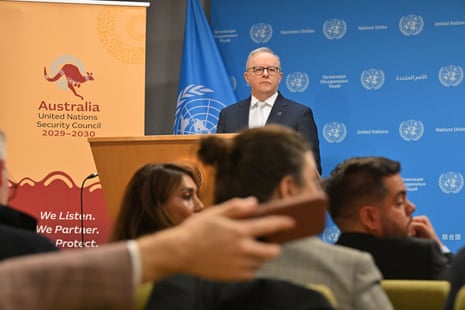
Against the backdrop of technological and economic transitions, Prime Minister Albanese used his platform in New York to officially launch Australia’s formal bid for a two-year non-permanent seat on the United Nations Security Council for the 2029–2030 term. Although the formal ballot will not occur until mid-2028, high-level diplomatic lobbying has commenced immediately during the UN General Assembly high-level week.

Australia has a rich history of engagement with the UN Security Council, having served five previous terms since the organization’s inception following the Second World War. Its most recent tenure spanned 2013 and 2014, a period defined by Australia’s leadership in orchestrating the international response to the downing of Malaysia Airlines Flight MH17 over Ukraine.
Albanese argued that active international engagement is not merely an idealistic pursuit, but a pragmatic necessity that directly influences domestic prosperity. "Engagement with the world matters. It matters because it makes a difference to the cost of living, to inflation, to Australians’ way of life," he told reporters. "That is why we can’t afford to not be engaged with the world, because it has a direct impact on the quality of life of Australians on a day-to-day basis."
In tandem with the security council bid, Foreign Minister Penny Wong announced a suite of critical diplomatic appointments. Former News Corp executive and current Australia Post chair Siobhan McKenna was named Australia’s next consul-general in New York, succeeding Heather Ridout in December. The appointment has drawn media scrutiny given McKenna’s extensive corporate background, though the Prime Minister defended the selection as merit-based, highlighting her dual expertise across private and public sectors. Additional diplomatic postings include Joel McGregor as ambassador to Egypt, Jamie Isbister as high commissioner to Papua New Guinea, and Lucienne Manton as ambassador to Timor-Leste.

Domestic Policy Debates: Fuel Excise and Solar Recycling
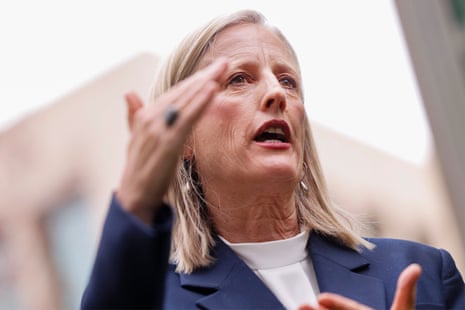
While federal leaders maneuver on the international stage, domestic political friction persists over cost-of-living measures and environmental sustainability. Finance Minister Katy Gallagher sharply criticized a recent Coalition proposal put forward by Angus Taylor, which suggested automatically halving the fuel excise whenever global Brent crude oil averages USD $100 a barrel over a two-week period.
Gallagher dismissed the policy as an "unfunded, uncounted promise," pointing out that the federal budget relies on permanent, structural tax adjustments to alleviate cost-of-living pressures rather than volatile, one-off excise cuts that could inadvertently stoke inflationary pressures within the broader economy.
Concurrently, New South Wales is taking unilateral action on environmental reform, moving to establish Australia’s first mandatory solar panel recycling scheme. Amid frustrating delays at the federal level for a national stewardship program, the NSW government launched consultations on a regulatory framework that will legally bind manufacturers to manage the end-of-life disposal of photovoltaic cells. Generating approximately 14,000 tonnes of electronic waste annually—a figure projected to surge to 89,000 tonnes by 2045—the state aims to finalize regulations by late 2026, setting a potential benchmark for nationwide adoption.
Legal Proceedings and Public Interest
Domestically, the New South Wales judicial system is grappling with profound public interest as the high-profile murder trial of former police officer Beau Lamarre-Condon gets underway in Sydney. Lamarre-Condon has entered pleas of not guilty to two counts of murder and one charge of aggravated break and enter regarding the February 2024 deaths of television presenter Jesse Baird and his partner, Luke Davies.
Presided over by Justice Natalie Adams, the Supreme Court trial commenced with jury empanelment on King Street. Legal experts anticipate the proceedings will span two to three months, featuring a comprehensive evidentiary brief involving more than 200 witnesses, marking one of the most closely watched criminal trials in recent Australian legal history.
Conclusion
As Prime Minister Albanese prepares for his high-stakes diplomatic exchanges in New York, the intersection of technological disruption, geopolitical maneuvering, and domestic economic management defines the current national trajectory. Whether Canberra’s cautious advocacy for artificial intelligence safety standards can influence the trajectory of global superpowers remains one of the defining foreign policy questions of the decade.