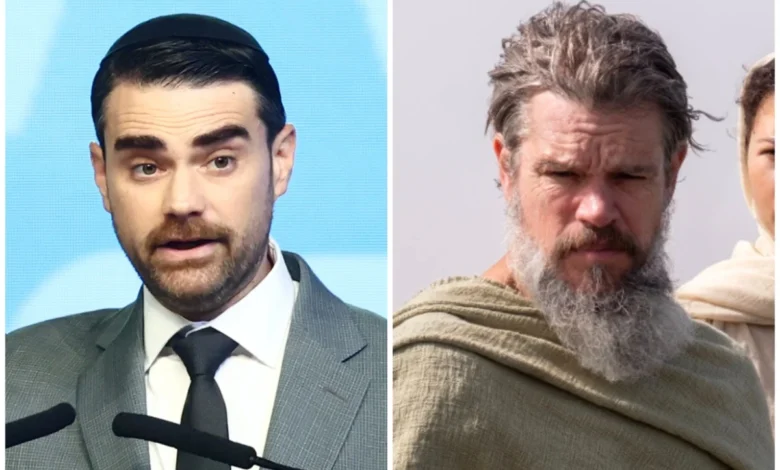
Conservative commentator Ben Shapiro has issued a comprehensive, 18-minute review of Christopher Nolan’s latest cinematic endeavor, "The Odyssey," on his YouTube channel, unequivocally labeling the Greek epic a "masterpiece." This declaration comes despite a notable wave of conservative backlash concerning the film’s casting choices and perceived deviations from historical accuracy. Shapiro’s assessment offers a nuanced perspective, acknowledging criticisms while firmly defending Nolan’s artistic vision and the film’s overall merit.
Shapiro’s Unqualified Praise for Nolan and the Film
Shapiro’s review, published on Saturday, positions Christopher Nolan at the pinnacle of contemporary filmmaking. "Nolan is unparalleled. He’s the best director working today, without a doubt. He just creates iconic movie after iconic movie," Shapiro stated, his tone conveying genuine admiration. This high praise for Nolan extends to his consistent output of critically acclaimed and commercially successful films, a track record that has solidified his reputation as a cinematic auteur. Nolan’s filmography, including blockbusters like "The Dark Knight" trilogy, "Inception," and "Interstellar," has consistently pushed the boundaries of filmmaking, often blending complex narratives with stunning visual spectacle. "The Odyssey," adapted from Homer’s seminal work, appears to have continued this trend in Shapiro’s view, resonating with his appreciation for ambitious and well-executed cinema.
The commentator’s praise was not limited to the director. Shapiro reserved significant commendation for the film’s lead actor, Matt Damon, who portrays the titular Odysseus. "I think he’s great in nearly everything," Shapiro remarked. "He sort of disappears into the part in a way that he doesn’t in a lot of other movies. He’s great as Odysseus." Damon’s ability to embody complex characters and deliver nuanced performances has been a hallmark of his career, and Shapiro’s observation suggests that his portrayal of the resourceful and enduring hero of "The Odyssey" has particularly impressed.
Supporting Cast Recognition and Defense of Casting Decisions
Beyond the lead, Shapiro lauded several key members of the supporting cast, highlighting their contributions to the film’s success. Robert Pattinson, as the antagonist Antinous, was described as "an excellent antagonist. He’s sleazy and gross." This portrayal suggests Pattinson has effectively captured the villainous essence of the character, providing a compelling foil for Damon’s Odysseus. Tom Holland, cast as Telemachus, Odysseus’s son, was also singled out for praise: "Tom Holland as Telemachus is excellent, well cast." Holland, known for his youthful energy and dramatic range, appears to have brought a vital presence to the role of the prince yearning for his father’s return. Anne Hathaway, taking on the role of Penelope, Odysseus’s loyal wife, "does a great job," according to Shapiro, indicating her successful portrayal of the enduring queen’s intelligence and resilience.
Addressing Conservative Backlash: Helen of Troy and Historical Accuracy
A significant portion of Shapiro’s review directly addresses the conservative outrage that has swirled around "The Odyssey," particularly concerning the casting of Lupita Nyong’o as Helen of Troy. Critics, including prominent figures like Elon Musk, have questioned Nyong’o’s appearance in the role, often drawing comparisons to historical depictions or expecting a specific ethnic profile for the legendary beauty. Shapiro, however, offered a robust defense of Nolan’s decision. "So, I know a lot of people were like, ‘Oh my god, Lupita Nyong’o is supposed to look like Diane Kruger.’ I don’t know. Diane Krueger doesn’t look very Greek. She’s German," Shapiro retorted, challenging the premise of the criticism. He further emphasized Nyong’o’s inherent beauty and offered a narrative justification for the casting, suggesting that Nolan’s script itself provides context that transcends conventional notions of Helen’s allure. "Lupita Nyong’o is a beautiful woman. But here’s the thing, actually, in the script, Nolan goes out of his way to explain that the war wasn’t really launched over Helen being gorgeous." This points to a potential thematic exploration within the film, where the motivations behind the Trojan War are presented as more complex than a simple dispute over beauty, thereby validating diverse casting choices by focusing on character and narrative depth.
A Single Casting Quibble: Elliot Page as Sinon
While largely effusive in his praise, Shapiro did express a singular reservation regarding the casting of Elliot Page as Sinon, the Greek soldier who tricks the Trojans into bringing the Trojan Horse into their city. Shapiro found Page’s role to be an "absolute puzzler." His critique was notably direct and focused on physical attributes and perceived suitability for the character. "He is about 5’2 and 105 pounds soaking wet and has the voice of a woman. It doesn’t work," Shapiro stated, implying that Page’s physical presentation and vocal characteristics did not align with his interpretation of the character Sinon. This comment, though isolated, highlights a point of contention for Shapiro within an otherwise overwhelmingly positive review.
Nolan’s Stance on Backlash and Artistic Integrity
The controversy surrounding "The Odyssey" is not new, and director Christopher Nolan himself has previously addressed the online backlash. In an interview with The Telegraph, Nolan conveyed a sense of detachment from such criticisms, suggesting that "online backlash comes with the territory" when producing major studio films. His perspective, as articulated in that interview, draws parallels to his experience with the "Batman" franchise. "Remember, I spent 10 years of my life dealing with Batman," Nolan explained. "When I came on ‘Begins,’ writers and artists had been working on this beloved character for almost 65 years, and a lot of freighted thoughts were out there about what he represents. And what I learnt over my time on that trilogy is you can’t worry about any of that at all. What you have to do is honor the original text by interpreting it in the strongest way you personally can." This philosophy underscores Nolan’s commitment to his artistic vision, prioritizing a powerful and personal interpretation of source material over appeasing external pressures or conforming to pre-existing expectations. Shapiro’s review, by strongly endorsing Nolan’s film despite the prevailing criticisms, implicitly aligns with this artistic ethos.
The Enduring Legacy of "The Odyssey" and Cinematic Adaptation
Homer’s "The Odyssey" is one of the foundational texts of Western literature, a sprawling epic poem detailing Odysseus’s arduous ten-year journey home after the Trojan War. Its themes of perseverance, loyalty, cunning, and the human condition have resonated across millennia, inspiring countless retellings and adaptations in various art forms. Christopher Nolan’s decision to tackle such a monumental work, with its inherent complexities and vast scope, signals a significant artistic undertaking. The film’s reported extensive runtime and ambitious narrative structure suggest an attempt to capture the epic scale and thematic depth of the original poem.
The challenges of adapting such an ancient and revered text for a modern audience are immense. Filmmakers must navigate the delicate balance between respecting the source material and making it accessible and engaging for contemporary viewers. This often involves difficult choices regarding narrative focus, character interpretation, and thematic emphasis. The casting decisions, therefore, become crucial in shaping the film’s reception and its resonance with audiences.
The Broader Implications of Casting Debates in Hollywood
The controversy surrounding "The Odyssey" is emblematic of ongoing debates within the film industry regarding diversity, representation, and historical accuracy in casting. While proponents of diverse casting argue that it enriches storytelling and reflects the contemporary world, critics sometimes raise concerns about perceived departures from historical or literary fidelity. These discussions often highlight differing perspectives on the purpose and function of cinematic adaptation.
For some, adaptations are opportunities to reimagine classic narratives through a modern lens, embracing inclusivity and exploring new interpretations. For others, there is a stronger emphasis on maintaining a degree of fidelity to the perceived original intent or historical context of the source material. Ben Shapiro’s review, in this context, suggests that even within conservative circles, there can be an appreciation for directorial vision and artistic merit that transcends strict adherence to traditional casting expectations. His defense of Nyong’o’s role, by pointing to narrative justifications within the film, indicates a willingness to engage with the creative choices on their own terms.
The enduring appeal of "The Odyssey" and the ongoing discussions surrounding its cinematic adaptations underscore the power of storytelling to provoke thought, spark debate, and connect with audiences across generations. Christopher Nolan’s "The Odyssey," as reviewed by Ben Shapiro, appears to be a film that has succeeded in generating significant conversation, whether through its artistic triumphs or the controversies it has ignited. The film’s ultimate impact and place in cinematic history will likely be determined by its ability to resonate with a broad audience and its lasting contribution to the rich legacy of Homer’s epic poem. The varied reactions, from unqualified praise to pointed criticism, highlight the subjective nature of art and the diverse interpretations that classic narratives can inspire in the modern era.