In a landmark achievement for marine biology and deep-sea exploration, researchers from the Institute of Deep-sea Science and Engineering at the Chinese Academy of Sciences have documented the deepest and most extensive animal communities ever observed on the planet. Utilizing the advanced manned submersible Fendouzhe, the scientific team identified thriving ecosystems of mollusks, tubeworms, and other invertebrates at depths approaching six miles below the ocean’s surface. This discovery, centered in the Mariana Trench and extending across the Kuril–Kamchatka and western Aleutian trenches, fundamentally challenges existing scientific models regarding the limits of life and the mechanisms of carbon cycling in the Earth’s most extreme environments.
The findings, recently published in the prestigious journal Nature, reveal that these "hadal" zones—the deepest parts of the ocean located within trenches—are far from the desolate, alien landscapes they were once thought to be. Instead, they harbor "vibrant oases" of life that rely on chemical energy rather than sunlight. The documentation of these communities marks a significant shift in our understanding of the biosphere, suggesting that complex animal life is far more resilient and widespread in the deep crust than previously hypothesized.
The Hadal Frontier: A New Biological Paradigm
The hadal zone, named after Hades, the Greek god of the underworld, refers to the deepest regions of the ocean, typically found at depths ranging from 6,000 to 11,000 meters (approximately 3.7 to 6.8 miles). These areas are characterized by near-freezing temperatures, total darkness, and immense hydrostatic pressure that can exceed 1,000 times the atmospheric pressure at sea level. Historically, these trenches have been among the least explored environments on Earth due to the extreme technological challenges associated with reaching them.
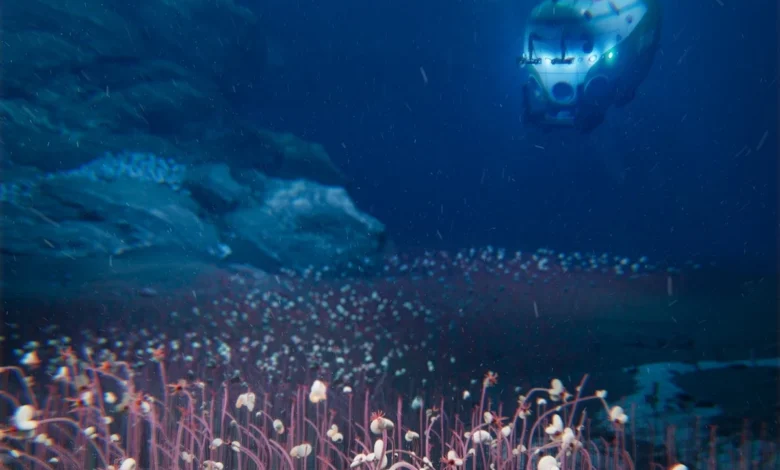
The research team, led by Xiatong Peng, conducted a series of 23 dives using the Fendouzhe (meaning "Striver") submersible. Their investigation spanned a massive geographical range, covering approximately 1,553 miles (2,500 kilometers) of the seafloor. The most significant discovery occurred at depths between 3.6 and 5.92 miles (5,800 to 9,530 meters). At these depths, the team observed dense colonies of siboglinid polychaetes (tubeworms) and various bivalve mollusks.
Prior to this expedition, documentation of such complex, chemosynthesis-based communities in hadal trenches was exceptionally rare. Most previous deep-sea biological discoveries focused on single-celled organisms or isolated, smaller invertebrates. The sheer abundance of the life forms found by the Chinese team—thousands of organisms clustered together—indicates a robust and well-established ecosystem that functions independently of the sun-driven food chains found in the upper layers of the ocean.
The Mechanics of Survival: Chemosynthesis in the Deep
The primary driver of these deep-sea ecosystems is a process known as chemosynthesis. In the absence of sunlight, which prevents photosynthesis, these organisms derive their energy from chemical reactions. The study revealed that these communities are sustained by fluids rich in hydrogen sulfide and methane. These chemicals are transported along geological faults that traverse deep sediment layers within the trenches.
Isotopic analysis conducted by the researchers suggests that the methane in these regions is produced microbially from organic matter that has settled into the trenches over millennia. As this methane seeps through cracks in the ocean floor, it provides a "fuel source" for specialized bacteria. These bacteria, in turn, form the base of the food web, often living symbiotically within the tissues of the tubeworms and bivalves or forming thick, snow-like microbial mats on the seafloor.
"What makes our discovery groundbreaking is not just its greater depth—it’s the astonishing abundance and diversity of chemosynthetic life we observed," stated study co-author Mengran Du, a marine geochemist. "Unlike isolated pockets of organisms, this community thrives like a vibrant oasis in the vast desert of the deep sea."
Video footage captured during the dives shows tubeworms reaching lengths of up to a foot, growing alongside mounds of clams and various other invertebrates. The researchers also noted the presence of free-floating marine worms, spiky crustaceans, sea lilies, sea cucumbers, and other scavengers that likely benefit from the localized high productivity of the chemosynthetic sites.
Chronology of Exploration in the Mariana Trench
The Mariana Trench, a crescent-shaped scar in the Earth’s crust located in the western Pacific, has a long history of sporadic exploration. To understand the significance of the Fendouzhe’s findings, it is essential to look at the timeline of human endeavors to reach the bottom of the world.
- 1960: The First Descent. Don Walsh and Jacques Piccard became the first humans to reach the Challenger Deep, the deepest known point of the Mariana Trench, aboard the bathyscaphe Trieste. Their stay lasted only 20 minutes, and visibility was limited, though they reported seeing a flatfish, a claim that was debated for decades.
- 2012: The Solo Journey. Filmmaker and explorer James Cameron made the first solo dive to the bottom of the trench in the Deepsea Challenger. Cameron described the environment as "desolate" and "lunar," observing very few large organisms, which reinforced the perception of the hadal zone as a biological desert.
- 2019-2021: The Five Deeps Expedition. Victor Vescovo led a series of dives that reached the bottom of all five of the world’s oceans. These missions began to uncover more evidence of life, including new species of snailfish and evidence of plastic pollution at extreme depths.
- 2023-2024: The Fendouzhe Missions. The Chinese Academy of Sciences launched a systematic exploration of the western Pacific trenches. Unlike previous "touch-and-go" missions, these dives focused on prolonged observation and geological sampling, leading to the discovery of the extensive animal colonies reported in 2025.
The Fendouzhe submersible represents the pinnacle of current deep-sea technology. Designed to carry three people, it is capable of withstanding the crushing pressures of the Challenger Deep and is equipped with high-definition cameras, robotic arms for sampling, and sophisticated sensors for chemical analysis.

Implications for Carbon Cycling and Global Models
The discovery of these flourishing communities has profound implications for our understanding of the global carbon cycle. Current models of deep-ocean carbon cycling often assume that biological activity at extreme depths is minimal and that the primary role of the deep sea is the passive sequestration of carbon.
However, the presence of large, active communities of chemosynthetic animals suggests that significant amounts of carbon are being processed and recycled within the trenches. If these "oases" are as widespread as the researchers suspect, they may represent a previously unaccounted-for component of the Earth’s metabolic system. The production of methane by microbes and its subsequent consumption by animal communities indicates a dynamic "deep-sea kitchen" where carbon is constantly being transformed.
Furthermore, the geological similarities between the Mariana, Kuril–Kamchatka, and Aleutian trenches suggest that these communities are not an anomaly. Lead author Xiatong Peng noted that because the geological faults and fluid seepage mechanisms are common features of subduction zones worldwide, chemosynthesis-based communities might be a global phenomenon in the hadal zone.
The Intersection of Science and Deep-Sea Mining
The publication of these findings comes at a critical juncture in international maritime policy. For several years, the International Seabed Authority (ISA) has been the site of intense debate regarding the future of deep-sea mining. Several nations and private corporations are eager to mine the seafloor for polymetallic nodules and crusts rich in cobalt, nickel, and rare earth elements—materials essential for the production of green energy technologies like electric vehicle batteries.
Environmentalists and ocean scientists have expressed grave concerns that mining operations could cause irreparable damage to fragile, slow-growing ecosystems. The discovery of vibrant life at six miles deep adds a new layer of urgency to these warnings.
"These findings show us that we are still in the ‘age of discovery’ when it comes to our own planet," said one independent marine biologist reacting to the study. "If we begin industrial-scale mining before we even know what lives down there, we risk extinguishing unique species and disrupting ecological processes that we are only just beginning to understand."
The Fendouzhe’s discovery suggests that the deep sea is not a "vast desert" that can be exploited without consequence, but rather a complex web of life that may be interconnected with the health of the broader ocean in ways yet to be determined.
Future Research and the Search for Extraterrestrial Life
The implications of the Fendouzhe mission extend beyond the confines of Earth’s oceans. Astrobiologists are looking at these hadal communities as potential analogs for life on other worlds. Icy moons in our solar system, such as Jupiter’s Europa and Saturn’s Enceladus, are believed to possess subsurface oceans kept liquid by tidal heating.
If life can thrive in the high-pressure, chemical-rich environments of Earth’s deep trenches without any reliance on sunlight, the possibility of similar life forms existing in the oceans of outer space becomes much more plausible. The study of Earth’s "hadal oases" provides a blueprint for the types of chemical signatures and biological structures that future space probes might look for when exploring extraterrestrial oceans.
As the Chinese Academy of Sciences continues its exploration program, the focus will shift toward mapping the full extent of these communities and understanding the long-term stability of the methane seeps that support them. For the scientists involved, the experience of descending into the trenches remains a source of profound awe.
"Diving in the submersible was an extraordinary experience—like traveling through time," said Mengran Du. "Each descent transported me to a new deep-sea realm, as if unveiling a hidden world and unraveling its mysteries."
With the successful documentation of these deepest animal colonies, the scientific community now faces the task of rewriting the textbooks on marine biology. The "hadal frontier" is no longer a dark abyss of the unknown, but a frontier of discovery that continues to challenge our perceptions of the limits of life on Earth.