The resurgence of interest in ancient, tactile crafts has found a unique intersection within the luxury hospitality sector in Western Ireland. Driven by a broader cultural shift toward authenticity and a growing weariness of the hyper-digital age, travelers are increasingly seeking out immersive, skill-sharing experiences over traditional leisure itineraries. At the forefront of this movement is Ashford Castle, the historic Guinness family estate-turned-five-star hotel in County Mayo, which has integrated centuries-old Irish artisanship directly into its guest offerings. Through its “Meet the Makers” and "Exceptional Irish Experiences" programs, the estate is bridging the gap between high-end tourism and the preservation of tangible, vanishing trades, offering a blueprint for sustainable cultural preservation through commerce.
Historical Roots and the Evolution of the Irish Forge
Long before it became a hallmark of curated travel itineraries, blacksmithing was the fundamental industrial engine of rural Ireland. Historically, the forge served as the literal and figurative hearth of the community. In the estates and villages of County Mayo and County Galway, blacksmiths were indispensable figures, tasked not only with shoeing horses for agricultural labor and transportation but also with fabricating iron fencing, structural gates, weapons, and essential farming implements.
According to Ashford Castle historian Fintan Gorman, the Guinness family historically retained specialized clans of blacksmiths—most notably the Hickey family—to maintain the vast estate’s infrastructure. Beyond their utilitarian output, forges functioned as vital social hubs. Because they were among the few locations where open fires burned continuously through harsh Irish winters, community members naturally gravitated toward them to share news, folklore, and local intelligence.

Over generations, however, mechanization and industrial manufacturing marginalized traditional metalworking, reducing a once-ubiquitous trade to a niche artisan pursuit. Today, initiatives like those at Ashford Castle aim to reverse this marginalization by creating a sustainable economic pipeline for contemporary craftspeople, ensuring that foundational techniques are passed down and economically sustained.
Chronology of an Immersive Artisan Itinerary
The contemporary iteration of this heritage preservation takes form in the hotel’s "Fire & Wood" itinerary, a curated full-day program designed to immerse guests in the raw realities of rural Irish craftsmanship. The experience departs significantly from passive museum-going, adopting an active, experiential learning model.
The day typically begins with an orientation at Ashford Castle, where guests are briefed by Eoin Warner, the estate’s exceptional Irish experiences ambassador. Following a historical overview of the property’s metallurgical history, participants are outfitted with safety gear—including traditional waterproof Wellies and protective outerwear—before embarking on a brief journey into the surrounding countryside.
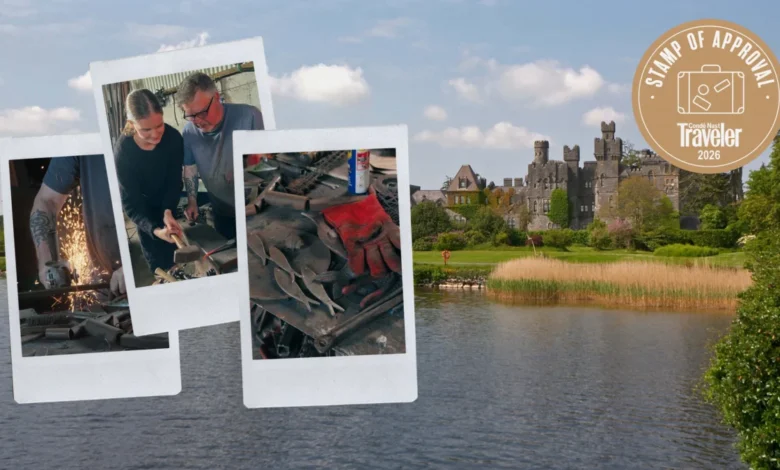
The core of the blacksmithing module takes place roughly 40 minutes away in Kilreekil, County Galway, at the working farm and forge of master blacksmith Stephen Quinn. Unlike sanitized demonstration workshops, Quinn’s workspace is an active industrial environment surrounded by intricate, hand-wrought iron balconies and structural elements in various stages of completion.
.jpg)
Under Quinn’s direct supervision, participants engage in trial-by-fire metalworking. The curriculum focuses on foundational techniques: feeding coal into the forge, heating iron to precise, glowing thresholds, and utilizing hammers, chisels, and the anvil to manipulate the metal. Guests are given the opportunity to forge functional items—such as leaf-shaped or horse-headed coat hooks—which undergo traditional finishing processes, including quenching in cold water and treating with protective mixtures of linseed oil and beeswax.
Following the forge session, the itinerary expands into the region’s broader agricultural and culinary landscape. A standard stop on the "Fire & Wood" track includes a visit to Kylemore Farmhouse Cheese in County Galway. Here, fourth-generation dairy farmer and artisan maker Teresa Roche guides visitors through active production spaces, including cow barns and curing rooms, offering a direct view of contemporary Irish food production. The visit culminates in a communal farmhouse lunch featuring regional cheeses and traditional baked goods, underscoring the interconnectedness of Ireland’s artisan food and craft sectors.
Economic and Cultural Implications of Maker Tourism
The integration of artisanal workshops into luxury travel packages reflects a broader structural change in high-end tourism economics. Industry analysts note a marked decline in the appeal of purely ostentatious luxury, replaced instead by "transformational travel"—journeys defined by skill acquisition, cultural exchange, and direct patronage of local communities.
For properties like Ashford Castle, which has routinely garnered top honors in international hospitality rankings—including multiple Condé Nast Traveler Readers’ Choice Awards—offering these off-the-beaten-path experiences serves a dual purpose. It diversifies the guest value proposition while directly injecting tourism revenue into micro-economies, supporting independent craftspeople who might otherwise struggle against mass-produced imports.

Stephen Quinn’s forge and Teresa Roche’s dairy farm represent a deliberate departure from the meticulously manicured environments typically associated with five-star resorts. By juxtaposing the opulent, fairy-tale architecture of the castle estate with the soot-stained reality of a working Galway forge, the property provides a holistic, unvarnished perspective of Irish culture.
Booking and Practical Considerations for Prospective Travelers
For travelers seeking to participate in these specialized heritage programs, Ashford Castle structures its offerings through a bespoke inquiry model.
The blacksmithing experience falls under the broader umbrella of the Exceptional Irish Experiences framework. Pricing for comprehensive, full-day custom itineraries starts at approximately $3,400 for a party of two, reflecting the private, highly personalized nature of the instruction and transportation.
Because the itineraries are modular, guests can tailor their schedules based on time constraints and specific interests. While the standard "Fire & Wood" package encompasses three distinct stops—typically including a furniture maker in addition to the blacksmith and cheesemaker—shorter stays allow guests to curate a selection of experiences. Reservations must be initiated directly through the Ashford Castle website, after which the estate’s concierge team coordinates the logistics to ensure private access to independent local makers.

As global tourism continues to recalibrate toward sustainability and meaningful local engagement, models like the one established in County Mayo demonstrate how historic hospitality brands can utilize their market influence to safeguard and celebrate indigenous craft traditions for future generations.